










































Perspectives on Polio Immunization Campaigns in Ibadan, Nigeria
Department of Anthropology, University of Michigan
"Ethnographic studies that document the perspectives of members of Hausa communities in Nigeria are key to understanding why individuals would decline a vaccine, hampering polio eradication campaigns that Western and international organizations deem urgent. Medical anthropologists can make important contributions to the dialogue between health organizations and vaccine recipients as well as bringing in the perspectives of polio survivors in Nigeria."
This paper does not aim to provide an in-depth analysis of resistance to immunisation campaigns in Nigeria. Rather, it presents the views of recipients of immunisations. Its premise is that ethnographic research and medical anthropological projects such as this one are not only invaluable in gaining local perspectives that can enhance the effectiveness of immunisation campaigns but are also crucial in determining what individuals' and communities' health needs are. "Research projects such as this one demonstrate that addressing these health needs must take into account local concerns and cannot be based solely on international concerns."
Being one of the few remaining polio-endemic countries, Nigeria has seen extensive efforts on the part of the international community to eradicate polio in West Africa and in developing nations in general. In the 4 years prior to the publication of this paper, Nigeria experienced an intensification of these efforts, with the use of mass immunisation campaigns. As reported here, resistance to these efforts created an international controversy, which garnered much attention in Western and Nigerian media. For example, Muslim leaders believed that the vaccine contained contraceptive agents and other contaminants with which the Western world hoped to control population growth. Kaduna State was one of the places that did not suspend polio immunisations in 2003; however, it was one of the Northern Nigerian states whose residents and leaders voiced opposition to mass polio immunisations and Western involvement in the Nigerian immunisation campaigns. In the summer of 2005, Dr. Elisha Renne and the author of this paper, Viola Allo, visited Zaria, the major city, to explore the social and political context of polio in Nigeria.
The author reflects on the fact that, as her first fieldwork experience, this 2-month stay in Nigeria was an opportunity to learn firsthand about ethnographic methods and the process of conducting fieldwork. She notes that, having grown up in Cameroon, "[s]ome of the research participants saw me as more 'African' than foreign. This no doubt made it easier to establish trust with participants and conduct interviews, especially considering that I did not reside within the Hausa community, but was lodged in a nearby upper-class residential area. Most of the respondents I interviewed appeared to be comfortable with me and would sometimes ask me questions about my background or solicit my comparisons of Cameroon and Nigeria."
One goal was to learn from participants whether there were any differences in perspective regarding the polio immunisation campaign between Hausa communities in the North and those in the South. If there were any differences, they also wished to gain perspective on why these differences existed. Residents interviewed in Sabo reported that their community did not greatly resist polio immunisations. However, one of the vaccinators interviewed said there was quite a bit of initial resistance and that some of the population still remained unconvinced about the merits of immunising their children. A community drama the author attended in Zaria highlighted the negative responses vaccinators might face, as they are scolded and driven away from households during national immunisation days (NIDs). As the excerpt from an interview with one vaccinator and local guide illustrates, the vaccinators play a great role in reassuring people and, indeed, in the overall immunisation process. "The use of members of the Hausa community in the vaccination process was hailed by the Councilor, the NPI [National Programme on Immunization] representative and the vaccinators. They suggested that continuing to recruit Sabo residents to work as vaccinators would help the campaign. Hausa vaccinators could improve communication between NPI officials and Sabo residents since they could speak Hausa to residents. They also knew the community well enough to act as guides to other vaccinators and supervisors who were outsiders unfamiliar with Sabo."
Reflecting on this experience, Allo concludes: "The difficulties faced by polio survivors in Nigeria highlight that the issue is larger than simply eradicating polio. Better healthcare, including routine immunizations for children and treatment for other life-threatening diseases, and educational and employment opportunities must be made available for Nigerians. Nigerian citizens must feel they can trust their government and trust that political leaders have their interests at heart. The motives of foreign agencies are distrusted, as resistance to the polio immunization campaigns shows."
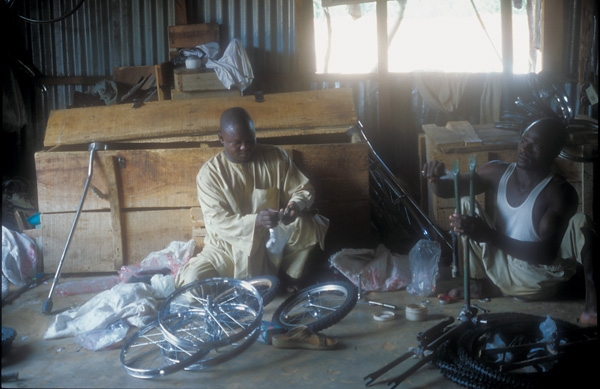
New Directions in Medical Anthropology, Vol. 17, No. 1, 2008, Ann Arbor, MI: MPublishing, University of Michigan Library. Image credit: E. P. Renne
- Log in to post comments