










































Organization and Implementation of an Oral Cholera Vaccination Campaign in an Endemic Urban Setting in Dhaka, Bangladesh
Institute of Epidemiology Disease Control and Research, or IEDCR (I.A. Khan); International Centre for Diarrhoeal Disease Research, or icddr,b (A.I. Khan, Rahman, Siddique, Islam, Bhuiyan, A.I. Chowdhury, N.C. Saha, Biswas, A. Saha, F. Chowdhury, Clemens, Qadri)
"Community participation in this program was notable, as reflected by community involvement in the program and vaccine coverage."
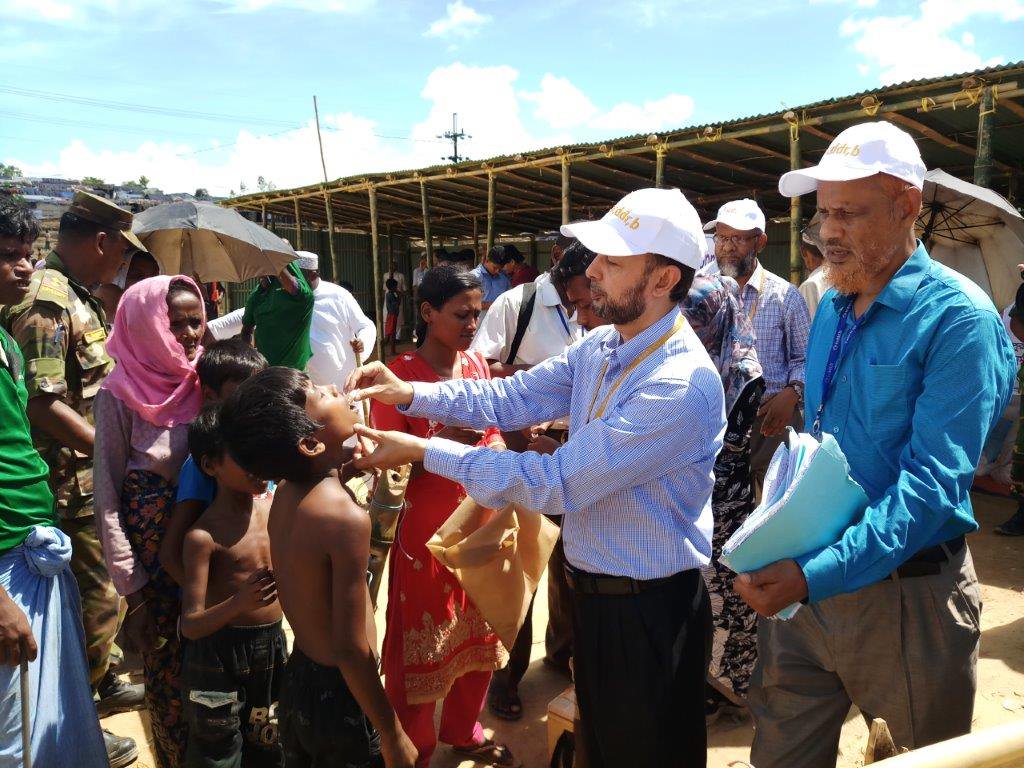
In collaboration with the government of Bangladesh, the Infectious Diseases Division, International Centre for Diarrhoeal Disease Research, Bangladesh (icddr,b) initiated operational research to test various strategies to reach a high-risk endemic urban population in Dhaka with an affordable oral cholera vaccine (OCV) and to examine its effectiveness in reducing diarrhoea due to cholera. OCV administration by trained local volunteers through outreach sites and mop-up activities yielded high coverage of 82% and 72% of 172,754 individuals for the first and second dose respectively, using national Expanded Program on Immunization (EPI) campaign mechanisms without disrupting routine immunisation activities. This article describes how the Introduction of Cholera Vaccine in Bangladesh (ICVB) vaccination programme was planned, prepared, and implemented; the below summary focuses on communication-related aspects of the endeavour.
Figure 2 shows the activity flow for the ICVB, which took place February 17 - April 16 2011. Planning and implementation, steering, and advisory committees were formed with the study investigators and representatives from the government, non-governmental organisations (NGOs), the World Health Organization (WHO), and the United Nations Children's Fund (UNICEF) to oversee programme activities, including social mobilisation. A press release was issued to the media detailing the ICVB study in Mirpur. Advocacy meetings were arranged with all stakeholders, including City Corporation officials, ward councilors, and community representatives. Just before vaccination, field workers and volunteers visited each household, distributed the ICVB card, and conveyed messages about the OCV programme. On vaccination days, field workers and volunteers reminded the communities to attend the vaccination site with the ICVB cards. Cell phone messaging was also used to remind them of the vaccination. On the vaccination days, banners were visible at the outreach vaccination sites and on the vaccine-carrying pickup trucks. During mobilisation and also at the vaccination sites, participants were told to report any adverse event at the sites or at the designated health facilities.
To avoid conflict with the National Immunization Day vaccine campaigns, organisers delayed their programme by one month to obtain support from immunisation-related stakeholders, particularly the EPI. Due to this change, the OCV vaccination schedule coincided with upazila and municipality elections and the national census, resulting in the movement of a large number of study participants who could not be vaccinated. Seasonality, low disease incidence period, the need to avoid other major community activities, and political issues must be taken into consideration when planning such programmes, the organisers say.
For better accessibility, the vaccination sites were placed in the cluster communities and remained open for 3 days at each site. Except for a few roadside vaccination sites, all sites were provided by the community, and, at all sites, they provided space for overnight safekeeping of logistics. To encourage participation, organisers used weekends and holidays for vaccination. They kept the door open for eligible newcomers in the clusters during the first round for the first dose. Ongoing monitoring revealed that there were many non-attendees in each cluster. Mop-up activities after the second round afforded the opportunity to improve 2-dose coverage and to verify vaccination data records submitted during the regular programme. Approximately 11% (13,029) of the delivered second doses were through mop-up activities, showing the effectiveness of this strategy.
The organisers explain that a considerable number of individuals initially did not consent to participate in the ICVB, as they were unavailable or lacked awareness about cholera or this new vaccination programme. However, in the course of the ICVB, a proportion of non-consented individuals attended the vaccination sites, consented, and received the vaccine. According to organisers, the shared experience of vaccination with neighbours and peers was instrumental in this phenomenon.
Furthermore, mass vaccination with assistance from the mass media is known to yield better compliance. In the case of the ICVB, the organisers avoided use of mass media communication due to the cluster randomised design of the intervention, mixed abodes of eligible and non-eligible populations within the same cluster, and the population living in buffer areas. The avoidance of mass media was exploited by one local newspaper, and their negative reporting was responsible for the spread of rumours and a substantial number of refusals, particularly during the second round. The organisers contend that a mass media campaign with interpersonal communication by field workers and institutional delivery, particularly in industry, factories, and educational facilities, could improve compliance and minimise refusal and absence of younger and middle-aged people.
"The experiences from a large-scale vaccination campaign as demonstrated by this study could serve to inform and encourage cholera high-risk countries to use OCV along with other preventive measures."
Global Health Action, 12:1, 1574544. https://doi.org/10.1080/16549716.2019.1574544 Image credit: icddr,b via Twitter
- Log in to post comments