










































LetsTalkShots: Personalized Vaccine Risk Communication
"While not a panacea for the global challenge of vaccine hesitancy, tailored vaccine risk communication can assist decision makers as they consider vaccination for themselves, their families, and their communities."
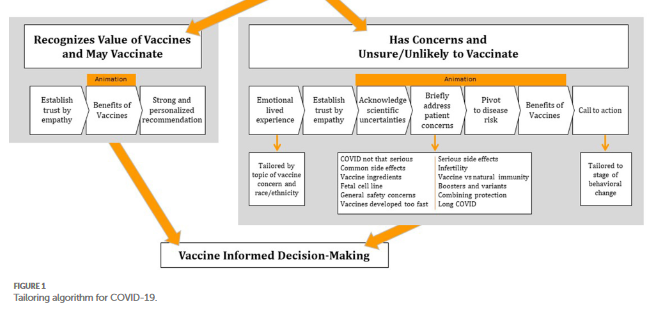
Educational interventions about vaccines for patients (and/or their parents) have largely been ineffective in reducing vaccine concerns and increasing vaccine uptake; they can even backfire among the most vaccine-hesitant persons. For that reason, this group of researchers' earlier initiative, MomsTalkShots was informed by tailoring theory, the Health Belief Model, Bandura's Social Cognitive Theory, salience, psychological reactance, and the Theory of Normative Conduct. A randomised controlled trial (RCT) (see Related Summaries, below) found that this intervention increased chart-confirmed vaccine uptake and sustainably improved vaccine confidence. Based on this model, the group built and evaluated an expanded personalised vaccine risk communication website called LetsTalkShots. This paper describes their mixed-methods research to test LetsTalkShots' animation and some aspects of credible sources and personal narratives that shape the personalised vaccine risk communication the website offers.
Available in English, French (Canadian), and Spanish, LetsTalkShots contains information for all recommended vaccines across the lifespan, including COVID-19, and tailors its content to adolescents, adults, parents, and pregnant women. The paper begins by describing the development approach, starting with a literature review that expanded their use of behavioural theories to include narrative theory anecdotes, Timing Inoculation Theory, and the Transtheoretical Model for Behavioral Change. This process led to identification of 74 topics to be addressed through informational animations. For example, one animation highlights portions of crowds in football stadiums of different sizes to visually depict and compare the risks of disease and the risks and benefits of vaccination. The goal is to tailor these and other animations, along with lived experiences and credible sources, to disseminate the right message from the right messenger to the right person.
Understanding that people are often most interested in hearing from people and credible sources from their own community, the team locally tailored LetsTalkShots to 16 communities. They identified about 60 local credible sources in these communities, ranging from healthcare providers to a US state's governor to religious leaders. They made multiple versions of these final comments of credible sources so they could tailor the call-to-action to the hesitancy of the user. They also recorded about 60 lived experiences about COVID-19 from persons within these communities, ranging from pregnant women to parents of young children to family members. By entering their zip code, viewers from these 16 communities are shown credible sources and lived experiences from their own communities.
In all, the researchers developed approximately 10 hours of video content (74 pieces of 2- to 4-minute animations, 60 credible sources, and 60 lived experiences. However, the platform is programmed so that each user receives only 3-8 minutes of content upfront.
Due to the fact that designing, evaluating and delivering the right message from the right messenger to the right person requires understanding the knowledge, attitudes, and behaviours in the intended populations, and how these vary by subpopulations, the process of developing LetsTalkShots was iterative and participatory. The researchers conducted 67 discussion groups (n = 325), stratified by race/ethnicity (African American, Hispanic, and White people) and population (e.g., parents, pregnant women, adolescents, younger adults, and older adults). These groups provided robust feedback specific to each animation as well as areas for improvements across animations. The major themes voiced by vaccine-hesitant participants included being critical of calls-to-action to vaccinate, the use of absolute adjectives such as "safest", and mention of the impact of vaccine refusal on other people that was perceived as guilting or shaming. In response, for example, the team softened the language of animations for persons with vaccination concerns, emphasised choice, and humanised very rare vaccine-adverse reactions. To cite another example: Adolescents' focus groups indicated a preference for a younger and more energetic narrator, so new narration was recorded for adolescent animations accordingly.
In addition, using an online national panel survey of United States (US) adults (n = 2,272), the researchers tested animations aligned with vaccine concerns and specific to population (e.g., parents of children, parents of adolescents, younger adults, older adults). Respondents without vaccine concerns viewed an animation reviewing the benefits of vaccines for their population. Respondents with concerns watched an animation specific to one of their concerns, followed by the benefits of vaccines animation for their population. Most respondents indicated that the information presented was interesting (85.5%), clear (96.0%), helpful (87.0%), and trustworthy (82.2%). The animations were well received even among subpopulations with lower reported usability. For example, 46% of persons who were not confident in the safety of vaccines and 68% of people with low trust in public health authorities reported the animation to be trustworthy.
Notably, these animations are not intended to be used in isolation but, rather, are meant to be introduced and ended by racially/ethnically congruent credible speakers. For COVID-19, LetsTalkShots includes videos of racially/ethnically congruent persons describing their lived experiences with COVID-19 (see one example by clicking on the video below). The researchers found that receiving a lived experience video prior to the informational animation increased the likelihood of listening to the entire animation by 9-fold, and that racial congruence between the credible source and user doubled the likelihood of viewing the entire animation.
As of this writing, the researchers are in the process of integrating LetsTalkShots into clinical practices so that the practice shares LetsTalkShots with their patients in advance of appointments. After the patient uses LetsTalkShots, their provider receives a profile of their patient's vaccine intentions and concerns, with specific talking points to help address each concern. They also include a provider training on how to talk to patients about vaccines and an electronically updated book providing clinicians information on vaccine-preventable diseases, vaccine recommendations, and the science around vaccine safety concerns. They are also partnering with public health and immunisation partners and exploring social media strategies for directing general and specific audiences to the LetsTalkShots website.
Reflecting on the process, the researchers highlight the need for keeping education materials up to date with new science and for ensuring that objective and credible vaccine communication is based on science. "Furthermore, science, no matter how well communicated, is only one factor in decision-making, which is a complex and individual calculation of information, values, the current context in which someone is making a decision, and access to services." In other words: "Communication strategies are just one arrow in the quiver of addressing hesitancy - particularly when hesitancy is grounded in historical trauma, institutional racism, and lack of access to services, as is the case in many vulnerable populations."
However, and in conclusion: "Tailored vaccine risk communication can assist decision makers as they consider vaccination for themselves, their families, and their communities. LetsTalkShots presents a model for personalized communication in other areas of medicine and public health."
Full list of authors, with institutional affiliations: Daniel A. Salmon, Johns Hopkins University Bloomberg School of Public Health; Matthew Z. Dudley, Johns Hopkins University Bloomberg School of Public Health; Janesse Brewer, Johns Hopkins University Bloomberg School of Public Health; Jana Shaw, State University of New York; Holly B. Schuh, Johns Hopkins Bloomberg School of Public Health; Tina M. Proveaux, Johns Hopkins Bloomberg School of Public Health; Amelia M. Jamison, Johns Hopkins Bloomberg School of Public Health; Amanda Forr, Johns Hopkins Bloomberg School of Public Health; Michelle Goryn, Johns Hopkins Bloomberg School of Public Health; Robert F. Breiman, Emory University; Walter A. Orenstein, Emory University School of Medicine; Lee-Sien Kao, ideas42; Robina Josiah Willcock, Morehouse School of Medicine; Michelle Cantu, National Association of County and City Health Officials; Tori Decea, National Association of County and City Health Officials; Robin Mowson, National Association of County and City Health Officials; Kate Tsubata, Bonnemaison; Lucie Marisa Bucci, Bucci-Hepworth Health Services Inc.; Jaqueline Lawler, Orange County Department of Health; James D. Watkins, Williams County Combined Health District; Jamie W. Moore, Guilford County Division of Public Health; James H. Fugett, Guilford County Division of Public Health; Adriele Fugal, Monongalia County Health Department; Yazmine Tovar, Monongalia County Health Department; Marie Gay, Orange County Department of Health; Aleen M. Cary, Johns Hopkins University Bloomberg School of Public Health; Iulia Vann, Utah County Health Department; Lee B. Smith, Guilford County Division of Public Health; Lilly Kan, National Association of County and City Health Officials; Magda Mankel, Earlham College; Sumayya Beekun, ohns Hopkins University Bloomberg School of Public Health; Victoria Smith, Williams County Combined Health District; Stephanie D. Adams, Center for Global Health Innovation; Steven A. Harvey, Johns Hopkins University Bloomberg School of Public Health; and Peter Z. Orton, Johns Hopkins University Bloomberg School of Public Health
- Log in to post comments