










































Investigating Climate Information Services through a Gendered Lens
University of Florida
"As women farmers are often invisible, it is the responsibility of researchers, practitioners, and extension officers to tailor communication methods to women's needs so that they also can benefit from climate information services and adapt their agricultural practices to the changing climate."
This paper from the CGIAR Research Program on Climate Change, Agriculture and Food Security (CCAFS) explores access to climate change-related information through a gendered lens. The premise of the paper is that climate change is rapidly affecting the lives of farmers throughout the world, producing a need for adaptive agricultural livelihoods strategies. Among the farmers most vulnerable to the effects of climate change are women, who make up between 60-80% of the agricultural labour force in developing countries. A central mechanism in the development of adaptive strategies to climate change is the strengthening and effective utilisation of information channels. The more relevant and useful the information is to the user, the better the user may be able to adapt to changes in climate. Despite this critical need for accessing climate-related information, many of the people who are most vulnerable to climate change and environmental shocks are often on the periphery of receiving practical information. This paper shows that women farmers are overwhelmingly left out of many forms of communication channels. Thus, the purpose of this study is to identify instances in which methods of communication are missing women and how to overcome these gaps. What the researchers propose is a context-dependent hybridisation of traditional methods of communication, which are familiar to communities, and modern technologies, which can be expedient in sharing new scientific climate knowledge with farmers.
Before discussing methods of information sharing, the paper first explores 3 theories of information sharing and innovation: social network analysis, diffusion of innovations theory, and concepts related to adaptive capacity. Blending key ideas from the literature provides insight into how women, in the face of social and economic constraints, receive and communicate climate information. In brief: Social networks provide the avenues by which information and innovation are diffused. In the context of crises such as the environmental shocks caused by climate change, social networks can be an important resource in evaluating community vulnerability, as well as in developing adaptive strategies. In the diffusion that follows, local norms and practices alter the way new communication innovations are used. The more members of the community observe the benefits of a particular innovation, the more likely that innovation will be diffused and adopted. "An adoption which seeks to solve a local problem results from information searches which match a possible technological solution to the local situation, and often immediately entails reinventions." (Rice and Rogers, 1980) Through processes of reinvention, innovations are tailored and gain traction in the local community. As women tailor the uses of new communication technologies to local needs, they demonstrate their own adaptive capacity to respond to climate change and, thus, manage risk. "In the context of climate change, it is important to recognize that women have different responsibilities than men and, thus, different uses for communication technologies." Authors cited in this section of the paper highlight the role of institutions in facilitating social learning processes and the ability of vulnerable communities to adapt.
As noted here, most traditional methods of communication rely on oral transmission and may take many forms (drumming, singing, dramas, etc.), some of which are explored in the paper. These traditional methods are used to communicate information to groups in such a way that anyone can understand, and they are particularly important in passing knowledge and experience across generations. Recent research on communicating development messages has focused on the advantages of using traditional media, including being part of the rural social environment and being considered a credible source by locals. As an example, the researchers point to an project conducted in 2009 in which the Food, Agriculture and Natural Resources Policy Analysis Network used Theater for Policy Advocacy as the medium of communication in order to explain agricultural policy to female farmer participants in Malawi and Mozambique. The researchers also argue that identifying and utilising key informants and groups that hold legitimacy within a community - e.g., traditional leaders, village criers, community gossips, local chatterboxes, cooperatives - may improve the dispersal of relevant climate information. Thus, it is important to understand the social networks of these individuals and groups to determine if and how information can most effectively flow within a community.
"Modern" communication technologies mean those methods which require electrical power, whether through batteries, electrical wires, or radio waves. For the purposes of this paper, information and communication technologies (ICTs) include use of computers, mobile phones, and radio. Information can be shared through texts, voice, video, numbers and diagrams, or images. The researchers caution that "focusing primarily on ICTs has often had an adverse effect, excluding those farmers who do not have access to these new technologies or are unable to use them, thus exacerbating existing inequities." For example: "While information sharing through mobile phones, for example, may be a great way to reach men, it is not the most efficient way of reaching women farmers in all contexts."
After discussing the roles of ICTs by order of their prevalence in developing countries, the researchers examine community information services, most often provided by community libraries established in rural communities, which highlight the need to interact with communities in more engaging and participatory ways. This discussion also points to the fact that there are nuances which must be identified in order to be more effective in communication - information should be delivered in local languages of communities and even disseminated in multiple ways to cover ranges of literacy in the community (e.g., written, pictures, etc.). Yet without proper feedback to the agencies providing climate information, the agency may not understand how to accommodate or tailor the information to make it locally useful. In addition, without feedback from the community, agencies may not understand how the climate information affects (or not) women differently from men. According to the researchers, this is where social network theory, among other theories, can be beneficial.
Next, the researchers explore the role of extension agents, who are often responsible for disseminating information to farmers in rural and remote areas. Research indicates that women farmers are not adequately reached by extension services, underscoring the need for female extension agents. The authors explain that, while extension services can help to bridge traditional and modern methods of communicating information, information asymmetries can still present barriers to information if not carefully addressed at the community level.
Along those lines, there are places where communication falls short, and the subsequent section of the report examines, first, gender gaps of traditional and modern methods. For instance, getting information to women by women can be difficult when women are not in leadership positions to diffuse information. And, despite the potential of new technologies, socioeconomic conditions of women may greatly limit their access to tools of adaptation. There are also dimensions of access and utilisation of ICTs, such as gendered control over assets within the household. (Ultimately, many women must depend on their husbands to purchase ICTs such as radios or mobile phones.) Apart from physical access, there are also educational barriers such as illiteracy and innumeracy that may affect women disproportionately. "Even when content is translated into local languages, it is important to recognise that the content should be relevant to women's experiences, interests, and livelihoods."
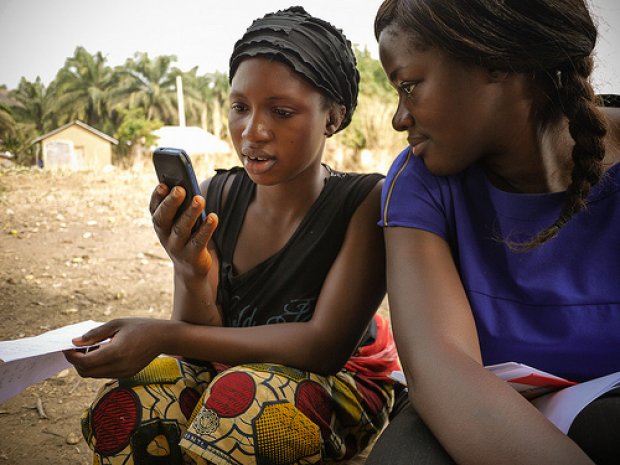
To bridge these gaps, the researchers propose a context-dependent hybridisation of traditional methods and modern methods of information sharing strategies and practices. These hybrid methods of communication provide an avenue for participation in the production and dissemination of information within communities. An example of successful hybridisation can be observed through a mobile phone programme in Bangladesh called Help Line (Raihan 2005), which offers primarily health, legal, and agricultural advice to women in rural communities through a call-in hotline. The key to the success of this hotline and the transmission of information to women through ICTs is what the programme calls the "info-mediary". This woman is responsible for traveling from door to door throughout the village with her mobile phone, assisting women in making calls and accessing the information they are seeking. In this way, the programme uses local knowledge and social norms to disseminate information through face-to-face interactions between women. Furthermore, it uses that social arena of daily visits from members of familiar social networks to introduce and teach other women about new technologies and to extend the social network. This form of hybridisation also overcomes the affordability barrier that many women face by providing communal access to a single mobile phone. Help Line also considers obstacles of language and education, as women teach other women in a common and familiar language how to use these new communication tools. Finally, the "info-mediary" helps to bypass male ownership and control of the mobile phone.
"This paper has shown that participatory dialogues between practitioners, scientists, and community members provide contextually tailored communication innovations that are more available to women. Community information services and extension officers provide important channels for these dialogues to occur." In short, when coupled with local social networks and traditional methods of communication, new ICTs can be effective tools for sharing climate information with women farmers.
Collaborative Change Communication, Issue no. 6, April 2016; and CGSpace: A Repository of Agricultural Research Outputs and "Is gender being considered within climate services?", by Sarah McKune and Chesney McOmber - both accessed on May 25 2016. Image credit: Reboot
- Log in to post comments