










































Dead and Resurrected
Author Arison Tamfu, December 12 2013: In the remote Bokwaogo locality in Buea on the eastern slopes of Mount Cameroon, Mama Mologan Francisca battles with the soil hurrying to meet weather deadlines for her maize and tea farm. She is a proud owner of a vast piece of land extending beyond half a hectare.
"This is my bread and butter. I eat and drink from here. This is my life," said Mama Mologan referring to the farmland. It has been a hell of a journey for her to come this far. In early 2001, she was a rich woman, buying farm produce cheaply from farmers in the South West region of Cameroon and supplying them with badly-needed sprayers, pesticides and improved seed at premium prices.
"It fetched me much money," she said, but the sound of a cellphone ringing shattered the profitable business leaving her in misery.
"Ma Mojoko came and taught the women how to use the cellphone to know the real prices of pesticides and food crops on the market. So, after knowing the actual prices, they refused to deal with me, preferring to wait for buyers to come from Douala city and buy. I lost everything and my business crumpled," lamented Mama Mologan.
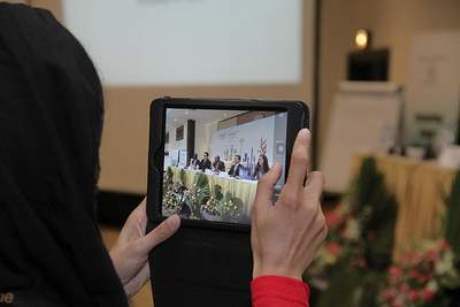
'Ma Mojoko' she referred to is Catherine Mojoko Molua, founder and president of Walana Wa Makwasi (women in action), a grassroots organisation founded in 2001 to boost the agricultural and technological skills of smallholder farmers in South West region of Cameroon. She presented her project at the ict4ag Conference in Rwanda, Kigali.
"The magic here is the mobile phone. We taught the smallholder farmers how to make a call and how to send an SMS in order to get vital information in real time. For the very first time they were able to get information relating to planting season, know when to apply fertiliser and what quantity and importantly how to bargain with buyers," explained Mojoko.
The conference was a milestone for organisations like Walana Wa Makwasi permitting them not only to project their activities but also to learn from others and seek partnership with similar ideas such as Rural eMarket in Madagascar, a web-application that allows subscribed farmers and buyers to send and request information on prices and farm produce.
"The mobile the app. gives the farmer just what he or she requires," said Andrianjafy Rasoanindrainy, Project coordinator, Rural eMarket.
And also TRAC FM, an innovative software platform used by media and non-profit organizations to amplify the voices of citizens, track reports, collect opinions and provide real time data.
"So you can use the service delivery system to take informed action," said Bart Sullivan of Farm Radio International.
"These could transform rural agriculture," said Mojoko hoping to entertain partnership with the innovators. Generally, the innovations and NGOs were testimony of the importance of mobile apps. in boosting agriculture in rural areas of ACP [Africa, Caribbean, Pacific] countries especially Africa, where it is estimated that one billion people will have access to a mobile phone by 2016. However, experts are concerned about its effectiveness.
"The mobile can help raise awareness and create commitment but to really make the change at farm level, the best approach is still the hands-on extension field workers because it is difficult to teach farmers how to plant or harvest through radio or text message," said Raf Somers of Belgian Development agency in Rwanda.
Maximo Torero of International Food Policy Research Center regretted that, in spite of the scramble for the mobile phone, penetration in rural Africa where farmers concentrate is below 50 per cent.
"And in terms of broadband which I think is the technology we need to move forward, the penetration is extremely low. Government should focus on ways of increasing access to broadband in Africa at this point," he said.
Until then, the mobile is presenting awkward times for the middlemen in Africa. ICTs [information and communication technologies] have reduced them to subjects and raised farmers to kings. Mama Mologan was smart to realise and quickly adapted to the changes.
"After the difficulty, I decided to start farming and joint the Walana Wa Makwasi group. I was taught how to use the mobile phone to facilitate the farming. And today after using the mobile phone to increase produce for 11 years, I live well. I was dead and now I am alive." She said.
It is unfortunate that despite the growing interest in African rural farmers in ICTs, they are handicapped by illiteracy. A problem, Mojoko said, "needs to be redressed urgently by sending coordinators to teach them."
[Editor's note: Journalist Arison Tamfu attended the International Conference on ICT4ag, which was co-hosted by the Technical Centre for Agricultural and Rural Cooperation (CTA) and the Rwandan Ministry of Agriculture and Animal Resources (MINAGRI), November 4-8 2013, Kigali, Rwanda.]
- Log in to post comments