










































Community Engagement for COVID-19 Prevention and Control: A Rapid Evidence Synthesis
University College Dublin (Gilmore); Makerere University (Ndejjo); Ministry of Health, Yaoundé, Cameroon (Tchetchia); RTI International (de Claro); Brandeis University (Mago); République de Guinée Ministère de Santé, Conakry, Guinea (Diallo); United Nations University International Institute for Global Health, Kuala Lumpur (Lopes); Public Health Foundation of India (Bhattacharyya); United Nations Children's Fund, or UNICEF (Bhattacharyya)
"Whether it be related to prevention and control, vaccine testing and ethics...or resilience and recovery,...community engagement can support successful efforts. It can also have fundamental roles in rebuilding a stronger health system after the more acute phase of COVID-19 and supporting an equity-focused public health response."
Experience with public health emergencies of international concern highlights the need for contextually appropriate community engagement strategies. Engagement lies on a spectrum, from more passive to active involvement. However, in general, through this "bottom-up" approach, the focus is on: facilitating community members to participate as agents in the response, involving local leaders and groups, tailoring interventions to communities, and ensuring two-way communication. Members of the scientific community, especially social scientists, have called on funders and implementers to recognise and explore the relevance of community engagement for COVID-19. To that end, this rapid evidence review examines the literature on community engagement for infectious disease prevention and control to learn lessons for COVID-19 and future pandemic response.
Between April 27 and May 2 2020, the researchers searched 3 databases and conducted snowballing for grey literature published since 2000 on Ebola, severe acute respiratory syndrome (SARS), Middle East respiratory syndrome (MERS), Zika, and H1N1. No restrictions were applied to study design or language. From 1,112 references identified, 32 articles detailing 37 initiatives met inclusion criteria.
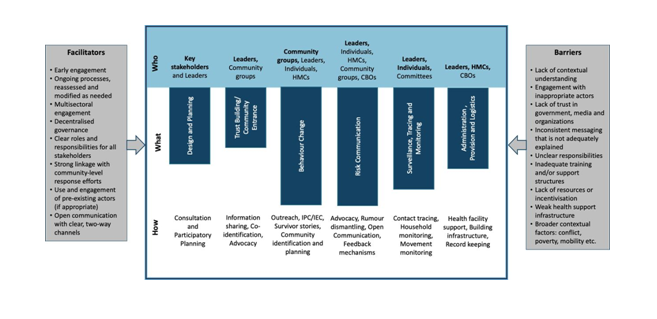
The review identified 6 broad types of community engagement actors: local leaders (traditional, religious, and/or governing); community and faith-based organisations (CFBO); community groups or networks or committees; health management committees (HMCs); individuals; and key stakeholders, which included students, survivors, women representatives, the elderly, and youth. These actors worked through 6 main channels: designing and planning interventions (including messaging), community entry and trust building, social and behavioural change communication (SBCC), risk communication, surveillance and contract tracing, and broader logistics and administration activities, such as procuring and setting up hand washing stations.
Many of the reported community engagement activities involved multiple actors and took multifaceted approaches for prevention and control. Community engagement was mostly used for SBCC and risk communication, followed by surveillance and contract tracing. The majority of community engagement activities had community-wide focus, with no specific equity considerations reported. In addition, almost all examples of community engagement from high-income contexts consisted of consultation, demonstrating passive involvement only with ethnic and minority populations. (The researchers opine: "While leadership buy-in is imperative for many community activities, so too is ensuring a balance between power and representation of diverse voices.")
The paper (figure 3; see above) presents key barriers and facilitators for community engagement for COVID-19 prevention and control that were extracted from the included studies. Furthermore, additional implementation considerations synthesised from guidance documents, which are provided in online supplemental file 3, emphasise the need for community engagement that is context specific as per particular cultures, traditions and customs, social norms, and collective beliefs. The researchers note that understanding local realities may require social research, including anthropological studies if possible, that uncovers knowledge gaps and sociocultural barriers.
In brief, the literature suggests that:
- Community engagement should be an ongoing, collaborative process that starts early with community members who are seen as legitimate actors able to represent and influence the community.
- Multisectoral engagement, decentralised government, and clear roles and responsibilities for all stakeholders are among the facilitating factors.
- A two-way dialogue with communities and other stakeholders, essential for trust building, should be established through multiple channels with transparent, accurate, and consistent information to help address rumours and misconceptions.
- Messages that are imparted should be focused, not fear inducing, respectful, and tailored to local contexts, with relatable examples.
- Regular feedback mechanisms for monitoring and course correction that reveal how knowledge, beliefs, and practices are changing can ensure inclusive and meaningful engagement.
Reviewing the aforementioned findings and materials, and considering guidance put forth by various organisations, the researchers offer these programme and policy recommendations:
- Conduct early discussions and negotiation with communities to understand: sociocultural contexts; what types of engagement interventions are safe, feasible, and acceptable; and what existing platforms and initiatives can be leveraged to support COVID-19 activities.
- Support communities in codesigning and delivering appropriate, evidence-based messaging (interpersonal communication (IPC)/information, education, and communication, or IEC).
- Ensure that COVID-19 pandemic management teams incorporate community members into planning, response, and monitoring of standard operating procedures (SOPs), and disseminate these plans within communities to ensure support. These SOPs could cover topics such as community response mechanisms if cases occur, and planning and community sensitisation on safe burials.
- Collaboratively identify and address health and safety considerations in the planning stages, such as: the safe structuring of engagement activities; distancing measures for face-to-face interactions; quarantine or isolation procedures of community; availability of water, sanitation, and hygiene (WASH) supplies; resource procurement for engagement actors, including personal protective equipment (PPE); and protocols for suspected/confirmed contact with COVID-19-positive persons.
Reflecting on the findings from this review, the researchers encourage implementers, policymakers, and other researchers to share learnings from past engagement initiatives and ongoing COVID-19 activities, especially from more diverse geographical settings and across different populations.
In conclusion: "COVID-19's global presence and social transmission pathways require social and community responses. This may be particularly important to reach marginalised populations and to support equity-informed responses. Aligning previous community engagement experience with current COVID-19 community-based strategy recommendations highlights how communities can play important and active roles in prevention and control."
BMJ Global Health 2020;5:e003188. doi:10.1136/bmjgh-2020-003188.
- Log in to post comments