










































Botched Ebola Vaccine Trials in Ghana: An Analysis of Discourses in The Media
Communication Science Unit, The Media School, Indiana University
"Bearing in mind the key role that the legacy media in developing contexts play in health communication and public health campaigns..., understanding discourses about vaccines in the media merits research."
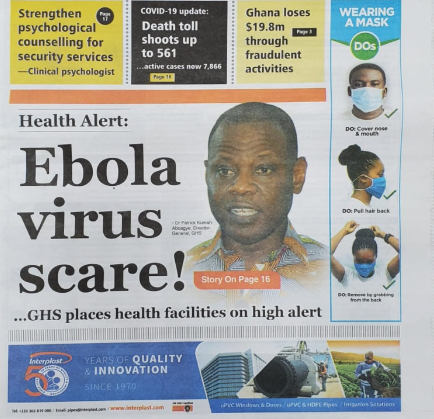
Even apart from vaccine hesitancy or vaccine trial controversies, the media play a role in providing information for individuals to create vaccination-related views and attitudes. Using a sociological lens that draws on moral panic and risk society theories, this study analyses discourses in the media that led to the June 2015 suspension of proposed Ebola vaccine trials in Ghana. It highlights the complexity and challenges of undertaking vaccine tests in societies where the notion of drug trials has underlying historical and sociological baggage that determine whether the trials proceed.
The researcher, Esi E. Thompson, sets forth the context - both of Ghanaian media in general and the emergence of the antagonistic responses to these particular Ebola vaccine trials. In brief, on May 21 2015, a local radio station published a story on its digital platform, starfmonline.com, about a planned Ebola vaccine trial at the Hohoe Midwifery Training College in the Volta region of Ghana. The story quoted some students who indicated being scared and not knowing the risks involved in the trials. On May 30 2015, the Coalition for Ghana's Independence Now (CGIN) issued a press release suggesting that the "criminal" trials will spread Ebola in Ghana and calling for an end to them. On June 10 2015, the trials were suspended.
Next, Thompson explains the concept of "moral panic", which sees the media as a main actor in the conscious or unconscious spread of societal reactions to threatening conditions, with a focus on the morality and value systems threatened in the sites of anxiety. "Risk society" focuses on the "irreversible potential catastrophes associated with technological or industrial development within those sites of anxiety". Thompson states that here, too, "the media play a vital role as the platform within which the risks are defined, made known, and the (in)actions of various actors exposed for public scrutiny."
The study's qualitative approach involved semi-structured in-depth interviews with 18 journalists in legacy media (television, radio, and newspaper) in the capital city of Ghana and qualitative content analysis of 21 stories in online media publications and 245 user comments. Data gathering occurred between August 22 and September 18 2015.
The findings, which are illustrated by quotations from the interviewees, indicate that:
- While some media workers expressed support for how the media covered the issue and unveiled what they saw as an evil cover-up, others condemned the media for poor journalism and tarnishing the image of journalists. Other journalists chastised the initial story in hindsight but admitted they would have made similar choices, citing the nature and competition in journalism practice in Ghana, which makes journalists eager to break a story.
- Other interviewees suggested that the suspension of the vaccine trials was because the issue was politicised.
- In relation to the TV3 network's being asked to retract a story about the trial, some media workers were concerned that the very constitutional basis of their profession - freedom of the press - was being trampled upon.
- Interviewees and user comments referred to Ebola's virulence and the fact that God had protected Ghana from infections to explain why the trials were dangerous for Ghanaians. Many commenters raised issues about safety, the greed of leaders, and the gullibility of potential trial participants, or they related the trials to the infamous Tuskegee syphilis trials. Other users suggested that the vaccine trials were population reduction attempts by Westerners.
- News stories and user comments framed the media and those opposed to the trials as saviors, while the trial investigators and pharmaceutical company were presented as traitors who were willing to sell their people for money. The trial investigators were often captured as conniving with evil foreigners to infect Ghanaians with the Ebola virus and hiding the true nature and purpose of the trials.
Thompson looks at the findings through the lens of the theories she introduced earlier, noting that "Convergence of public and expert concerns legitimized the idea that the trials would lead to Ebola virus infections in Ghana. The claims evoked the idea that a group of people was breaking the moral and ethical responsibility of protecting the lives of Ghanaians." Furthermore, with regard to risk society discourses, for example, some news stories, user comments, and media workers constructed the Ebola vaccines as "a manufactured risk with unknown effects that had the potential to threaten lives and health. The Ebola vaccine was viewed as carrying the Ebola virus or requiring that one be infected with the Ebola virus before being vaccinated."
In short, Thompson suggests that "the public uproar did not result from the positions taken by the members of parliament, the CGIN, the Volta regional NDC [National Democratic Congress] or even by how the media covered the issue. Rather, there exist social and historical frames of reference common to both the regulators and ordinary Ghanaians which influenced responses and reactions to the Ebola vaccine trials."
Some implications include:
- There is a need for "more open communication and engagement on vaccine issues in contexts where historical, colonial, and present realities of mistrust intersect with fears about how such activities are interpreted."
- There are knowledge gaps in relation to Ebola as a disease and the associated biomedical interventions (in this case, vaccine trials) geared at addressing them. More broadly, there is limited understanding about vaccines and how they work, not unrelated to anti-vaccine scares that have emerged in some developed countries.
- There is low knowledge of science and health communication in general among the Ghanaian media and a need to engage them generally on health and science issues. (Journalists in Ghana do not specialise in subject matter, and science and health reporting are second to politics and the economy.)
Based on this discussion, some recommendations are offered:
- Implementers of sensitive (and possibly controversial) vaccine trials should engage the media after trial approval, but prior to the start of trials, to explain the trial processes.
- To address concerns, volunteers from previous trials can be recruited as "advocates" to help in public sensitisation activities prior to the start of trials.
- Trial implementers need to get buy-in or at least inform community leaders and chiefs.
In conclusion: "The context of a risk society (the fear of Ebola) provides a conducive environment for moral panic to develop, particularly when the legacy media is perceived as a critical and credible source of information. An effect of the suspended vaccine trials was a weakening of the journalist-scientist relationship. Indeed, some scientists later chastised the media for how they handled the issue. This could lead to challenges with communication during other disease outbreaks or health risk situations."
Vaccines 2021, 9(2), 177; https://doi.org/10.3390/vaccines9020177. Image credit: Ghanaian Times
- Log in to post comments