










































Because I am a Girl: The State of the World's Girls 2009
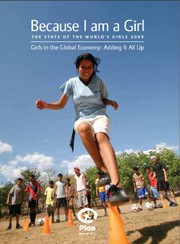
"Girls and young women have tremendous economic potential to shape humanity for the better. Investing in girls' economic empowerment and protecting their economic rights...makes sound economic sense."
Plan International's "Because I am a Girl" series is an annual report that looks thematically at the state of the world's girls. The series began in 2007 and will run until 2015. In 2007, Plan introduced a cohort group of 142 girls worldwide and set a context for the social, economic, and political situation into which they were born. The 2008 report addressed the situation of girls affected by conflict.
The 2009 report looks at girls and the global economy, and the obstacles they will need to overcome to become active and equal economic citizens. The core argument of the 306-page report is that economic empowerment for girls and young women is about their capacity to make strategic life choices: choices about going to school, getting a job, learning a skill, spending disposable income, investing their savings, and/or purchasing assets. In order to be economically empowered, girls need: access to human, social, material, and legal assets; the ability and power to act in their own best interests; and the chance to benefit from what they achieve. The report looks at what kinds of support girls need from their families, their governments, the private sector, and both local and international organisations and donors in order to enable them to break the cycle of poverty and participate in the economy with dignity, equality, and respect. It also offers statistical evidence proving that there is a connection between a country's level of economic development and their investment, both financial and social, in girls. This year's report adopts a life-cycle approach, revealing the different pressures, obstacles, and opportunities in girls' lives as they make the transition from their early years through adolescence and into womanhood.
Specifically, the first chapter outlines the situation of girls in the world today and the particular challenges. For instance, the immediate impacts of the global recession include:
- Young women, millions employed in the informal and export-related sectors, are the first to lose their jobs.
- Remittances (money sent home by workers abroad) fall and migration decreases.
- Lending for microfinance and other projects is restricted.
- More girls become involved in child labour.
- Girls are pulled out of education and into domestic and other work.
- Infant deaths - the majority of them, girls - increase.
- More girls and women are forced into the sex trade.
Chapter 2 points out that gender inequality and discrimination begin early in a girl's life, so changing her economic future must involve examining the root causes of the obstacles she faces both at home and in her community. Plan identifies the assets she needs - personal, social, material, and legal - to lay the foundation for her economic future. Chapter 3 considers how girls are prepared for economic life and asks whether current education systems provide them with what they need to lead economically productive lives. In Chapter 4, the focus shifts to how adolescents and young women can make the most of the opportunities presented by the world of work while avoiding the risks associated with it. Adolescent girls and young women are over-represented in the informal economy and agricultural sector, where jobs are plentiful but job security is minimal and working conditions leave them vulnerable to exploitation. Chapter 5 examines the role of the private sector as a potential force for positive change in the lives of young women and in the societies in which they operate.
A case illustration in one chapter examines information and communication technology (ICT) expansion, noting the new opportunities that have resulted for many young women living in developing countries. However, "these new jobs have different consequences for men and women", in light of the fact that, per Plan, the ICT industry reflects the unequal distribution of women in the workforce. Plan explores how the strategy of telecentre use across the developing world to enable rural connectivity and ICT access impacts on the lives of women. Reportedly, efforts to promote girls' leadership through telecentre management are having an impact - for example, the Mahiti Manthana project in southern India. This project attempts to create a new information culture in the community whereby economically poor dalit women's collectives run telecentres that employ girls from the community who create and maintain information databases about the village, which are used for local planning. And yet "experience from India...indicates that poor, rural young women are able to run profitable IT [information technology] enterprises only if they are backed by the state or local non-governmental organisations which can ensure their access to specialised locally based skill training." Highlighted here is a training course developed by the European Commission's Department for Employment, Social Affairs and Equal Opportunities. The JIVE development Partnership is made up of regional "desegregation hubs" to open up career paths for women in male domains of the labour market, including the IT industry. It does this through a number of training courses, which include mentoring girls at schools and providing professional and personal support during the early stages of training and career development. "A sea-change in vision and policy is needed to consider not just the right content and software, but also the most appropriate communication methods to benefit girls' participation in creating, utilising and sharing knowledge."
Chapter 6 features a call to action - recommendations to governments, donors, the private sector, and global civil society. At the centre of the call to action are 3 key imperatives:
- Building the foundation for girls' economic future in the early years - example: "Because of their proximity to, and connections with, the community, civil society organisations are well positioned to influence and challenge gender stereotypes and social norms and practices. Civil society organisations must take a lead in overturning discrimination and challenging bias that limits girls' options and prevents their economic progress. This includes civil society's role in advocacy and as a watchdog to ensure that national social protection programmes do not reinforce gender stereotypes or discrimination. In particular, civil society organisations should target sensitisation programmes that work with boys and men, including community and traditional leaders, to change the deeply rooted bias and stereotypes which affect girls in the earliest years of their lives."
- Equipping girls with economic tools and skills in the middle years - example: "Girls from across the world have identified ICT skills as among the most important they would need to master in order to get a job....And while girls and young women lag behind in gaining specialised skills and employment - with women dominating only at the lower skill end of the ICT industry worldwide - they are more likely than boys and young men to use mobile communication for peer support and social networking. This is an important opportunity both for the technology sector and for policymakers. There are three core areas of policy change which can make ICT more accessible for girls and young women: addressing gender inequality in national ICT policies and programmes, including tackling existing inequalities in ICT employment and access; creating linkages between ICT policy and social development policy; and stimulating and facilitating supply responses including generating skills, knowledge, financial resources and organisational capabilities in ICT."
- Ensuring that markets and business opportunities work for young women so that they can achieve full economic empowerment - example: "Ensure that the barriers to doing businesses do not stand in the way for young women to engage in enterprise creation. This includes ensuring that inheritance, land and property laws treat women fairly, that young women have access to financial instruments for credit and savings, including microfinance. The private sector needs to invest in supporting training and apprenticeship schemes for girls and young women, and then provide finance and business support services to young women entrepreneurs. Business licences must be granted in a gender-blind manner."
Beginning on page 212, the reader will find a global yearly mapping of laws, policies, and court cases that have a particular relevance to girls' rights. The mapping, which covers the past year (2008-2009), draws a picture of the main progress made regarding girls' rights by region. Some progress has been made. For example, Yemen, Madagascar, and Sierra Leone outlawed child marriage in that year. Also, the government of Niger paid compensation to a young woman for failing to protect her from being sold into slavery at the age of 12. India started a scheme to pay US$3,000 towards the cost of raising a girl child in 7 states, and Mumbai has started paying girls 1 rupee per day to attend school.
Prior to a number of appendices, the report features a global charter for investment in girls. In short, the 10-point action plan includes:
- Do not compromise on global gender equality goals and international commitments.
- Promote the full integration of gender equality principles into national and regional economic policies.
- Prioritise girls' education from their earliest years through to adolescence and beyond.
- Maintain national social protection programmes and safeguard social services.
- Scale up investment in young women's work opportunities.
- Support young women workers and ensure they get decent pay and conditions.
- Invest in young women's leadership.
- Ensure equality for girls and young women in land and property ownership.
- Count and value girls and young women's work through national and international data disaggregation.
- Develop and promote a set of practical global guiding principles on girls and young women at work.
Email from Keshet Bachan to The Communication Initiative on October 9 2009.
Comments

Because I am a Girl
I work as volunteer for the Girl Scouts of the Philippines and I found the materials very relevant to our cause. I will be bringing these materials to the World Association of Girl Guides and Guides Asia-Pacific Summit in Tagaytay City, the Philippines on November 11 to 14, 2009!
Dr Paz H Diaz
Found the report very
Found the report very useful, and have quoted it in my paper presented at the annual conference on sustainable development, Islamabad, 2009
- Log in to post comments