










































Femina Hip
Communication Strategies
Femina Hip uses edutainment as its main approach and methodology, entertaining and educating audiences throughout Tanzania in formats that mirror youth culture and language. Real-life stories, role-modelling, and docudrama are central to the approach, as are interactive, participatory production processes - thereby giving a voice to ordinary people all over Tanzania.
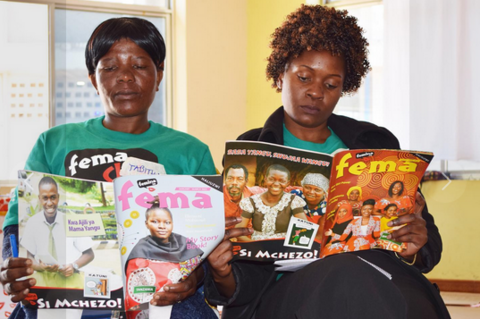
Through the production of recurring, long-term media vehicles with national reach, Femina Hip aims to create a media platform enabling people to express themselves, share experiences, and learn. The central media product is Fema magazine. Produced and printed quarterly, the bilingual (English and Swahili) magazine is distributed to secondary schools, folk development colleges, and local government and civil society partners across Tanzania. The magazine content includes sections on all of Femina Hip's strategic agendas: sexual and reproductive health and rights, economic empowerment, citizen engagement, and youth connect. Every issue carries a theme campaign and is produced with content identified with partner organizations and gathered from different regions of Tanzania, highlighting various parts of the country and fostering a sense of "nationhood". Editorial collection is highly participatory: Approximately 100 youth from Femina Hip's Fema Clubs engage quarterly in youth reporting or contribute to the content with their own letters and stories.
Fema Clubs operate throughout every region of Tanzania in secondary schools, folk development colleges, and out of school ones run by Femina Hip's civil society partners. The Fema Clubs programme aims to create more focused engagement with the Fema Magazine content and to promote youth leadership, teamwork, volunteering, and life skills. Each school selects a teacher (mentor) who oversees and facilitates the activities and discussions in the Fema Clubs. Femina Hip trains these teachers in an active learning methodology. To stimulate Fema Clubs engagement, each magazine edition features "club challenge activities" to stimulate conversation and growth by engaging clubbers through debate, drama, and community/club projects - all fostering peer education. Femina Hip incentivises these activities with awards and recognition to motivate increased participation. Fema Clubs networks are reportedly identifying themes they are passionate about, mobilising their own funds, and putting on activities, festivals, and events that engage their peers and community leaders. For students who graduate from Fema Clubs and go on to university, Femina Hip offers a Fema University Network to facilitate continued engagement and participation with the platform.
Femina Hip's other media products - Fema TV and Fema radio, as well as Fema social media, reinforce and complement the messages in the magazine and extend the organisation's reach:
For more information, visit:
Through the production of recurring, long-term media vehicles with national reach, Femina Hip aims to create a media platform enabling people to express themselves, share experiences, and learn. The central media product is Fema magazine. Produced and printed quarterly, the bilingual (English and Swahili) magazine is distributed to secondary schools, folk development colleges, and local government and civil society partners across Tanzania. The magazine content includes sections on all of Femina Hip's strategic agendas: sexual and reproductive health and rights, economic empowerment, citizen engagement, and youth connect. Every issue carries a theme campaign and is produced with content identified with partner organizations and gathered from different regions of Tanzania, highlighting various parts of the country and fostering a sense of "nationhood". Editorial collection is highly participatory: Approximately 100 youth from Femina Hip's Fema Clubs engage quarterly in youth reporting or contribute to the content with their own letters and stories.
Fema Clubs operate throughout every region of Tanzania in secondary schools, folk development colleges, and out of school ones run by Femina Hip's civil society partners. The Fema Clubs programme aims to create more focused engagement with the Fema Magazine content and to promote youth leadership, teamwork, volunteering, and life skills. Each school selects a teacher (mentor) who oversees and facilitates the activities and discussions in the Fema Clubs. Femina Hip trains these teachers in an active learning methodology. To stimulate Fema Clubs engagement, each magazine edition features "club challenge activities" to stimulate conversation and growth by engaging clubbers through debate, drama, and community/club projects - all fostering peer education. Femina Hip incentivises these activities with awards and recognition to motivate increased participation. Fema Clubs networks are reportedly identifying themes they are passionate about, mobilising their own funds, and putting on activities, festivals, and events that engage their peers and community leaders. For students who graduate from Fema Clubs and go on to university, Femina Hip offers a Fema University Network to facilitate continued engagement and participation with the platform.
Femina Hip's other media products - Fema TV and Fema radio, as well as Fema social media, reinforce and complement the messages in the magazine and extend the organisation's reach:
- The Fema TV Show has been on air since 2003, highlighting different themes and campaigns each season. Recorded "on the road" in different locations across Tanzania, the show has been hosted by a series of young role models. Some shows are shot on location in rural areas, allowing a wider public to share their experiences and giving voice to young people and communities who generally do not have the opportunity to access the airwaves. Each episode features young people, experts, celebrities, and politicians discussing critical - sometimes controversial - issues relating to youth lifestyles. Each show highlights youth stories and testimonials and incorporates comic elements to reinforce the messages. Youth Reporters from the Fema Clubs participate in each episode to help explore their communities by asking questions and seeking out interesting stories.
- The Ruka Juu TV Show (see Related Summaries, below), first aired in 2011, is an entrepreneurship competition produced every two years to promote Femina Hip's economic empowerment agenda. Six contestants from different regions compete for a 5 million tsh prize. Judges and the audience are involved in score setting. The season that aired in 2017 focused on agricultural value addition and processing and the role it can play in the economic empowerment of Tanzanian youth.
- The Fema Radio show, first aired in 2013, is produced in 3-month seasons each year. (Click on the video below to listen to one episode.) The show's content is crafted to echo other Femina Hip agendas that are implemented at the same time. The programme employs well-known presenters who drive the shows' content with the help of Fema Club Youth Reporters. In the past, the radio programme has been aired on national stations, but Femina Hip is focusing on local FM stations to reach a more diverse audience.
- Femina Hip promotes active communication between its team and audience, helping to further connect Tanzanian youth to the movement. The team has active conversations through its social media platforms (e.g., Facebook and Twitter), email and SMS (short messaging service, or text) speak-back system (Sema na Fema), which allows youth to directly connect with each other and with the Fema team members on a daily basis.
For more information, visit:
Development Issues
Youth, Sexual and Reproductive Health and Rights, Economic Empowerment, Citizen Engagement, Gender Equality
Key Points
According to the organisation, Femina Hip media products provide conduits for hard-hitting discussion and open talk on a broad range of contemporary themes and issues for men and women alike. Through a mix of mediums, it aims to enhance positive and democratic public debate, stimulate critical thinking and personal responsibility, and contribute to behaviour and social change in Tanzania.
Femina Hip started during the height of the HIV epidemic, so the focus was on HIV/AIDS awareness and prevention, as well as sexual and reproductive health and rights. The team pioneered "open talk" on these sensitive issues to meet the urgent need for sex education among youth in Tanzania. As time went on and the audience base grew, Femina Hip received more and more requests to cover topics like employment and money issues. Young women were particularly adamant, since without their own income, they had difficulties negotiating safe sex. Responding to the needs of the audience has always been a priority for Femina Hip, so, 10 years into Femina's journey, economic empowerment was added to the agenda.
Femina Hip started during the height of the HIV epidemic, so the focus was on HIV/AIDS awareness and prevention, as well as sexual and reproductive health and rights. The team pioneered "open talk" on these sensitive issues to meet the urgent need for sex education among youth in Tanzania. As time went on and the audience base grew, Femina Hip received more and more requests to cover topics like employment and money issues. Young women were particularly adamant, since without their own income, they had difficulties negotiating safe sex. Responding to the needs of the audience has always been a priority for Femina Hip, so, 10 years into Femina's journey, economic empowerment was added to the agenda.
Sources
Emails from Rebecca Arnold to Soul Beat Africa on November 26 2003 and from Diana Nyakyi to The Communication Initiative on July 30 2008; and Femina Hip website and interview of Minou Fuglesang, produced by Naomi Pyburn for Ogunte - both accessed on September 8 2022. Image credit: Femina Hip via Facebook
Comments

booklets
Great work .Our clients like the booklets v.much.What is the posibility of getting femina HIP quaterly for distribution to our vct clients in the villages where the mobile clinics go?
Dr LM Minja
Training Coordinator EMINI/MMRP
PO Box 2410
Mbeya
mminja@mmrp.org
Congrats femina
Bravo femina,you have been doing a very good job and i deeply appreciate your work-its outstanding.I started to read it when i was in high school and find it very interesting.I truly enjoy it and i suggest that you stive to make it available for free in rural areas where HIV-AIDS is wide spread.-Dastan,udsm.
il like to get involved in ur project
Mrs. Rima Desai - resident of Mwanza, Tz. WIsh to write or get involved in your HIP project.
Currently a free lance writer with THE CITIZEN newspaper of saturday
- Log in to post comments