










































A Web Application About Herd Immunity Using Personalized Avatars: Development Study
Laval University (Hakim, Giguere, Kavanagh, Parent, Paquette, Roberge, Tremblay-Breault, Reinharz, Witteman); University of British Columbia (Bettinger); Dalhousie University (Chambers, Orji); University of Manitoba (Driedger); Institut national de santé publique du Québec (Dubé); University of Padova (Gavaruzzi); University of Sydney (Leask); University of Alberta (MacDonald); Toronto General Hospital (Sander); University of Iowa (Scherer); University of Ottawa (Wilson)
"Applications with personalized avatars may be more effective than abstract visual representations or text-based explanations to help people understand their personal role in population health."
Community immunity occurs when a large portion of a community (the herd) becomes immune to a disease, making the spread of disease from person to person unlikely. Research has found that it can be difficult for people to understand the connection between individual-level vaccination behaviour and community-level risk and benefits. This paper describes the process of designing a web application ("app") about community immunity that could be understood by people with varying levels of education and working to optimise it based on users' cognitive and emotional responses.
As the paper outlines, the guiding methodological framework for the project was that of a user-centred design, in which potential users are consulted early and often, with their responses to prototype versions serving to help guide iterative improvements of the intervention or tool. The overall integrated framework combined 4 existing models, which are described in the paper: (i) the Health Belief Model (HBM), (ii) Gestalt visual principles, (iii) the Cognitive Theory of Multimedia Learning, and (iv) Affect Heuristic.
Before designing the first prototype, the multidisciplinary team began by developing a concept map to organise the underlying content presented in the visualisation - a brief narrated animation about community immunity - within 3 major themes: (i) community, content about how a community is made up of individuals, including vulnerable people living among other individuals, (ii) infection, content about how different pathogens cause different infections and spread at different rates, and (iii) vaccines, content about how effective vaccines may or may not be, how some vaccine effectiveness may wane over time, and how different diseases require different vaccine coverage.
The process involved 4 psychophysiological data collection methods: eye tracking, galvanic skin response, electroencephalogram (EEG), and facial emotion recognition. Participants (110 in total, primarily French-speaking people in Quebec City, Canada) sat in a stationary chair in front of a desk with a mobile eye tracker and a webcam mounted on the computer monitor, a keyboard, a mouse, and computer speakers. Using semistructured interview questions, the researchers asked participants to summarise in their own words what they saw in the visualisation, what message it aimed to convey, and anything they found confusing or unclear. They were also asked questions about how to improve the visualisation or personalised avatar building. If their explanation about the visualisation indicated they may have missed some visual elements, the researchers probed for more specific information on how to improve those visual elements.
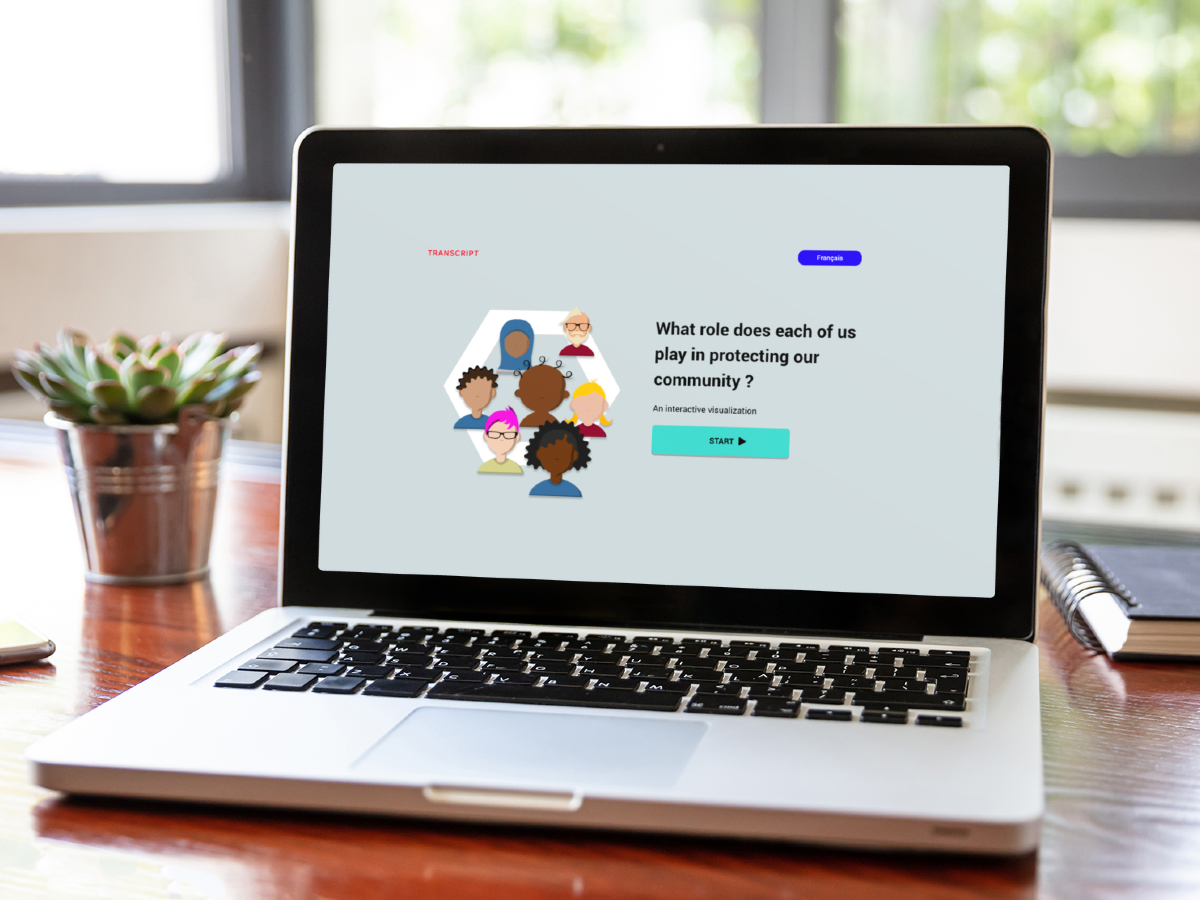
By the fourth iterative cycle, the content of the visualisation had achieved nearly all predefined communication goals (see Table 3 in the paper to learn about the elements of the app and the communication goals for each cycle). However, up to this cycle, the visualisation featured generic avatars. On the basis of data from previous cycles, the researchers developed an additional piece in which people were asked to build their own communities by making personalised avatars (their own, 2 vulnerable people in their community, and 6 avatars of people around them who could be family members or coworkers). This added feature intended to enable people could better identify with the avatars that were subsequently integrated into the app, which consists of a 2-minute visualisation showing how different parameters (e.g., vaccine coverage, and contact within communities) influence community immunity.
Other iterative changes across the cycles included: adding specific signals about who was represented by the different avatars, using colour and movement to indicate protection or lack of protection from infectious disease, and changing terminology to ensure clarity for people with varying educational backgrounds.
Table 4 outlines key findings of all 4 cycles. Overall generalisable findings include:
- Visualisation appears to be a promising medium for conveying what community immunity is and how it works. For example, by the fourth cycle, all 8 participants who tested this version reported that community immunity safeguards vulnerable people and everyone in the community, and all participants reported that some infections spread faster and need enough people to get vaccinated to prevent the spread of infections.
- By involving multiple users in an iterative design process, it is possible to create a short and simple visualisation that clearly conveys a complex topic. For example, by the fourth cycle, all 8 participants found it easy to create avatars by following instructions without a tutorial. However, the researchers concede that building avatars and launching an app requires a certain level of computer literacy.
- Evaluating users' emotional responses during the design process, in addition to their cognitive responses, offered insights that help inform the final design. The researchers cite Peters et al., who describe 4 possible functions of affect in health communication and decision making. For instance, it can function as a "spotlight" to direct a person's attention toward information, which, in turn, shapes their judgments and decisions. Because the app is designed primarily to convey a complex concept to inform decisions, the researchers adapted the app to provoke emotional reactions to key information, such as the vulnerability of some community members.
The researchers conclude that visualisation with personalised avatars "shows promise as a method of conveying the concept of community immunity to a broad range of members of the general public. This study has practical implications regarding how to design health communication materials about complex topics, such as community immunity, and other concepts that combine individual and population benefits and harms, such as antibiotic resistance, health resource allocation, and interventions during epidemics." Next steps include assessing the effects of the app on risk perception, knowledge, and vaccination intentions in a randomised controlled trial (RCT).
Journal of Medical Internet Research 2020 (Oct 30); 22(10):e20113.
- Log in to post comments