










































Differential Determinants and Reasons for the Non- and Partial Vaccination of Children among Nigerian Caregivers
Harvard T.H. Chan School of Public Health
The vaccination rate in sub-Saharan Africa remains low. Nigeria, the study site of this paper, is one of the three countries that have not eliminated polio. In 2003, oral polio immunisation was boycotted in the country due to mistrust of the vaccine, which led directly to 80% of the world's cases of polio during the boycott period. This study evaluates reasons for incomplete vaccination of all vaccines separately according to vaccination status - not- and partially vaccinated - and examines the differential association between sociodemographic characteristics of caregivers and reasons for incomplete vaccination for each status.
Data from the Multiple Indicator Cluster Survey (MICS) conducted in Nigeria in 2016 and 2017 were analysed. (For MICS, women and men aged 15-49 years old were interviewed; questions regarding immunisation focused on children under 2 years old.) Logistic regression was used to evaluate associations between sociodemographic characteristics of caregivers and incomplete vaccination according to different reasons.
The most common reason for non-vaccination is that caregivers have no faith in immunisation (27.0%), followed by lack of awareness of the need for immunisation (26.0%) and the perception that the place where immunisation is given is too far/inconvenient (24.3%). Among caregivers whose children are never vaccinated, a lower level of education is correlated with more likelihood of having no faith in immunisation, and economically poorer households are more likely to state a lack of awareness of the need for immunisation need and an inconvenient place as the reasons for non-vaccination.
The most common reason for partial vaccination is that caregivers thought the children had already been fully immunised (44.8%), followed by the inconvenient location for immunisation (15.3%) and supply-side issues such as shortage of vaccine stock and absence of vaccinators (14.4%). Among these caregivers, those who are educated and wealthier are more likely to state they thought their children were fully vaccinated, while economically poorer caregivers tend to give an inconvenient immunisation place as the reason for incomplete vaccination.
This paper emphasises the importance of differentiation by vaccination status because the policy implication for each barrier is different. For example, for caregivers who cited their lack of faith in vaccination and lack of awareness of the need for it as reasons, "providing the correct information on the purpose and effectiveness of vaccines can be effective to remove their barrier by mitigating the distrust of vaccines and promoting awareness of the importance of vaccination." In contrast, for caregivers who thought the child was fully immunised, rather than focus on distrust of vaccination and lack of awareness of vaccine efficacy (not the major barriers), "providing the correct information on the vaccine schedule and possibly giving timely reminders of follow-up doses of vaccination can potentially help reduce the prevalence of incomplete vaccination."
The policy implication is also different by the sociodemographic characteristics of caregivers that are associated differently with reasons of incomplete vaccination. "For example, among caregivers whose children are never vaccinated, those with less educational attainment and those from wealthier households are more likely to have distrust of vaccine efficacy. Targeting caregivers with limited educational attainment to provide the information on vaccine efficacy can be effective in increasing the vaccination rate."
The researcher concludes that policies developed to increase vaccination uptake should take differentials such as those identified by this study into consideration
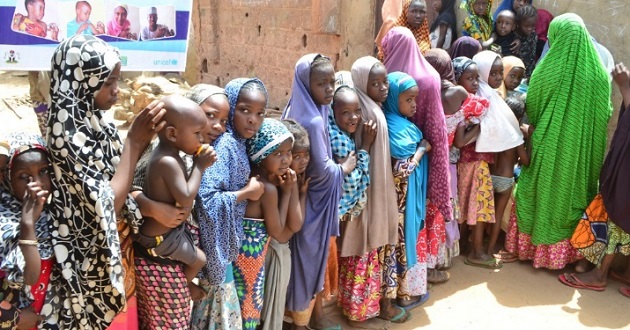
Vaccine, Volume 38, Issue 1, 3 January 2020, Pages 63-69. https://doi.org/10.1016/j.vaccine.2019.09.097. Image caption/credit: Children standing in line for their meningitis vaccine in Sokoto state, Nigeria. World Health Organization (WHO)
- Log in to post comments