










































How Has Media Programming Supported Polio Eradication?
"Drama is a powerful genre through which to provide salient information in an entertaining way and to role model healthier behaviours, such as vaccinating children."
Since 2013, BBC Media Action has been working closely with the United Nations Children's Fund (UNICEF) to support polio eradication. Through mass media programming - radio magazine shows and drama, and radio and TV public service announcements (PSAs) - it has sought to break down barriers to increase demand for and uptake of vaccines against polio and other childhood diseases among vulnerable and hard-to-reach communities in Afghanistan, Nigeria, and Somalia. This briefing synthesises findings from research conducted in the 3 countries, with a focus on Afghanistan. It highlights how media can engage parents, caregivers, and community influencers - informing them about the risks, helping change deeply-rooted attitudes, and encouraging them to seek polio vaccination for their children.
BBC Media Action's analysis of the 3 countries' media landscapes informed its decision to produce radio programming to support the polio eradication initiative. Radio is more common among those living in remote and rural areas - the very areas that tend to have the highest vaccination refusal rates. In addition, BBC Media Action's research with audiences in Afghanistan found that many families do not have a TV at home due to their belief that watching TV is haram (forbidden) in Islam. Meanwhile in Nigeria TV and radio were almost equally accessed, so BBC Media Action opted to use both platforms.
In Afghanistan, one of the remaining polio-endemic countries, research found that refusals often arise due to parents' uncertainty as to whether Islam permits vaccination against the disease, their concerns about the efficacy and negative side effects of the vaccine, and their mistrust of vaccinators. Since July 2016, BBC Media Action has been producing and broadcasting Ghamai (Jewel), a weekly Pashto-language, family health radio show designed to disseminate information, address commonly-held misconceptions about polio and other childhood vaccinations, trigger discussions, and inspire listeners to reflect on improving children's health. (See Related Summaries, below, for more.) As of September 2018, BBC Media Action had produced and broadcast 89 episodes of the radio magazine-style programme, each of which comprised: personal stories of polio sufferers, discussions with doctors and religious leaders, features on nutrition, and a short drama clip. These aired on the BBC Afghan Service and on 6 local radio stations in areas where polio vaccination levels were low.
BBC Media Action conducted qualitative formative research before Ghamai started, audience feedback soon after it first aired, and evaluative qualitative research at the end of its first series (in early 2017). Findings suggested that the programming: provided listeners with accurate, trusted, and clear informatio; increased knowledge on the requirement of multiple doses of vaccines and vaccination schedules; garnered trust and confidence among caregivers thorough inclusion of doctors and religious leaders; prompted discussion and dialogue in communities; encouraged parents to vaccinate their children by dispelling misconceptions about vaccinations; and increased listeners' trust of health professionals, particularly polio vaccinators.
One notable finding: Ghamai's drama segment proved especially powerful, bringing to life the difficulties of living with paralysis. In one episode, the central character ties her husband's feet together so he experiences how it would feel to travel to the market with paralysed legs. Personal, real-life stories of people affected by vaccine-preventable diseases also proved highly motivating. Many, particularly fathers, cited the interview with a father and his young daughter who had been paralysed by polio as having encouraged them to change their minds and allow their children to be immunised against polio.
In Nigeria, BBC Media Action produced Madubi (Mirror), a weekly Hausa-language radio drama that aimed to increase demand for the polio vaccine, challenge barriers to immunisation, and help build family and community support for protecting child health. A total of 144 episodes of Madubi, along with accompanying 19 radio and 5 TV PSAs, aired between 2015 and 2017 on over 50 stations across Northern Nigeria. (See MERCI, under Related Summaries, below.) BBC Media Action research found that:
- Listeners of Madubi were twice as likely as, and viewers of the PSAs were 1.5 times more likely than, non-listeners/viewers to know about the national immunisation schedule.
- Listeners said Madubi increased their confidence to reject false narratives about the polio vaccine, particularly the view that it is a means of controlling the population of Muslims in the north.
- Those tuning into Madubi were 1.4 times more likely than non-listeners to discuss plans for immunisation.
- Listeners were twice as likely as non-listeners to say that they had taken action following vaccinator visits. They were also more likely to allow vaccinators to enter their houses, to ask them questions, and to encourage their neighbours to vaccinate their children.
- Compared to non-listeners/viewers, a higher proportion of the audience intended to allow vaccinators to give their children under the age of 5 polio drops each time these were offered.
In Somalia (see Related Summaries), BBC Media Action produced Dhibcaha Nolosha (Drops for Life), a weekly radio magazine programme that focused on removing barriers to polio vaccination and addressed the beliefs, norms, and knowledge gaps that were preventing the uptake of a broader range of vaccinations. Each episode contained a short drama segment, poetry, and a personal story of suffering. Between December 2013 and May 2015, 42 episodes aired on the BBC Somali Service. Listeners reported that their understanding of the causes, transmission routes, and consequences of polio and other vaccine-preventable diseases had improved as a result of tuning in. They trusted the information they gained from the programme, both because of the BBC's credibility and because the show hosted well-respected individuals (e.g., doctors and religious leaders locally known as sheikhs), and many felt responsible for disseminating the knowledge they had acquired from the show. Listeners said the show had dispelled previously-held misconceptions about vaccinations and had successfully persuaded them to vaccinate or give boosters to their children. Several caregivers reported convincing their relatives or friends to do the same. By increasing their understanding of polio, Dhibcaha Nolosha helped vaccinators simplify and improve how they spoke to families about the polio vaccination, which has reportedly enhanced the public's trust in them.
Together, the findings from the 3 countries have revealed the need to:
- Identify and challenge entrenched social and religious norms that drive parents' refusal to vaccinate their children;
- Convey important information through trusted figures, such as religious leaders and doctors;
- Use simple, jargon-free language; and
- Bring the full extent of polio-induced suffering to life, either by role modelling or featuring real-life stories.
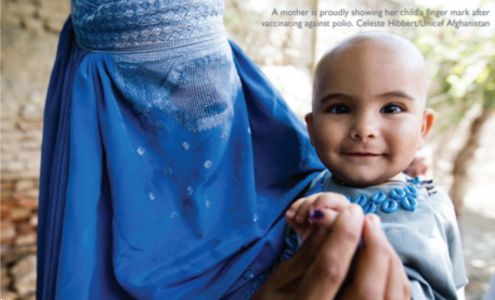
C4D Network and BBC Media Action website, both accessed on November 19 2018. Image caption/credit: "A mother is proudly showing her child's finger mark after vaccinating against polio." Celeste Hibbert/UNICEF Afghanistan
- Log in to post comments