










































Engaging Black Communities to Address HIV: Community Responses to the "Keep It Alive!" Social Marketing Campaign in Ontario, Canada
Western University (Baidoobonso); AIDS Committee of Toronto (Husbands); University of Ontario Institute of Technology (George, AfzalMbulaheni)
"...Black communities in Ontario and Canada as a whole are heterogeneous, but our results underline the importance of better understanding how and why campaigns are received in varying ways within a targeted population. In addition, the findings raise awareness about the complexity of designing and implementing a positive campaign focused on values and resilience in a community so diverse, even if unitary in many respects."
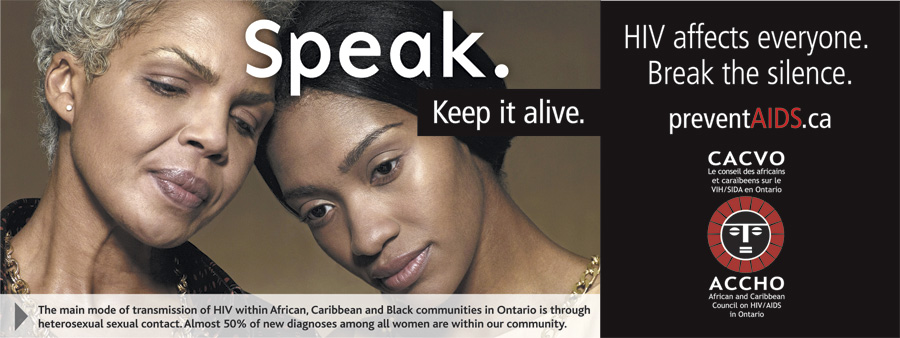
Black people comprise 4.3% of Ontario, Canada's population but 19% of HIV-positive people in the province. Developed and implemented by the African and Caribbean Council on HIV/AIDS in Ontario (ACCHO) between 2006 and 2009, "Keep It Alive!" (KIA) was a community-based HIV/AIDS education and awareness social marketing campaign (SMC) for African, Caribbean, and Black (ACB) communities in Ontario, Canada. This article presents results from the KIA evaluation study to determine how the campaign was received among Black communities in 3 of Ontario's largest cities: Toronto, Ottawa, and London. Primary objectives are to evaluate the impact of the KIA campaign on people's self-reported awareness about HIV and assess the campaign's attractiveness to Black people in the aforementioned cities. Secondary objectives assess: (i) how the campaign resonated with Black communities in the 3 cities (i.e., which groups of people were reached by the campaign or were more likely to attribute increased awareness of HIV to the campaign); and (ii) the associations between demographic, geographical, and other factors (e.g., HIV-related stigma, history of HIV testing, level of exposure to the campaign) and people's assessment of the campaign (i.e., self-reported awareness about HIV, appeal, and importance of the campaign).
The objectives of the KIA campaign were to: raise awareness about HIV among ACB communities in Ontario, promote safer sex and HIV testing, reduce HIV-related stigma within ACB communities, and raise the profile of ACCHO, a newly formed organisation at the time. KIA conveyed messages about stigma, safer sex, and HIV testing by appealing to community values of self-respect, love, family, potential, pride, and friendship and by portraying Black people as capable of leading change. KIA was inspired by 2 theoretical traditions: theories of health and behaviour change (e.g., the Health Belief Model), which assert that people may adopt life-enhancing practices if they become more knowledgeable about the benefits of change, inspiring people to change attitudes, beliefs, and practices, which entails engaging individuals and communities as capable agents of change. Phase 1 of the KIA campaign was delivered through: advertisements on billboards, in public transit, and in community newspapers; posters, postcards, and pamphlets distributed through community organisations and community events that attracted primarily Black audiences; and on radio through a rap music advertisement. The print materials publicised a website that gave more in-depth information about HIV and ACCHO. Phase 2 was launched in 2007 with 7 TV advertisements that were strategically aired in February and March during a popular sitcom that appealed to Black people, and the advertisements were repeated throughout the summer. The TV advertisements showcased individuals speaking to their significant others or Black communities, using scripts they prepared with assistance from the campaign committee and communications company. The TV advertisements emphasised HIV prevention, stigma reduction, and the well-being of people living with HIV.
KIA was similar to other health- and HIV-related SMCs that use mass media or mass communication techniques to influence how people think about or manage their health. Through SMCs, health agencies promote the benefits of certain attitudes, norms, or behaviours by appropriately framing the health-related issue for the intended audience, disseminating credible information about the issue, and recommending how the individuals or communities sought to be reached by the campaign can address or resolve the issue. The effectiveness of SMCs in HIV prevention is well documented (see the many citations in this article), and it has been demonstrated that people who rate the message as being effective early in the campaign have stronger intentions to adopt the behaviour promoted by the message.
Between September 2009 and March 2010, the researchers recruited a convenience sample of 243 survey participants. Participants were recruited from a variety of sites and events frequented by Black communities, including barbershops/hair salons, universities, cafés, community events, community organisations, churches, and restaurants. Participants had to be at least 18 years old and identify as African, Caribbean, or Black. Findings suggest that exposure to the campaign, the rated appeal and importance of the campaign, and participants' assessment of whether the campaign raised their awareness of HIV among Black communities varied across Ottawa, Toronto, and London. Reception of the campaign was more favourable among participants who tested for HIV previously; it is likely that people who have prior involvement in, or connection to, HIV issues may be more inclined to notice the campaign, and that people who tested for HIV in the past continue to be informed about or sensitive to HIV issues. Put another way, campaigns seem to generate action (getting testing or spreading the word) or attract the attention of previous testers who may use the campaign as an opportunity to have conversations about HIV. The campaigns may allow people who are living with HIV to raise the subject among their social circle without also raising suspicion that they themselves are HIV positive.
Reception of the campaign was also more favourable among participants who discussed the campaign with others, demonstrated a greater knowledge of HIV, visited the campaign website, were of Caribbean or African ethnicity, and were male. The study results showing that people of Caribbean ethnicity were more likely to see the TV advertisements may be partially explained by how the advertisements were positioned on TV. In Ontario, some elements of the KIA campaign appeared during a very popular Caribbean-themed sitcom that was based in Toronto. In general, the campaign's reception varied by city and participants' first language (English or French). For example, participants in London reported that the KIA images raised their awareness more so than those in Toronto. The social climate in Toronto due to the International AIDS Conference and other ongoing campaigns may have made people more cognisant of HIV issues and created a general awareness of HIV in the city, which cannot be attributed solely to the KIA campaign. The results also suggest that implementation issues (i.e., management of a SMC) may have influenced how the campaign was received among the intended audience.
The article concludes with the assertion that HIV social marketing campaigns in Canada are not uniformly received and interpreted among the respective intended audiences. This was demonstrated in participants' differential reports on exposure to the campaign, appeal and importance of the campaign, and their assessment of whether the KIA raised their awareness of HIV among Black communities in Ontario. These findings may inform the development of future social marketing campaigns for African diasporic communities in Canada and abroad with disproportionately high numbers of HIV infections.
SAGE Open Aug 2016, 6 (3) 2158244016663799; DOI: 10.1177/2158244016663799; and "Staying Alive: Evaluation of the Keep it Alive! HIV Awareness and Prevention campaign for African, Caribbean and Black Communities in Ontario" [PDF], ACCHO, 2012 - accessed on August 15 2016. Image credit: ACCHO
- Log in to post comments