










































AIDSFree Guidance Database
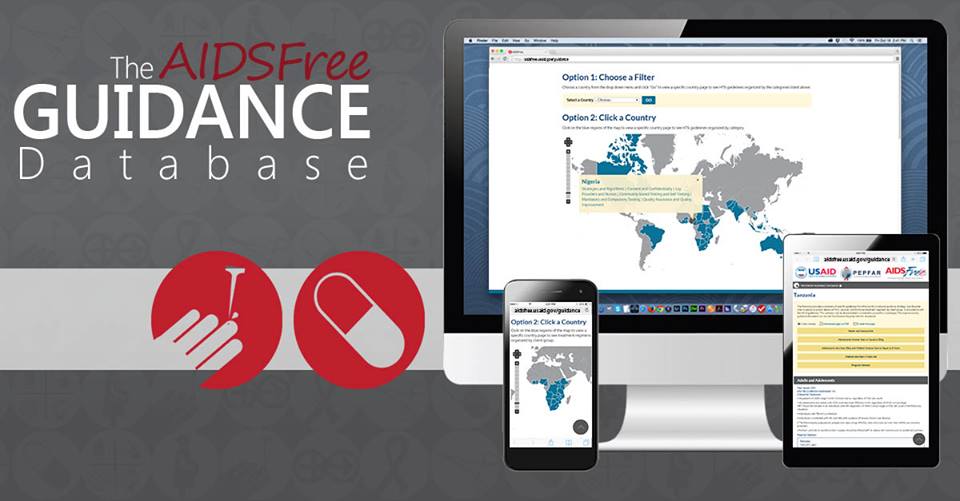
The AIDSFree Guidance Database brings together national HIV testing and treatment guidance from many priority countries around the world. This interactive database can be used to prepare guideline revisions for specific countries, conduct research and product development, prepare training materials for health care personnel, write proposals and grants, and more.
Specifically:
- The AIDSFree HIV Treatment Guidance Database provides national treatment guidelines for adult, adolescent, and paediatric HIV treatment and prevention of mother-to-child transmission (PMTCT). Organised by country and patient population, it "provides continuous access to the most up-to-date country guidelines."
- The AIDSFree HIV Testing Services (HTS) Guidance Database provides guidelines and policies on HIV testing services, including national guidelines on consent and confidentiality, testing algorithms and strategies, use of mandatory testing, self-testing, and quality assurance and quality improvement.
- The HIV/TB Co-Infection Guidance Database includes up-to-date HIV/TB co-infection country guidelines. One can use this interactive database to prepare guideline revisions for a specific country, conduct research and product development, prepare training materials for health care personnel, write proposals and grants, or learn about guidelines from other countries. Included in this database are guidelines for adults, adolescents, pregnant or breastfeeding mothers, and children.
- The Post-Exposure Prophylaxis (PEP) Guidance Database provides national PEP guidelines from many priority countries around the world. Included in this database are criteria for starting PEP, evaluation of risk, recommended prophylaxis, and follow-up screening recommendations for populations such as healthcare workers and sexual violence survivors. It is organised by country and patient population (determined by what is in each country's national guidance). Once the user clicks through to the specific country page of interest, he or she can view the guidance on any device, download or email a summary of the guidance, and/or view the original country guidance documents.
- The TB Guidance Database provides up-to-date national treatment guidelines from many priority countries around the world. Every few years, the World Health Organization (WHO) revises its HIV treatment recommendations in response to emerging evidence. In response, countries should revisit their national guidance to ensure they make the best use of their country resources to provide access to treatment for as many people as possible. Included in this database are guidelines for various populations, as well as case definitions, diagnostic methods, standard protocols, and DOTS (Directly Observed Treatment, Short-course) recommendations.
This resource is a product of the Strengthening High Impact Interventions for an AIDS-free Generation (AIDSFree) Project, a 5-year cooperative agreement funded by the United States (US) President's Emergency Plan for AIDS Relief (PEPFAR) and managed by the US Agency for International Development (USAID)'s Office of HIV/AIDS. Focus areas of this initiative include: promoting gender equality and women's empowerment in HIV responses; promoting high-quality HIV testing and counseling for individuals and linking it to care; reaching more people with appropriate combination, biomedical, structural, and behavioural prevention services; eliminating mother-to-child-transmission of HIV; delivering life-saving therapies to those who need them most; and accelerating scale-up of voluntary medical male circumcision (VMMC).
Publishers
Emails from Vanessa Miranda to The Communication Initiative on January 27 2016, May 12 2016, and June 22 2016; and AIDSFree, January 28 2016, June 22 2016, and July 27 2016.
- Log in to post comments