










































Rock Point 256
The campaign is designed to contribute to a reduction in HIV incidence and early pregnancy, and an increase in the proportion of young people who complete primary education. Rock Point 256 tells the story of people living in a fishing and farming community called Rock Point. The radio drama addresses issues of sexual exploitation of young people, especially girls, gender equitable attitudes and practices, effective communication between adults and young people, completion of school by girls, abstinence from sex, and community support for the health and safety of young people in Uganda. It is intended that the characters in the drama model positive behaviour change, which evolves over time as the story unfolds. Rock Point 256 is produced in English, Luganda, Runyankole/Rukiga/Runyoro/Rutooro, Luo, and Ateso.
In the first year of the radio drama, the series concentrated on transactional sex - which was defined as the exchange of sex for gifts, favours, or money. The drama was designed to give young listeners three messages: abstain from sex until you are ready to settle down for a long-term relationship; set long-term goals that you do not compromise for material gain; and do not give or receive gifts or favours in exchange for sex. The message intended for adults was: examine your personal role in protecting young people. The second year of the radio series focused on concepts of masculinity.
In order to reinforce the messages of the drama, the following supportive activities and products were developed:
- A letter-management system was instituted to track letters submitted to the programme. According to the organisers, thousands of letters were received.
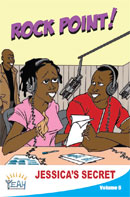
- Serial comic books were designed to reinforce messages and stories of the radio drama. Two sets of comic books were produced with boy and girl audiences in mind. The Rock Point series for boys included the titles "Girl Trouble", "Change of Heart", and "Fishy Business". The series for girls included titles such as "Temptations", "Smart Girls", Foolish Choices", and "Rock Point Finds Out". The comic books include questions to stimulate discussion.
- Promotional materials such as pens, cups, key rings, T-Shirts, car stickers, and bandanas were produced and distributed to advertise and promote the drama and its messages.
- Journey Through Rock Point Board Game was designed to promote thinking and discussion about sex, morals, ethics, decision-making, HIV/AIDS and sexually transmitted infections (STIs), substance use, and "something for something" love. The objective of the board game is to get to the finish and collect the most tokens. As players progress along the board, they encounter scenarios where they have to make a choice between two options. Based on their answer, they either get to move their game piece or receive tokens. At the end of the game, the players are supposed to talk about which decisions they regretted and why. The back of the game board contains a fact sheet with frequently asked questions.
- A radio drama contest was designed to stimulate community dialogue about transactional sex.
- "Listen In...Look Out" Listening Guide for Groups of Young People was developed for Rock Point 256 Listening Groups. The Guide is distributed together with audio cassettes and CDs of the radio serial drama.
Click here to download editions of the Rock Point 256 comic.
HIV/AIDS, Reproductive Health, Youth.
Young Empowered and Healthy (YEAH) campaign is a national social and behaviour change effort designed for young people aged 15-24. The campaign uses mass media, person-to-person dialogue, and community media approaches to stimulate dialogue and action and model positive practices. Under the auspices of the Uganda AIDS Commission HIV/AIDS Partnership, YEAH is designed and implemented by a coalition of Ugandan organisations, including the Communication for Development Foundation Uganda (CDFU), and the Straight Talk Foundation (STF).
In June 2005, YEAH conducted qualitative research to understand Ugandan definitions of masculinity and to identify behaviours and practices used to express masculinity in sexual relationships, fatherhood, reproductive health, and violence. The research suggested that men generally have more power in sexual relationships/encounters, men are not expected to be faithful, and men often use violence as a way to resolve conflicts and control sexual partners. The research helped confirm the link between gender relations and increased vulnerability to HIV. YEAH and Instituto Promundo used these results to design the strategy for the second phase campaign on male gender norms.
Johns Hopkins Bloomberg School of Public Health/Center for Communication Programs, Save the Children, Communication for Development Foundation Uganda, Straight Talk Foundation, Media for Development Trust (MFDT), Instituto Promundo, Uganda, AIDS Commission, Save the Children in Uganda, World Vision, AIDS Information Centre, PCY/Ministry of Gender Labour and Social Development, UNICEF, and Student Partnership Worldwide.
HCP website and Radio Serial Drama Rock Point 256 [Power Point] on May 16 2008.
Comments

great
Hi rock point this is my first time writting bt i follow every episode what i wanted to know is do u hve like memberships if yes hw do i join coz am interested.My e-mail address is aisha.said93@yahoo.com.The programme is so entertaining and educative.Thanx
Rockpoint Club
My name is kirya julius from mehta ss lugazi.
I would like to take this opportunity to thank you for the rockpoint has embressed us about the dangers of acguiring HIV/AIDS.
My comment is that how can i join rockpoint club.
I will be grateful if my comment is answered.
- Log in to post comments