










































Using Community Engagement and Geographic Information Systems to Address COVID-19 Vaccination Disparities
Eastern Michigan University (EMU)
"The implementation of mobile clinics expanded COVID-19 vaccine access and community-driven, multi-sector partnerships can increase the capacity to enhance efforts and facilitate access to COVID-19 vaccination for hard-to-reach populations."
While the COVID-19 vaccine supply increased significantly in 2021 and was accompanied by increases in COVID-19 vaccination rates in the United States (US), racial and ethnic disparities in vaccine uptake persist in that country. These disparities are amplified for individuals with limited English proficiency (LEP), who often experience additional barriers to healthcare access related to communication, culture, and systematic influences. The purpose of this paper is to apply community-engaged and geographic information system (GIS) strategies to increase equitable access to COVID-19 vaccination, with a particular focus on Asian Americans (AAs) with LEP.
Building upon existing academic-community partnerships between a university and local community-based organisations (CBOs) in Michigan, US, the project team began by conducting a needs assessment among 442 AAs regarding access to COVID-19 vaccinations. Respondents were recruited with the help of community partners through social media, ethnic newspapers, and personal connections. Surveys were administered at community centres, mosques, temples, churches, and a nail salon; they were available in English and 7 Asian languages. The results showed that more than 80% of these individuals reported having LEP. In addition, while more than 70% reported they had access to the internet, 59% stated they did not know how to use the internet to register for COVID-19 vaccines/boosters, and 60% did not know how to find places to get COVID-19 vaccinations.
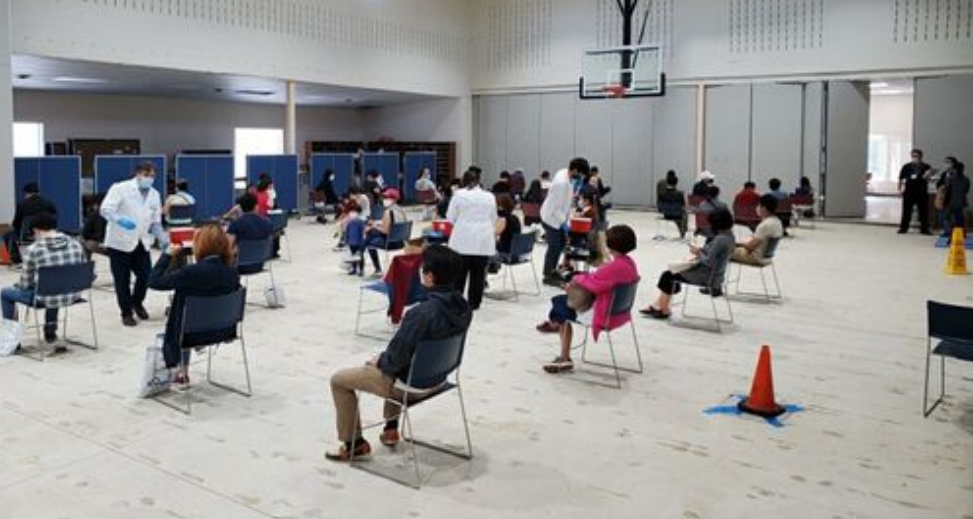
Partnering with CBOs, the project team established 34 COVID-19 vaccination sites in 2021 at trusted locations where AA individuals and families regularly visit, including mosques, churches, grocery stores, and community centres. They also set up mobile clinics (numbering 41 as of May 2022). To do so, the team applied GIS mapping to assess needs geographically to ensure the vaccination sites were set up in neighbourhoods where underserved AAs resided and where computer accessibility (or the ability to use a computer for vaccine appointment registration) was lacking. As part of the process, the project team deployed GIS to tabulate, visualise, and monitor key vaccine metrics and trends that supported the COVID-19 vaccination distribution plan. The GIS project was published and shared on the ArcGIS Online platform, where the general public could see the maps via a URL. (Maps provided in the paper show how the mobile clinics played a role in narrowing the vaccine disparity gap between counties, as well as the way in which socially vulnerable communities were incorporated into key public health decision-making and activities when the mobile clinics were set up.)
The project team also identified bilingual community leaders and conducted training to support their roles as trusted messengers with resources and tools that were translated into 14 languages and dialects to educate their respective communities. Training included participation in at least one 2-hour Zoom education session, accompanied by ongoing technical assistance. Participants were trained on communication strategies and such technical matters as COVID-19 and influenza vital statistics, preventive measures, and updated vaccination guidelines. These trusted messengers were also present at the COVID-19 vaccination clinics, which further supported the promotion of COVID-19 vaccine messaging that was designed to build vaccine confidence among community members in linguistically and culturally accessible ways.
As of this writing, the COVID-19 mobile clinics have served more than 3,700 hard-to-reach individuals in Michigan. The project team reports several challenges, including financial considerations that impeded the expansion of community-based vaccination sites, limited Wi-Fi hotspots for registration, and lack of adequate space to ensure patient privacy in some sites. They conclude that, despite these challenges, "the implementation of mobile clinics using GIS maps expanded COVID-19 vaccine access, and community-driven, multi-sector partnerships increased capacity to enhance efforts and facilitate access of COVID-19 vaccinations for hard-to-reach populations."
Tropical Medicine and Infectious Disease 2022, 7, 177. https://doi.org/10.3390/tropicalmed7080177. Image credit: EMU
- Log in to post comments