










































Lessons for the COVID-19 Response from a Multidrug-Resistant Tuberculosis Study in South Africa: How Public Health Promotion Can Reach Vulnerable Young Women
Howard College, University of KwaZulu-Natal
"...adds impetus to calls to understand how women will be impacted by COVID-19, and to proffer evidence on how to reach them with health education and services..."
KwaZulu-Natal Province (KZN), where the first two cases of COVID-19 in South Africa (SA) were confirmed, is experiencing rapidly rising drug-resistant tuberculosis (DR-TB) rates. Scholars have observed that TB information is not widely or commonly available, and that universal misconceptions about TB remain prevalent. In light of the possibility that gaps in and successes of SA's TB management programme could inform COVID-19 responses, the present study assessed public health promotion strategies for reaching vulnerable young women with multidrug-resistant TB (MDR-TB) in KZN with information they will access, retain, share, and discuss with others in their primary circles.
As the researcher explains, African countries' experiences of the COVID-19 pandemic will likely differ from those of Europe (Spain and Italy) and China, where higher numbers of deaths of older people were recorded. Africa has a younger population and higher levels of deprivation and malnutrition, whose working and living conditions can make it challenging to implement public health recommendations - e.g., to self-isolate when ill, or to stay home. Another piece of the picture is that KZN hosts a dual HIV epidemic; more than 75% of people with all forms of TB in the province are also living with HIV. HIV-associated TB complicates TB management efforts, and TB comorbidity both complicates COVID-19 diagnosis and is correlated with worse outcomes among people with COVID-19. Provincial, district, and municipal health systems are overstretched.
The study's conceptual framework was designed to probe links among contextual motivations for young women's health behaviours, mass media use and preferences, and opportunities to improve health promotion in public health programmes in low socioeconomic contexts. The framework incorporated Flaskerud and Winslow's vulnerable populations conceptual model (VPCM), whereby vulnerability is conceived as intersectoral and caused by multiple risk factors often acting synergistically in the same individual, and Lazarsfeld and Katz's two-step flow theory and its later conceptualisations, whereby media audiences' discussion of health information is seen as a prerequisite for its acceptance and impact on individual and group attitudes toward health recommendations.
Between March 6 and September 29 2018, the researcher conducted 3 focus group discussions (FGDs) with women aged 18-34 years with MDR-TB and 11 key informant interviews in eThekwini Metro, KZN. All 20 participants - 10 women being treated for MDR-TB, 3 family members/treatment supporters, 3 KZN Department of Health TB Management Programme senior staff, 3 nurses, and 1 community health promoter - were women.
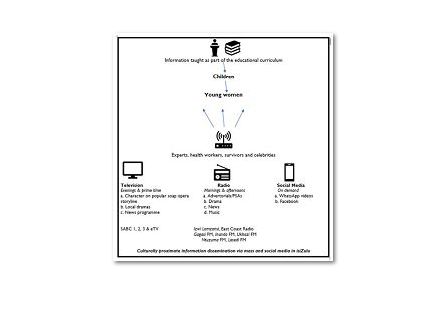
As noted here, SA has high mass media penetration - television (83.4%), radio (67.9%), and mobile phone technology (93.8%) - and, thus, mass and social media are viable mediums for health promotion. Residents of marginalised areas are more likely to own or have access to radios than televisions, though interviews with medical experts on television news programmes on the SABC 1 channel were the most commonly recalled MDR-TB content. Indeed, research cited here indicates local news programmes are more effective than international media at closing knowledge gaps because local audiences are more invested in the information, as it is relatable and directly impacts their lives.
Other findings:
- Including a public health storyline into established local soap operas or dramas can increase young women's reception and retention of information, and increase the chances they will act on it. In SA, local soap operas, which reflect the cultures and contexts of viewers, have high viewership and can support public health promotion efforts. A quotation from an FDG participant illustrates that young women also respond positively to information shared by admired celebrities and actors.
- Advertisements or public service announcements (PSAs) broadcast during popular local programmes can also be effective, though repetition of advertisements to reach the same people more frequently is counterproductive, as some viewers report avoiding them.
- New media can support the sharing and discussion of health information received via other channels among geographically and culturally varied groups. In this conceptualisation, online gatekeepers share and encourage the recirculation of information via new media, and opinion-makers shape prevailing ideas and attitudes through sharing and discussing content. This is illustrated in one interviewee's explanation of the confluence of mass and social media, and how audiences make meanings from soap opera and drama texts.
- Many participants in the study reported that their knowledge of and attitudes towards health information are most strongly influenced by knowledge shared by their children, especially if the information was received at school as part of the curriculum. Thus, there may be potential to achieve a multi-step flow of health information, as several people engage with and discuss the learner's homework, with benefits for multiple household members. This finding may have relevance in the COVID-19 context, as the impacts of health promotion could be improved by incorporating child-friendly information and formats, disseminating COVID-19 infection prevention messages via schools, and engaging children through education-entertainment they will be excited to recirculate.
Thus, the study found that, in highly populated urban areas, television and radio (local soap operas, dramas and hard news programmes), social media (Facebook and WhatsApp), and information from children are the best mediums for reaching young women to provide integrated public health education about both MDR-TB and COVID-19. It proposes that vulnerability factors be incorporated into both MDR-TB and COVID-19 responses. Notably, it is "worth ensuring that the pathology of COVID-19 is explained in ways that are easy for communities to understand within their cultures..."
In conclusion, this article "privileges the importance of public participation and sustained individual, household and community actions to reduce the transmission of COVID-19 in low socioeconomic status contexts, and the primacy of public health promotion in achieving this. Public health promotion is a critical yet often underrated strategy....To be effective, however, interventions must be informed by mapping of popular communication channels, and an understanding of how different groups prefer to receive health information and who the most influential people are to disseminate it."
Southern African Journal of Public Health (incorporating Strengthening Health Systems) 2020;4(2):34-40. DOI:10.7196/SHS.2020.v4i2.117
- Log in to post comments