










































Young Carers Project South Africa
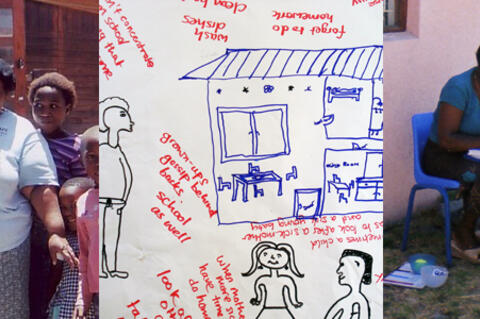
Launched in 2008 by the Department of Social Policy and Intervention at the University of Oxford, the Young Carers Project is a research initiative that involves South African young people (especially HIV-positive young people) in research about orphans and other vulnerable children (OVC). "This context of parental illness is characterised by co-existing health issues (such as tuberculosis [TB] and malnutrition), extreme poverty, poor health and social services, and the ongoing apartheid legacy of institutionalized social inequality and deprivation in Black African-designated environments."
The project uses both interviews and standardised questionnaires to collect qualitative and quantitative information about parental AIDS morbidity and the effects of acting as a "young carer" on health and educational outcomes for 6,000 children aged 12-18 in South Africa. Information collected concerns psychological and physical health, education, and social functioning.
With the South African Government (Department of Social Development, Department of Health, Department of Basic Education and Department of Agriculture), the study is part of the National Action Committee for Children Affected by AIDS programme. Government and non-governmental organisations (NGOs) are using the findings of this study to develop policy and interventions.
This project is based on the belief that young people living in AIDS-affected families and those who are HIV-positive themselves can have a valuable role in ensuring that research on the needs of OVC is relevant, ethical, and youth-friendly. However, including young people in research can be complex, and there is little research literature that describes the hurdles and opportunities involved.
This study includes participation of children affected by AIDS and their carers. The Teen Advisory Group (TAG) includes 12 young carers, all of whose parents have HIV or TB. Organisers hold annual weekend workshops, where they give advice on questionnaire design, interviewing style, acceptability of items, and questionnaire content.
The study features a prospective longitudinal design, through which researchers can specify mechanisms and routes by which parental illness and parental death impact on child outcomes. The study also compares orphans, children with AIDS-sick parents, and children in non-affected families. It uses a stratified systematic sampling method. Decisions regarding adults' cause of death are made using validated World Health Organization (WHO) clinical criteria and the verbal autopsy (VA) method. The VA method has been validated in Southern African community samples where clinical evidence is unavailable or unreliable and was developed for use in areas with over 20% HIV-prevalence. Organisers' previous research has used this international standard to distinguish AIDS-orphaned from other-orphaned children in South Africa. The sample size is designed to allow sufficient numbers in each subgroup (i.e., AIDS-orphaned children, other-orphaned children, young carers of AIDS-sick parents, young carers of other-sick parents, and non-affected children).
The study uses standardised questionnaires with strong psychometric properties. Tools are all translated and back-translated into isiXhosa, isiZulu, Shangaan, and SeSotho, and children complete face-to-face one-hour interviews in the language of their choice. The survey assesses psychological health (i.e. depression, anxiety, post-traumatic stress disorder (PTSD), and behavioural problems), physical health (i.e., contraction of TB, nutrition, and upper respiratory tract infections), education (i.e., school enrolment, attendance, and performance), and social functioning (i.e., peer relationships and family functioning). Questionnaires were independently piloted with AIDS-affected children in the Western Cape.
The study is:
- identifying what caring tasks young carers undertake by examining type and amount of care tasks undertaken by children with AIDS-unwell, other-unwell parents, orphans, and non-affected children (i.e. medical care, intimate care, domestic tasks, and sibling care). Researchers are examining associations between care activities and positive and negative outcomes.
- examining the effects of being a young carer on key developmental outcomes by using cross-sectional and longitudinal data to examine hypotheses about increased risk of adverse outcomes (physical health, mental health, sexual risk, and social and educational factors) for children who have experienced parental death or parental illness due to AIDS.
- identifying policy-relevant risk and protective factors for child outcomes by testing the effects of hypothesised policy-relevant risk and protective factors (i.e. malnutrition, school access, stigma, extent of caregiving) that may mediate the association between parental AIDS morbidity/mortality and child outcomes.
- identifying phases of specific vulnerability for AIDS-affected children through a longitudinal design that will allow researchers to test when children are most vulnerable in the process of parental sickness and death, in order to inform the targeting of interventions at the most relevant periods for children.
- working with government and NGOs to inform evidence-based policy for young carers. Biannual feedback to the Departments of Social Development, Health and Education has been established. Feedback to the National Action Committee will take place at their annual conference.
"Collaboration is an important part of the Young Carers project. It encourages collaborator input and investment, fostering long-term commitments. Findings will be disseminated to all collaborators, and all stakeholders will be involved in further dissemination. Collaboration, particularly with representatives of Young Carers, takes note of social inequalities that exist in such a large-scale project between the various stakeholders and carers. Collaboration gives voice to groups who would otherwise be targets of research and intervention, rather than as the partners they are."
Fourteen AIDS-affected teens who are part of the TAG made a 14-minute movie, "Through Our Eyes", about their experiences; it may be viewed below. Click here to read an article about the making of this film. Also, the teens set up this Facebook page to share information and spark conversation about the movie.
HIV/AIDS, Health, Children, Youth.
Previous research has reported that orphaned children are more likely to have mental health problems and educational deficits and to contract HIV as adolescents. However, according to organisers, there is a lack evidence to show whether AIDS orphans experience greater hardship than other orphans and - importantly - to examine outcomes for children who are caring for their AIDS-sick parents. These young carers are also potentially at high risk for problems in the areas of mental, physical, and sexual health, as well as education. There is also a lack of information on the group who are perhaps at most risk of all: AIDS-orphaned children who also live with a surviving, AIDS-sick caregiver.
The project's initial findings and advocacy have contributed to a number of policies and plans by: the South African National and Provincial Government, the Southern African Development Community, the Government of Lesotho, the United Nations Children's Fund (UNICEF), Save the Children, the World Health Organization (WHO), and the United States Agency for International Development (USAID).
Department of Social Policy and Social Work at the University of Oxford and the South African Government.
Email from MEASURE Evaluation to The Communication Initiative on November 28 2012; Young Carers website, November 29 2012; and email from Lucie Cluver to The Communication Initiative on December 2 2012.
- Log in to post comments