










































When Do Gain-Framed Health Messages Work Better than Fear Appeals?
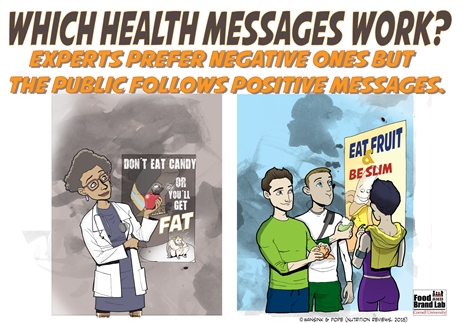
Cornell University (Wansink), University of Vermont (Pope)
"Message framing is one of the most researched, yet least conclusively understood, phenomena in health communication. Positive or gain-framed messages are sometimes effective, but negative or loss-based messages (such as fear appeals) are often favored by the public health community."
This research examines gain-framed (focused on benefits) versus loss-based (either positively or negatively focused on loss) health messages to find "how individual (person-specific) differences in the perceptions and processing style of the target audience could predict whether a positive message or a negative fear appeal will be most effective." Previous research has focused on "message characteristics, situational (context) characteristics, and demographic characteristics." Examples of messages include: Gain-framed - "By using sunscreen, people can attain healthy skin". Loss-framed - "Wear sunscreen and lower your risk of skin cancer."
"This review proposes that whether a loss-framed or a gain-framed message is effective depends largely on the perceptions and processing style of the [intended] audience." The researchers find that messages created by health professionals are more effective amongst an audience of health professionals, while messages designed to be more "person-specific" are more likely to influence a general audience.
The "review provides an overview of positive or gain-framed messages and negative or loss-framed messages and discusses four key individual (person-specific) differences in terms of how they influence a person’s predisposition toward gain- or loss-framed messages. Examples are provided to show how various ... audiences would respond differently to various types of appeals. Future research directions are outlined along with implications for using an audience-centered framework to make more conclusive sense of past research and to better predict when gain-framed messages might be more effective than loss-framed messages."
The researchers find that individual differences have a great effect on how the individual perceives the message - whereas prior research focused on the message content. Thus, "[u]nderstanding a person’s level of involvement, understanding, or interest in a particular subject" helps explain degrees of message effectiveness. For example, knowledge of high personal risk for developing skin cancer or a high level of self-efficacy for preventing it are both indicators of message receptivity. In addition, another influencing characteristic is "whether the individual has a prevention orientation or a detection orientation."
Another factor is high or low outcome certainty. For example, in an experiment which manipulated women's certainty of obtaining a positive HIV test result, those feeling some certainty were more likely to follow through with testing.
Risk tolerance is a factor to which "prospect theory" (how humans make decisions in the face of risk) is applied. Studies found, for example, that gain-framed messages delivered in a personalised message can be effective in increasing positive health behaviour.
"The fourth moderator of message success is a person’s cognitive processing style." Those who deliberate and aggregate information - in "piecemeal" detail - are less immediately affected by messages, whereas those who look at the bigger - heuristic - picture "are more likely [affected] by the message’s superficial features, such as the source, length, credibility, and design." Gain-frame messages more likely affect those with a low need for cognition, for example, those who look for a trusted source; those looking for high detail and cognition are more likely to be affected by negative or loss-framed messages. An individual's "amount of time, level of energy, and level of distraction" can influence whether they prefer heuristic or piecemeal messages.
The researchers emphasise that creating messages for audience characteristics and personalising them is more effective than using messages preferred by message designers. "A focus on audience-centered messaging could be particularly useful in the health information and advertising culture that currently exists.... For example, if a health message was framed as 'If you quit smoking using this help line, you can save almost [US]$2,000 a year,' the audience will know what to do, they will know how to do it, they will have an incentive, and they will have a positive feeling about their ability to quit." They suggest that future research assess the use of a message tailored to a focus group in order to compare message efficacy of gain-framed messages for both that group and a control group, as well as loss-framed messages for that group and a control group.
Nutrition Reviews Journal, October 13 2015.
- Log in to post comments