










































What Do Participatory Approaches Have to Offer the Measurement of Empowerment of Women and Girls?
KIT Royal Tropical Institute
"The field of measuring empowerment is constantly evolving."
This KIT Royal Tropical Institute paper considers how the "voice" of women and girls can feature more prominently in existing methods to quantify characteristics of women's and girls' empowerment from both political and technical standpoints. It highlights the value of participatory approaches to achieve this citing various examples. The paper complements the development of a KIT conceptual model on empowerment of women and girls, developed for the Bill and Melinda Gates Foundation, and presents various examples of participatory approaches. It draws on a review of approaches and interviews using 24 online consultations with Gender and Evaluation Community of Practice and Pelican Platform for Evidence-based Learning and Communication for Social Change.
Three core arguments emerge on the importance of the participation of women and girls in measurement efforts :
- "Firmly acknowledging that the voice and knowledge of women and girls are key in grounding definitions of empowerment in women and girls’ perspectives and experiences...." Thus, measurement data are "informed by women and girls’ realities and interests. In other words, based on what they define themselves as important."
- "Allowing for context specificity..." Considering place and time differences, as well as age, race, class, religion, etc., acknowledges how one woman's experience differs from another.
- "Valuing whose knowledge counts and who is best positioned to explain the change..." means taking into account that empowerment is both an outcome and a process of transformative change that requires participation.
Four different purposes for using participatory approaches to measure empowerment are presented in Table 1. These highlight when and where they are best suited to avoid tokenistic use of participatory approaches. The paper argues that when participatory approaches are used in a representative way, measurement elicits women and girls’ understandings of empowerment. When participatory approaches are used in a transformative way, more emphasis is given to women and girls driving the measurement process to challenge inequalities.
Examples include:
- Design stage of participatory monitoring and evaluation (M&E) approaches - Three examples: a participatory monitoring system: Women Empowerment Scorecard; an Empower Change Map to collectively define their own evaluation frameworks (visions of change); Outcome mapping using participatory approaches to engage project participants to develop visions of gender transformative change and to capture women's voices on impact.
- Testing stage - For example, after designing the index to identify appropriate dimensions of measurement, "women were engaged with triangulating the results and identifying the appropriate weighting."
- Data collection stage - Participatory mapping describes a group of data gathering tools for collecting "women and girls' spatial access and knowledge of different resources, freedom of movement, and how this is affected by different relations within communities..... For example in Kissa Kahana (an adolescent health project in Uttar Pradesh, India), body mapping was used in a representative way to support adolescent girls to draw maps of their bodies as a way to discuss their experiences (positive and negative) of reproductive health."
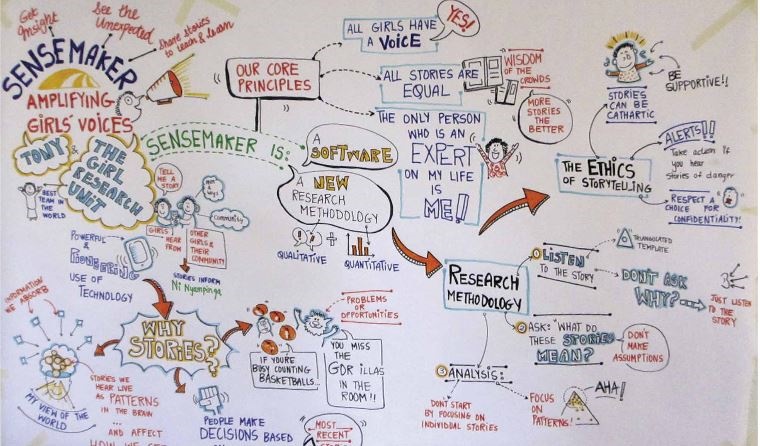
- Data analysis stage - For example, Sensemaker® uses narrative and analyses with software capable of a large number of narratives allowing representative use and participatory involvement, such as in Girl Hub. Community Score Card from CARE uses the participatory process to diagnose and improve relationships among a programme's users and service providers. "CARE later developed a quantitative women empowerment measure and health worker measure drawing on WE-MEASR© (Womens Empowerment-Multidimensional Evaluation of Agency, Social Capital and Relations)"
- Validation stage - For example, participatory visual storytelling, such as photovoice, participatory video, such as used by Video Girls for Change, and digital storytelling. Save the Children in Nepal used photovoice for a mixed methods evaluation of the CHOICES curriculum (gender transformative curriculum targeting both girls and boys in addressing gender norms) to capture both girls and boys voices. The process, with careful facilitation, can be used at baseline, throughout implementation and to evaluate impact. "Photovoice became transformative for the children involved when they were supported to use their photographs to stimulate dialogue with local governance actors to address causes of children’s inequalities and& disempowerment in their local communities."
KIT Royal Tropical Institute is an independent centre of expertise and education for sustainable development. KIT assists governments, NGOs and private corporations around the world to build inclusive and sustainable societies, informing best practices and measuring their impact. Guided by the Sustainable Development Goals (SDGs) of the United Nations, its work focuses on health care, gender, economic development and intercultural cooperation.
C4D network website, May 2 2019. Emails from Dr. Julie Newton on May 8 and Dr. Roland Kielman on May 13 2019. Image credit: Nitya Wakhlu cited by Tony Quinlan 2014
- Log in to post comments