










































Vaccination Coverage and the Factors Influencing Routine Childhood Vaccination Uptake among Communities Experiencing Disadvantage in Vellore, Southern India: A Mixed-Methods Study
Tampere University (Francis, Nuorti, Lumme-Sandt); National Institute for Health and Welfare, Helsinki, Finland (Nuorti); Christian Medical College (Kompithra, Balraj, Kang, Mohan)
"Timely and region-specific estimates of routine immunization coverage among children from disadvantaged communities can identify potential inequities in service delivery or uptake and inform targeted interventions to tackle the barriers to vaccination uptake in such settings."
After India was certified polio-free in 2014, the Indian Government launched the Mission Indradhanush (MI) campaign in 2015 to increase full immunisation coverage in the poorest-performing districts to 90% by 2020. Vellore was one of eight "MI districts" in Tamil Nadu, with a focus on reaching children from communities experiencing disadvantage such as migrant, tribal, and other hard-to-reach groups. This mixed-methods study was conducted to assess routine immunisation coverage and the factors influencing childhood vaccination uptake among these communities in Vellore.
Between 2017 and 2018, the researchers conducted a cross-sectional household survey (n = 100) and six focus group discussions (FGDs: n = 43) among parents or primary caretakers of children 12-23 months of age from groups experiencing disadvantage in Vellore, such as Narikuravar, Irular, stone quarry, and brick kiln worker communities. The Narikuravar are a semi-nomadic tribe similar in origin to the Romani or Roma communities of Europe. This community has low literacy, poor access to public welfare services such as health care, and limited sources of income. The Irular are a large tribal group characterised by low literacy, extreme poverty, and a degree of cultural and geographic isolation.
In the household survey, the proportions of fully vaccinated children were 65% and 77% based on information from vaccination cards or parental recall and vaccination cards alone, respectively. Almost all parents (95%) agreed that immunsation was important to keep their children healthy, and 56% reported they were familiar with the recommended immunisation schedule for their children.
In the univariate analysis, children who had a vaccination card were more likely to be fully vaccinated compared to those without a vaccination card available during the survey (77% versus 53%). Children from non-Narikuravar communities (Irular, brick kiln, and stone quarries) were more likely to be fully vaccinated than children from Narikuravar communities (81% versus 51%). Children with educated mothers (primary schooling or higher versus no formal education) and with mothers who were homemakers (compared to daily wage or salaried employees) or fathers who were daily wage labourers (compared to salaried employees) were also more likely to be fully vaccinated. In addition, parents' familiarity with the recommended immunisation schedule for their children, receiving information about the immunisation schedule during antenatal visits, and receiving a financial incentive for up-to-date vaccination (with three pentavalent doses) were positively associated with children's vaccination status.
The positive association between parental familiarity with the recommended childhood immunisation schedule and children's vaccination status remained in the multivariate analysis but was no longer statistically significant. In addition, while children from Narikuravar communities had less than half the odds of being fully vaccinated compared to children from the other surveyed communities, this finding was not statistically significant.
The FGDs were conducted in Tamil by a field supervisor with experience in community engagement and fieldwork in the study region. Separate FGDs were held with mothers and fathers to ensure their free participation. The qualitative discussions were analysed by using the "5As" taxonomy for the determinants of vaccine uptake.
In the FGDs, parents identified difficulties in accessing routine immunisation when travelling for work (Access) and discussed convenient timing (a non-financial cost - Affordability - described in the 5As taxonomy) of routine vaccination sessions as a facilitator of childhood vaccination uptake, especially by mothers in the Narikuravar community. Regarding Awareness, a few parents expressed a need for regular knowledge-sharing sessions, including those featuring detailed information on the routine immunisation schedule, at a convenient time for their community; they highlighted the role of village health nurses (VHNs) in disseminating vaccination-related information. Parents across the communities largely displayed Acceptance of vaccinations for their children. Mothers tended to be the primary decision-makers for vaccinating their children and appeared proactive in following up with vaccinations for both their child and other children in the neighbourhood. A Narikuravar mother described the need for vaccinating all children, seemingly assuming the role of a "vaccination advocate" in her community. A small number of Narikuravar and Irular parents discussed the importance of prompts and reminders (Activation) for childhood vaccinations, suggesting telephonic reminders and house visits by the VHNs as facilitators of childhood vaccination uptake.
Around a fifth (22%) of the parents were hesitant (strongly hesitant, hesitant, or neutral) towards childhood vaccines in the household survey. Although parental vaccine hesitancy was not linked to childhood vaccination uptake in the multivariate analysis, it is an important barrier to children being fully vaccinated in migrant and slum-dwelling communities in India. A few parents from the Narikuravar and Irular communities expressed fears due to negative news reports about certain vaccines (one parent mentioned the oral polio vaccine - OPV) and common side effects following vaccination such as fever or body pain. Parents (in the FGDs) could not remember any details of these news reports but were probably referring to a 2014 report about two deaths among children in the Theni and Dindigul districts of Tamil Nadu, wrongly linked to the OPV. Community-based health education campaigns can build confidence in vaccines by combating the prevalent rumours and misconceptions regarding childhood vaccines and educating parents on managing the common side effects following immunisation.
In short, the study full childhood vaccination coverage in Vellore to be suboptimal. The findings suggest the need to:
- Improve vaccination card retention and explore alternate sources of vaccination histories such as provider-maintained records to improve the accuracy of vaccination coverage estimates for children from disadvantaged communities in Vellore.
- Focus on reaching children from Narikuravar families, perhaps by improving awareness on how and where the Narikuravar (and Irular) communities can access routine vaccinations when away from their regular residence and by scheduling catch-up appointments for due vaccination doses.
- Collaboratively plan immunisation sessions based on the availability of parents, and implement ongoing telephonic or face-to-face reminders by VNHs (and other health workers) to help ensure timely childhood vaccinations in these communities.
- Hold periodic community-based health education campaigns to educate and engage fathers, who requested more information on the benefits and risks of vaccination and the specific vaccines available in the routine immunisation schedule for their children (but who may not be present during antenatal visits, when vaccination information is often shared).
In short, this study suggests the need for targeted and contextual interventions to improve routine immunisation uptake among children from communities experiencing disadvantage in Vellore.
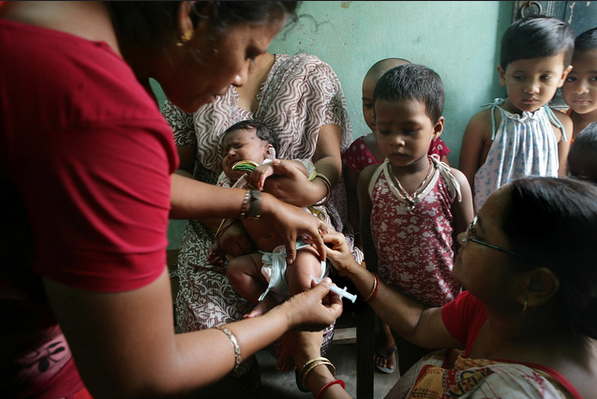
BMC Public Health (2021) 21:1807. https://doi.org/10.1186/s12889-021-11881-8. Image caption/credit: Radha Das, a social health activist, applies the Hepatitis B vaccine to a child at a rural health centre in India - Piyal Adhikary, India, via United Nations Development Programme on Flickr (CC BY-NC-ND 2.0)
- Log in to post comments