










































USAID Adaptation Community Meeting: Does Climate Change Need Behavior Change?
"Social resilience increases a community's ability to organize and respond to climate-related threats."
This webinar emerges from an October 20 2016 Adaptation Community Meeting on behavioural approaches to building community resilience to climate change: the capacity of a community to embrace change by coping, adapting, and prospering with regard to stresses and disturbances that are a result of unpredictable climate change impacts. It featured Kevin Green, Senior Manager of Behavioral and Social Science at Rare, an international conservation organisation whose mission is to inspire change so people and nature thrive. Rare has trained local leaders in more than 50 countries to design and execute behaviour change "Pride" campaigns (see Related Summaries, below) that inspire communities to change the way they interact with nature. The event was organised by the United States Agency for International Development (USAID)'s Climate Change Adaptation, Thought Leadership, and Assessments (ATLAS) project.
Drawing from examples of Rare's current work with small-scale fishing and farming communities in Latin America, Asia, and Africa, this presentation explores emerging efforts to apply insights from the behavioural sciences to collective action problems like natural resource management and climate adaptation. Specifically, it considers how behavioural approaches like Rare's can build social resilience, help communities adapt to climate change, and connect the dots between community engagement and national policy. Kevin Green highlights how two Pride campaigns - in the coastal town of Pilar, Cebu (during and after 2013's Typhoon Haiyan) and in the San Vicente de Chucuri municipality of Colombia (before and after a landslide that destroyed more than 70% of the cocoa-producing properties upstream) - transformed the local communities into stewards of their marine and freshwater resources and helped them to adapt to a changing climate's threatening impacts. In exploring these examples, Green outlines the Adaptive Capacity Index and explores a theory of behaviour change that includes: Knowledge, Attitude, Interpersonal Communication, and Barrier Removal - all leading to Behaviour Change. This is in keeping with Green's work collaborating with field staff and partners in using social research methods and tools in the field, designing strategic social marketing and behaviour adoption campaigns, and driving on-the-ground application of the growing body of research in the behavioural sciences about how human beings are motivated.
According to Green, such adaptation and resilience building, done in collaboration with local democratic governance, has generated demonstrable evidence of changes at the sub-national and national levels.
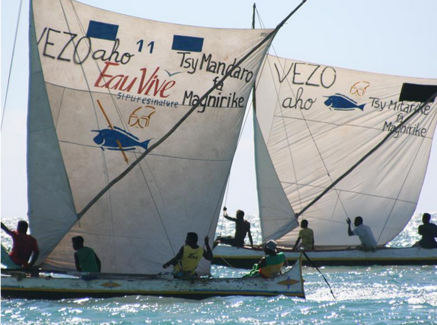
Climatelinks website and Kevin Green profile on Eventbrite, both accessed on November 16 2016. Image credit: Rare
- Log in to post comments