










































Technical Advisory Group on Polio Eradication for the Horn of Africa Countries: 17th Meeting Report
The 17th meeting of the Horn of Africa Technical Advisory Group (HOA TAG) was held from May 2-4 2018 in Nairobi, Kenya; this report offers details about the discussion. Since the group's last meeting (see Related Summaries, below), the HOA has experienced a polio outbreak of circulating Vaccine Derived Poliovirus Type 2 (cVDPV2) in Somalia and Kenya. The outbreak is considered a regional outbreak and a public health threat of international concern to the entire HOA region. In addition, four circulating Vaccine Derived Poliovirus Type 3 (cVDPV3) were detected in March 2018 in environmental samples in Mogadishu, Somalia, providing further evidence of gaps in population immunity, most likely linked to children in security- and access-compromised areas not being reached with vaccination.
Within the above context, the 17th HOA TAG meeting was called with the following objectives (with the present summary focused on 2d - communication strategies):
- To review the cVDPV outbreak situation in Somalia and Kenya, including the implemented and planned response in those and other HOA countries, and to provide recommendations as required.
- To review the following with particular reference to Somalia, Kenya, Yemen, Ethiopia, and South Sudan, and to make recommendations concerning: a) The sensitivity of surveillance in countries, particularly with reference to access-compromised, high-risk, and mobile populations; b) The risks of outbreak following wild poliovirus (WPV) importation/cVDPV emergence, as well as outbreak response preparedness, and risk mitigation strategies; c) Plans for strengthening basic immunisation services in the context of polio transition; and d) Communication strategies focusing on building and sustaining demand for immunisation, particularly in high-risk groups.
- To make recommendations as required to strengthen surveillance and mitigate risks with respect to other HoA countries.
TAG members acknowledge the current focus of community engagement/communication for development (C4) interventions in highest-risk areas, including conflict, hard-to-reach, and inaccessible populations. Country summaries related to C4D:
- Ethiopia - The National Communication Working Group (CWG) developed a communication plan in support of the implementation of a polio campaign in August and December 2017. Relevant messages were developed and disseminated using various channels. An advocacy visit was made to selected regions' sector bureau heads to foster support for the supplementary immunisation activities (SIAs). Community structures such as health development/women development armies and other networks were engaged to mobilise the community. Moreover, health workers were trained on the polio communication strategy and key messages during SIAs.
- Kenya - No C4D report was provided, but in relevant news, the health sector has suffered from industrial action with a nationwide doctors' strike between December 2016 and March 2017; the situation worsened after June with a nationwide nurses' strike that lasted until October 2017. The successive action by the various cadres of health workers took its toll on performance of the health system and is reflected in the decline of performance indicators for both acute flaccid paralysis (AFP) surveillance and routine immunisation (RI).
- Somalia - The programme is using a combination of C4D strategies, including: (i) high-level advocacy with stakeholders, ministries, religious leaders, Ministry of Education (MoE); (ii) community mobilisation through radio/TV, megaphone announcements, and house-to-house community mobilisation in all the vaccination campaigns conducted; (iii) wide distribution of polio information, education, and communication (IEC) materials, with a special focus on polio surveillance; and (iv) dissemination of pre-tested frequently asked questions (FAQ) leaflets and posters to all three zones. Emphasis is placed on the sensitisation of mobile nomadic populations and internally displaced persons (IDPs), concentrated in the largest communities.
- South Sudan - C4D played a crucial role in 2017 in polio eradication, marking the first year of its Integrated Community Mobilization (ICM) network catering routine and campaign-based interventions to create demand for the polio vaccine. Social mapping is being expanded to seven stable states, and the rest of states ongoing. Unity, Upper Nile, Jonglei, and Lakes are currently following social-map-based micro planning for communication interventions.
- Sudan - Social mobilisation continued during SIA rounds. At the local level, megaphones were used by members of the locality education community and mosques. Publicity by athletes and other community figures reportedly had a tremendous impact on raising people's awareness. Important officials like Motamads/members of the Legislative Council of localities were encouraged to make appearances at areas where the vaccination teams were working to attract attention and increase coverage. Expanded Program on Immunization (EPI) units in the localities worked to strengthen participation of people in local decision-making and to improve oral polio vaccine (OPV) coverage in sub-national immunisation days (SNIDs). Social mobilisation activities included: meetings with Motamads, executive directors, and council members; public meetings; school meetings; roundtable discussions; and interpersonal communication.
- Tanzania - No C4D report was provided, but with regard to transition planning: Through the Interagency Coordination Committee (ICC), the World Health Organization (WHO) communicated to the government about the Global Polio Eradication Initiative (GPEI) budget ramp and the need for transition planning.
- Uganda - Community mobilisation and enhanced polio risk communications were emphasised during the SIAs. Following the 2016 equity assessment, the identified unreached communities were the focus, especially the those in urban economically poor settlements, migrants, ethnic minorities, members of some religious sects (e.g., Muslims, Bisaka sect, and Triple 6), upcoming town settlements, fishing communities, refugee communities, and remote rural, island, and mountainous communities. Communication packages were developed for stakeholders and health workers to enable them to effectively communicate and mobilise communities for immunisation services. Meetings were held in Busoga region to engage both community and religious leaders to address the identified hindrances to immunisation.
The TAG offers overall recommendations on C4D in:
- Outbreak countries: Outbreak response plans should have a dedicated section that reflects social and communication indicators, including the percentage of missed children and refusals. It is necessary to clearly define communication strategies to enhance skills of mobilisers and vaccinators and to update microplans with social mobilisation information. Specific suggestions:
- Somalia: Systematically collect standardised information on communication indicators through existing monitoring mechanisms such as independent monitoring (IM) or lot-quality assessment sampling (LQAS), where possible.
- Kenya: As part of pre-campaign activities for June and July (2018) rounds, collect information on C4D indicators, including vaccine hesitancy, and then conduct post-campaign, rapid assessment on indicators after each round.
- Surrounding/at-risk countries, including Ethiopia, South Sudan, and Yemen: TAG members call upon all neighbouring countries of the outbreak to immediately update C4D outbreak preparedness plans and ensure the readiness of resources/materials that could be used in an outbreak response (e.g., draft plans, prepare budgets, conduct a media landscape analysis, integrate polio-related social/behavioural data questions into current studies, explore research and evaluation opportunities).
- Other countries, including Sudan, Tanzania, Uganda, and Zambia: Programmes should review of current C4D-related (communication, behaviour change) data already being collected, consider potential questions that would be relevant to developing outbreak preparedness responses, and incorporate C4D information in detailed epidemiological investigations.
TAG concludes by sending a strong message of urgency and emergency to the GPEI, to all governments, and to development partners and all other stakeholders to conduct a coordinated and effective regional outbreak response. Advocacy may play a role in heeding this call. On that note, the TAG was encouraged by the interest and involvement of the Inter-Governmental Authority for Development (IGAD) and sees the IGAD platform as a potentially valuable avenue to set up immediate high-level coordination mechanisms for member states.
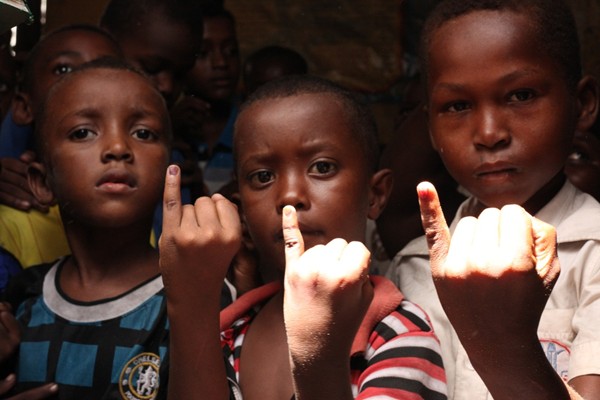
Image caption/credit: Children in Somalia show their ink-stained fingers that show they have received a dose of the OPV. WHO/T.Moran
- Log in to post comments