










































The Suitcase Project
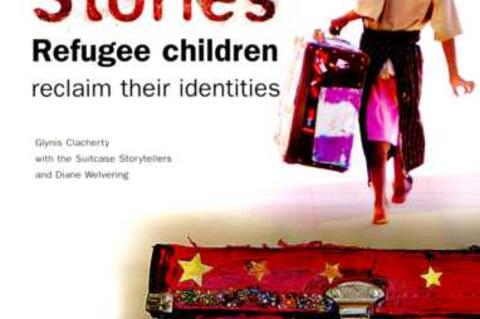
According to a project report, The Suitcase Project evolved among refugee children in Hillbrow, in Johannesburg, South Africa, during weekly Saturday meetings held at a local school. The project consists of a number of components:
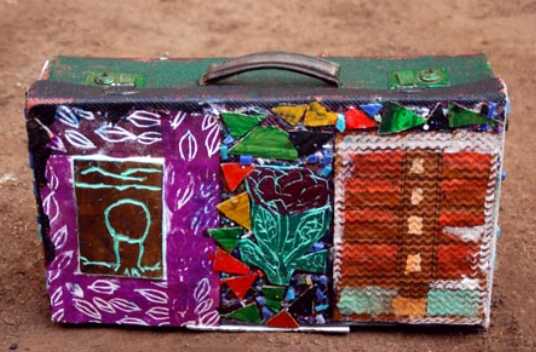
- Artwork and journaling: The children used mixed media such as drawing, printing, wax resist, and painting to make images that told the story of their lives in the present, that explored the past and their journey to Johannesburg, and that looked to the future. The project began by working with the outsides of the suitcases to represent the children's lives "now", as this was less emotionally threatening for the children than telling stories about their past. Once the children felt their suitcases were finished outside, they began work on the insides. The insides of the suitcases were about memories of their pasts. Once they felt the insides and outsides were finished (this took over 10 weeks), they began work on a set of small journals that would go into the suitcases. Children were encouraged to work on these journals in a tactile way with many different media. By this latter stage, the facilitators knew the children well and were able to direct the work, encouraging children to draw particular issues that they knew troubled them. However, at all stages the children decided what they wanted to represent.
- Storytelling: The artwork was used as a focus for informal storytelling. Children would bring a piece of artwork and tell the story behind it. Children were always given the choice to do this. The artwork was the focus of the storytelling, and this created some measure of emotional distance. According to the organisers, once the facilitator became a trusted person, almost like a family member, then many more stories were told. In some cases, Rwandan and Burundian children only began to tell the stories of their pasts and presents after about 6 months. Some took over a year before they felt able to tell their stories.
- Sharing the work and advocacy: During the project, the children's artwork was exhibited twice. Initially this was done to raise awareness of the lives of refugee children, but ultimately it also served a therapeutic purpose. The exhibitions became a way to integrate the children with outsiders and encourage them to be proud of their histories and home countries. At the second exhibition, they freely opened up their suitcases and shared the contents with academics at the University of the Witwatersrand who attended the exhibition. The project was profiled in The Sunday Times' "Read Right", an educational supplement.
- Two levels of interaction were overtly encouraged in the project. Firstly, the group was encouraged to build relationships with the facilitators. Many of the children had lost adult caregivers and had experienced deep grief and were very wary of building relationships with adults in case they were let down. The second kind of social interaction that was encouraged was the attempt to help the children support each other.
According to the organisers, the approach was informal. The art materials were set up in a large open space, and once instructions for the day's activity had been given, the children worked uninterrupted for 2 or 3 hours with support from the art teacher and an assistant. While working, some children went and sat under a tree and talked about the stories they had told in their artwork. About once every 2 months, counsellors from a local mental health centre attended the group. Particular children were referred by the facilitator to spend additional time with the counsellors.
Once the suitcases were finished, the children began work on large maps to tell the story of their journey to Johannesburg. They began by making large pieces of handmade paper. The group then went on to work on large body drawings. On the body drawings, they drew and painted and printed images that answer the question "Where are you taking your suitcase?" This work prompted the older members of the group to come up with concrete plans for their immediate futures. For example, two of the boys who were over 18 and in Grade 9 and Grade 10 at a local high school were concerned about the quality of education they were receiving.
Together with the children involved in the project, Glynis Clacherty wrote a book about the project called The Suitcase Stories: Refugee Children Reclaim Their Identities. The book tells, in the children's own words and through their art, "their remarkable stories of hardship and longing, strength and resilience."
The Suitcase Project is currently being run by the Sophiatown Counselling Services. The project offers individual counselling services to refugee children and their families and 4 therapeutic groups for children in different areas of Johannesburg. The groups still use the art-based approach.
Children, Conflict, Refugees
In 2007, The Suitcase Stories was short-listed for The Sunday Times Alan Paton Literary Award.
Hillbrow is a densely populated, low-income area where many migrants, including refugees, live, often with as many as 15 people living in a 3-room apartment. The children who were part of this project were living in 2 large neighbouring apartments used as an informal "shelter" for unaccompanied minors by the Jesuit Refugee Service (JRS).
Clacherty & Associates website on March 16 2009 and April 28 2010.

- Log in to post comments