










































A Study on Awareness and Utilization of Mission Indradhanush in an Urban Slum of Bhubaneswar
Kalinga Institute of Medical Sciences
It is estimated that, annually, more than 89 lakh (8.9 million) children in India do not receive all vaccines that are available under the universal immunisation programme. In part, this is due to the fact that, in urban areas, a large portion of the population lives in slums, where mothers are illiterate and have numerous myths about vaccination. As a strategic endeavour, the Ministry of Health and Family Welfare, Government of India, launched Mission Indradhanush in December 2014 in an effort to achieve more than 90% full immunisation coverage by the year 2020. This community-based cross-sectional study was carried out from June 1 2017 to September 30 2017 to assess the awareness of the respondents about Mission Indradhanush, to assess their attitude and practices regarding childhood immunisation, and to determine the association between knowledge and practice with selected variables.
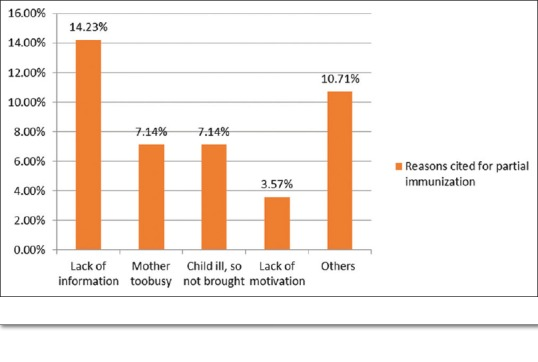
Participants in the study were 100 mothers with children aged 12-23 months living in the urban slums under field practice area of Urban Health and Training Centre (UHTC), Department of Community Medicine. A total of 73% of the respondents had the child's vaccination/mother and child protection (MCP) card with them; 72% of children were fully immunised, and 28% were partially immunised. The most common (14.23%) reason cited for partial immunisation was lack of information.
Only 10% of the respondents had heard about Mission Indradhanush, although 95% knew about ongoing immunisation services. Healthcare workers/doctors/volunteers were the most common source of vaccination information among 64% of the respondents, followed by friends and relatives, mass media, etc. A total of 64% of the respondents had adequate knowledge about vaccination; 67.65% of the literate mothers and 56.25% of those who were illiterate had adequate knowledge about vaccination, although this was not found to be statistically significant. Literacy status of the father, birth order of the child, and sex of the child had a positive association with their knowledge about vaccination.
A total of 84% of the respondents had a positive attitude about vaccination. Age of the mother, literacy status of the mother, birth order of the child, and sex of the child had a positive association with attitude toward vaccination. For example, 91.18% of the literate mothers and 68.75% of the illiterate mothers had a positive attitude.
This study highlighted the fact that in the future, efforts are required to strengthen information, education, and communication (IEC) activities regarding Mission Indradhanush, as very few participants had heard about it. The results reinforce the need for periodic awareness generation activities toward ongoing and new programmes launched by the government.
Journal of Family Medicine and Primary Care. 2018 Nov-Dec; 7(6): 1294–99. doi: 10.4103/jfmpc.jfmpc_146_18.
- Log in to post comments