










































Stop Child Labour - School Is the Best Place to Work
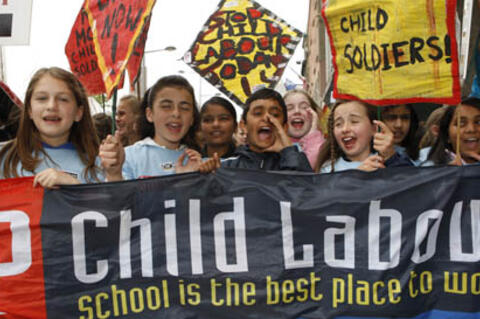
Information and communication technology (ICT) is at the centre of this effort to raise awareness and inspire activism. The Stop Child Labour website details the campaign's principles. It also provides information about child labour and action ideas for politicians, companies, schools, and consumers. For example, suggestions are offered about how to:
- "Sign petition to Stop aid cuts
- Fly a Kite to Stop Child Labour
- Keep an eye on what you buy-are you child labour-free?
- Investigate companies like Tiny Pickers International
- Find out more about Stop Child Labour campaign
- Organise your own campaign
- Buy ethical products
- Play the game & get children into school [Click here to access the game.]"
Here is an example of a specific advocacy element of the campaign: In the lead-up to the May 2010 Global Conference on Child Labour, held in The Hague, The Netherlands, the Stop Child Labour campaign drew on the internet to galvanise support for children's rights. The campaign urged organisations around the world to sign an online petition called "Eradicate All Child labour - Get Every Child Into School". The Hague Global Child Labour Conference primarily focused on the worst forms of child labour. However, as those who signed this petition wished to communicate, the time has come to eradicate all forms of child labour. In part, the petition reads, "[w]e call on the participants of The Hague Child Labour Conference to discuss the need for a Global Action Plan against all forms of child labour. In June the International Labour Conference of the ILO in Geneva should then decide to develop such a Global Action Plan before the end of 2010 and implement it by 2016. National Action Plans by all ILO members and a binding commitment by employers not to engage in and/or benefit from child labour, should be integral part of such a Global Plan."
The petition was presented to the chair of the conference, Minister Donner of the Ministry of Social Affairs and Employment, on May 10 by the chair of the Dutch Federation of Trade Unions, Agnes Jongerius, together with Venkat Reddy, co-ordinator of the MV Foundation in India, an organisation that has spearheaded a movement that has brought 600,000 children from work to full-time schools. The anti-child labour activist Shantha Sinha, former chair of the MV Foundation and the National Commission for Protection of Child Rights in India, contributed a "roadmap" [PDF] for the workshop on Education and Child Labour at the Global Conference. The Stop Child Labour campaign contributed to draft versions to this roadmap, the outcome document of the Global Child Labour Conference on how to eradicate child labour.
Children, Education, Rights.
Organisers explain that, in 2000, the ILO Convention 182 on the Worst Forms of Child Labour came into force. It was to be a stepping stone for the implementation of the ILO Minimum Age of Employment Convention (Convention 138) which, before 1998, was ratified by only 58 countries. Since then the emphasis has been on the eradication of the worst forms of child labour, culminating in a Global Action Plan of the ILO to ban these by 2016. "However, more than 4 out of 5 countries have now ratified both Conventions and are therefore ready to tackle all forms of child labour....Experience has taught us that when only children engaged in worst form of child labour are targeted they are still vulnerable and at risk of getting into other work. Focussing on all forms of child labour in an area and getting them into full-time education turns out to be more effective....Focusing on tackling 'the worst forms' has also sent the wrong signal to a range of actors, including companies and NGOs [non-governmental organisations], that some forms of child labour are acceptable..." The petition also stresses that the international community is obliged by Millennium Development Goal (MDG) #2 to get every child in school by 2015. According to organisers, this can only be achieved by eradicating all forms of child labour.
People In Need (PIN), IBIS: Education for Development, Welthungerhilfe, Concern, Cesvi, Hivos, Alliance2015.
India Committee of the Netherlands (ICN) News, May 7 2010; and Stop Child Labour website, May 26 2010.


- Log in to post comments