










































Social and Behaviour Change: Insights and Practice
"The true behaviour change magic happens when we thoroughly understand how people feel about their existing behaviours, how they perceive the desired behaviours, what exactly is preventing them from adopting these behaviours and then we use these insights to tackle the identified barriers."
Published by the Deutsche Gesellschaft für Internationale Zusammenarbeit (GmbH or GIZ), this practical guide introduces the basics of social and behaviour change (SBC) needed in the setup, implementation, and evaluation of food and nutrition security programmes.
Throughout this publication, SBC is understood as a process involving individuals, communities, or societies that enables them to adopt and sustain positive behaviours. Project implementers are typically confronted with questions such as: How to go about having an impact on how people do certain things? Where to start? What are the essentials? What steps to take, and which mistakes to avoid? The guide aims to answer these (and many other) questions.
Examples throughout the guide highlight the importance of the "social" aspects of SBC, including:
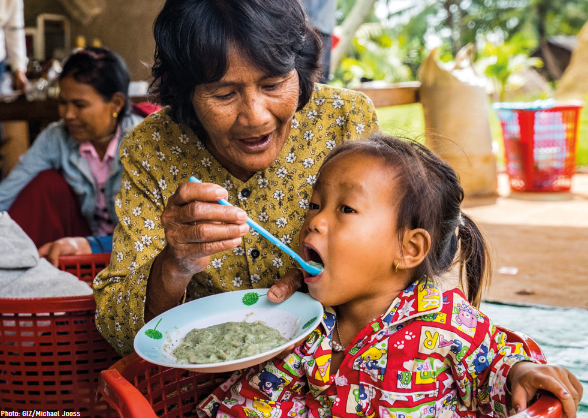
- In Northern Laos, mothers-in-law often have a much greater influence on childcare than do the mothers. Interventions focusing exclusively on mothers would be likely to bring only limited results.
- In rural Zambia, groups of men with more progressive attitudes towards helping their wives with domestic chores have motivated other men to follow their example.
- Orthodox Christianity, the major religion in Ethiopia, encourages its followers to fast 200-250 days a year. This represents a problem especially among pregnant and lactating women. Fasting is not entirely an individual choice; it is deeply entrenched in the cultural norms encouraged by an influential church authority without whose explicit support it would be impossible to change. GIZ and other stakeholders therefore focused their efforts on the Ethiopian Orthodox Church. As a result, in late 2017, the Church made a declaration relieving pregnant and lactating women from the fasting obligations.
In light of such experiences, the guide aims to help the reader understand:
- What is social and behaviour change;
- What drives human behaviour;
- How to integrate SBC, step by step, into the various stages of an intervention, starting from the design all the way to evaluation; and
- Where to find tools, guidance, examples, and other resources.
48
Emails from Petr Schmied to The Communication Initiative on July 1 2019 and July 2 2019. Image credit: GIZ/Michael Jooss
- Log in to post comments