










































Saving the Planet
This educational TV series was launched through a participatory process that involved a call to "anyone, anywhere in the world" to nominate a project to be considered for inclusion in this series. TVEAP's call involved words meant to be inspiring: "Confronted with a range of environment and development problems, the world is looking for bright ideas to sustain life on the planet. Education at all levels can shape the world of tomorrow, equipping individuals and societies with the skills, perspectives, knowledge and values to live and work in a sustainable manner." Information and communication technologies (ICTs) were used to facilitate this process; members of the public were invited to submit their nominations by visiting the Saving the Planet website.
Based on worldwide public nominations, an independent regional panel chose 6 projects for the first series of Saving the Planet, announcing the winners on May 15 2007. The stories cover the traditional "green" environmental activities as well as the "brown" environmental issues and related challenges in pursuing sustainable development. Among the topics covered are eco-tourism, preserving cultural heritage of indigenous people, and community-based waste management. Specifically:
- Environmental Education for children and adults in 3 floating villages on the Tonle Sap lake, Cambodia.
- School and Community Farmland Bio-Diversity Conservation, Thailand.
- Biyaheng Ayta, a theatre-based educational initiative of indigenous youth, Philippines.
- Young People Transforming Education - volunteers engage school teachers and students in Laos in a process that introduces fun and play into learning.
- "Kude Se Dhan" - housewives and school children join hands to clean up the southern Indian city of Dindigul...and also make money from their garbage.
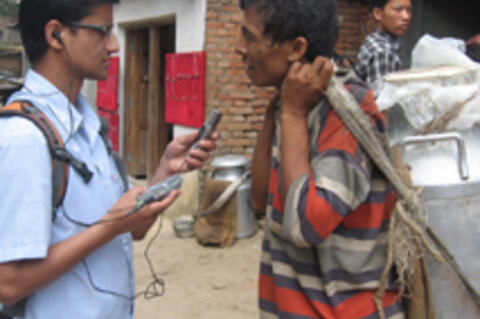
- Radio Sagarmatha public radio station, Kathmandu Valley, Nepal - a citizen-owned broadcaster using its airwaves to resolve conflicts between tourist hotel operators and local people.
Details about each winning story may be found on the Saving the Planet website. Each 10-minute story is a self-contained documentary, filmed on location by a local film crew with the participation of local organisations whose work was being profiled. In brief: "Saving the Planet profiles groups working quietly and relentlessly to spread knowledge, understanding and attitudes that inspire action that will help humans to live in harmony with the planet. They often work without external funding and beyond the media spotlight. They have persisted with clarity of vision, sincerity of purpose and sheer determination. Their stories inspire many others to pursue grassroots action for a cleaner and safer planet."
The series had its global premiere during the ACCU Asia-Pacific Forum for ESD Educators and Facilitators held in Tokyo, Japan, in late August 2009. The Forum brought together nearly 200 educators, facilitators, policy makers, and researchers from 16 countries across the Asia Pacific region. However, to foster broader access, TVEAP has made the entire series viewable online. Broadcasters may request tape copies from sales@tveap.org Educational and civil society users may directly order the series on DVD from TVEAP's online film catalogue. TVEAP is providing the series without any license fee or royalty charge in an effort to encourage the widest possible use and adaptation of its content.
The series itself is part of a broader effort to "tell stories to save the planet", and to enhance the capacity to do so. Representatives from the 6 selected projects were sponsored to attend a regional workshop in mid-2007, where they received a week of training in communicating through audio-visual tools and new media. Beyond building the skills of these media makers, a key strategy involves staying connected with the initiatives featured in the series; TVEAP claims to be "committed to an inclusive, participatory communications process...we don't just shoot and depart; we stay engaged with the individuals and groups whose stories we capture and amplify."
Education, Environment, Sustainable Development.
TVEAP is a regionally operating non-profit organisation that specialises in using audio-visual and new media to communicate sustainable development and social justice issues. TVEAP products (journalistically packaged TV, video and online content) are used by broadcast, educational and civil society organisations across the region for education, awareness, advocacy, training or activist purposes. In 2006, ACCU designated TVEAP a regional centre of excellence in ESD.
The series was made by TVEAP in partnership with ACCU and the 6 organisations whose stories are profiled in the series, and using funding support from the United Nations Educational, Scientific and Cultural Organization (UNESCO)/Japan Funds-in-Trust for the Promotion of Education for Sustainable Development.
UNESCO Asia and Pacific Regional Bureau for Education's ICT in Education: News, March 2 2007 (click here for the archives); UNESCO Bangkok website; Saving the Planet website; email from Manori Wijesekera to The Communication Initiative on March 9 2007; TVEAP press release ("Saving the Planet: New Asian TV Series Showcases Communities Thinking Globally and Acting Locally"), forwarded from Nalaka Gunawardene to The Communication Initiative on September 24 2009; and email from Nalaka Gunawardene to The Communication Initiative on October 21 2009.

- Log in to post comments