










































Resilience in Childhood Vaccination: Analysing Delivery System Responses to Shocks in Lebanon
London School of Hygiene and Tropical Medicine (Ismail, Bell, Borghi); RAND Corporation (Tomoaia-Cotisel); Queen Margaret University (Noubani); American University of Beirut (Fouad); University of Geneva (Blanchet)
"Rather than single interventions, meaningful promotion of long-term health system resilience likely requires packages of measures reflecting local contextual factors and varying in composition according to changing on-the-ground conditions."
Delivery of essential services such as vaccination is challenging and liable to disruption in countries affected by conflict or other forms of humanitarian crises. This study examines vaccination delivery system responses and mitigation strategies to sequential shocks in Lebanon: large-scale refugee arrivals from neighbouring Syria, COVID-19, an economic crisis, and a large blast in the capital Beirut in August 2020 that destroyed the national vaccine storage warehouse. The analysis also identifies points and pathways in the system through which responses were implemented to consider what was learned from efforts to strengthen resilience over time.
This was a retrospective, qualitative system dynamics study drawing on analysis of semistructured interviews carried out in 2 waves (February-March 2020 and July 2021-January 2022) with 38 stakeholders working at different levels in the system. System resilience was assessed in terms of population vaccination coverage for measles over time (i.e., first and second doses of measles-containing vaccine or MCV1 and MCV2). Interview transcripts were analysed using purposive text analysis to generate individual stakeholder causal loop diagrams (CLDs) mapping out relationships between system variables contributing to changes in coverage for routine antigens over time. These CLDs were combined using a stepwise process to produce an aggregated CLD. The aggregated CLD was validated using a reserve set of interview transcripts.
Immediate responses included macrolevel, mesolevel, and microlevel mobilisation to address what was perceived as a high risk of vaccine-preventable disease (VPD) outbreaks (especially polio and measles) in the context of population movement. For example, over time, community engagement activities were stepped up to strengthen demand by (i) reinforcing the importance of vaccination as a preventive measure, (ii) offering opportunities to cross-check vaccination records to make sure children were up to date with the national vaccination schedule, (iii) and strengthening household-level knowledge in areas likely to promote a decision to vaccinate, including information on the national schedule, on the actual cost of vaccination to refugees through the primary healthcare centre (PHC) network, and the location of the nearest PHC(s). These activities depended on stepped up recruitment of community engagement workers and increases in implementing partner funding. In that vein, supply side responses included donor funding mobilisation, as well as diversification of service delivery models and cold chain strengthening.
Particularly in response to refugee arrivals, some systemic changes were introduced. The researchers identified two potentially transformative changes, the first being a policy change to bring some private clinics under the Ministry of Public Health's fold for lower-cost access to vaccines. This policy was introduced in 2015 but did not result in significant behavioural change until demand collapsed in the private sector in 2021/2022, helping to push host communities towards PHCs for vaccination and other health services. The second was the implementation of task-shifting to nurse-led vaccine administration in PHCs. Although neither of these changes resulted in large-scale goal reorientation across the system, both introduced new mesolevel and microlevel system pathways promoting vaccination delivery that had not previously existed.
Interviewees described a range of responses to COVID-19. On the demand side, community engagement activities continued but were shifted online or via tools such as WhatsApp, although quality of engagement with service users was perceived as poorer as a result of this. Messaging focused on reinforcing the importance of vaccination as a preventive service and emphasising that clinics remained open despite COVID-19-related movement restrictions. Responses to the economic crisis were similar in nature but generally targeted different pathways within the system.
Some resilience-promoting measures introduced following earlier shocks paradoxically increased vulnerability to later ones. For example, electronic record systems were originally introduced as a mechanism for improving service efficiency and record completeness following refugee arrivals from Syria. As electricity supplies became more unreliable, facilities sometimes had to revert to paper-and-pen methods, for which later online reconciliation would be needed to ensure records were complete.
The findings highlight the importance of timely information flows to support situation appraisal. Delays to recognition of critical changes in behaviour (e.g., the time taken to identify changes in service demand and the time taken for donors to formally recognise unfolding crises) imposed significant limits on vaccination delivery system responsiveness.
A number of policy implications emerge from the analysis. For instance, evidence in this study emphasises the extent to which long-term system resilience depends on delivery using a variety of service delivery models and underscores the importance of continual demand reinforcement through community engagement (for which multiple strategies were used in Lebanon). It also underscores the need for measures to address multisystemic risk.
In conclusion: "Flexibility in financing and human resource allocation appear key for system resilience regardless of the shock. System dynamics offers a promising method for ex ante modelling of ostensibly resilience-strengthening interventions under different shock scenarios, to identify - and safeguard against - unintended consequences."
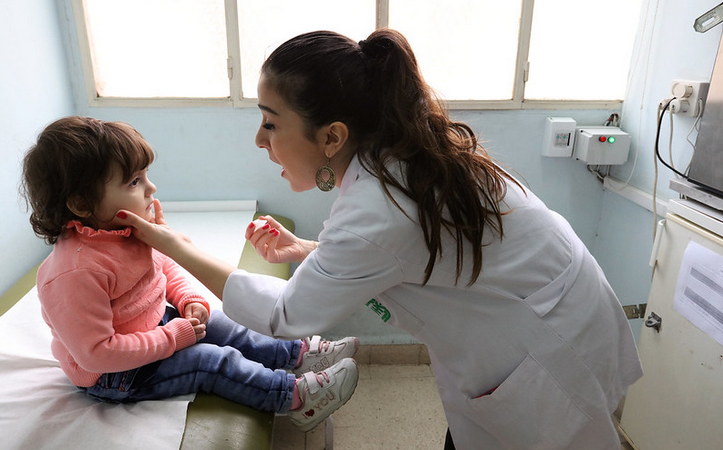
BMJ Global Health 2023;8:e012399. doi:10.1136/bmjgh-2023-012399. Image caption/credit: A registered nurse vaccinates a child for polio at the Howard Karagheusian PHC in Beirut, Lebanon. Photo © Dominic Chavez/World Bank via Flickr (CC BY-NC-ND 2.0 Deed)
- Log in to post comments