










































Report of the 36th Meeting of the Expert Review Committee (ERC) On Polio Eradication & Routine Immunization in Nigeria
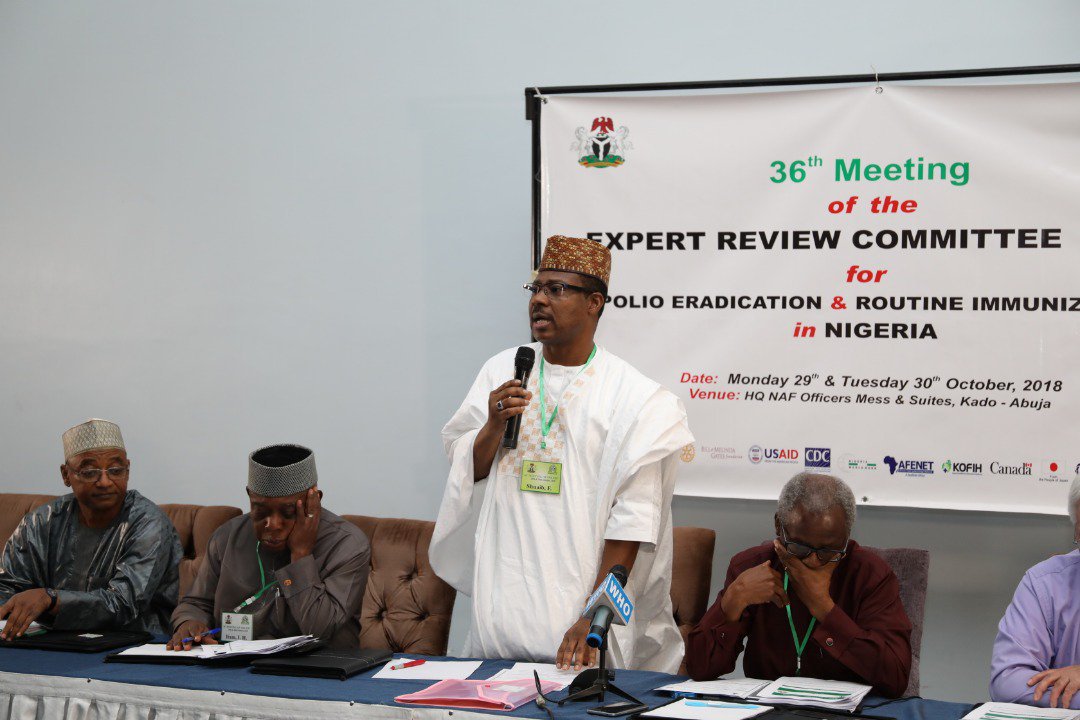
This report summarises the main findings, conclusions, and recommendations of the 36th meeting of the Expert Review Committee (ERC) for Polio Eradication and Routine Immunization (RI), which was convened from October 29-30 2018 in Abuja, Nigeria. The present summary focuses on communication and advocacy elements of the meeting/report.
The context: As of the end of October 2018, Nigeria had gone 25 months without any wild poliovirus (WPV1) case being reported. However, the country had reported 78 positive isolates of vaccine-derived poliovirus type 2 (VDPV2) events, of which 19 were from acute flaccid paralysis (AFP) cases in 7 affected states. The virus has continued to spread within the country and to neighbouring countries, as 6 of the cVDPV2 cases confirmed in Niger Republic are linked to viruses in Jigawa and Katsina states. The ERC stresses that population movement across the Lake Chad Basin countries makes it imperative that Nigeria sustain its collaboration with Niger Republic and other Lake Chad countries for both surveillance and cross-border immunisation activities, with a focus on Nomads.
The document details key developments since the last meeting. For example, some of the communication activities include: High-level advocacy to military high commands has been extended to the Chief of Naval Staff; intensive communication support for Borno State has been offered through automated calls (2 million people/caregivers in Borno reached on polio and routine immunisation, or RI), communication has been enhanced with the aid of information, education, and communication (IEC) materials on polio and RI using military and local informants in inaccessible areas; and community mobilisation structures have been mapped.
The ERC reports that various innovations introduced by the National Emergency Routine Immunization Coordination Centre (NERICC) to rapidly improve RI coverage since July 2017 (e.g., Optimized Integrated Routine Immunization Sessions (OIRIS) to improve outreach sessions; a short message service (SMS) project for real-time data from health facilities; and a community engagement framework) have started yielding results. There is also increased awareness, as daily broadcast of jingles and regular media appearances is ongoing in the states. Social media outputs show increasing reach to respondents, while caregivers' concerns are being addressed real-time via a toll-free line introduced by the National Primary Health Care Development Agency (NPHCDA). Meanwhile, the country has developed a 10-year strategy to sustainably improve immunisation and broader primary health care (PHC) services; this is, in part, a response to emerging refusals due to demand for other felt needs. Known as Nigeria's Strategy for Immunization and PHC System Strengthening (NSIPSS) plan, it is aimed at attaining 84% average national immunisation coverage with all scheduled routine antigens by 2028.
According to the ERC, the engagement of traditional and religious leaders remains critical in resolving non-compliance; 54% of non-compliant cases in the September 2018 outbreak response (OBR) were resolved by traditional leaders. The NPHCDA has sustained high-level advocacy to governors, military chiefs, and traditional leaders for increased access, oversight, and timely release of counterpart funds. Engagement of religious leaders and institutions has been further strengthened with the reactivation of the partnership with Dawa'ah Coordination Council of Nigeria (DCCN), a network of over 40 Islamic organisations. Mapping of community structures has been completed in preparation for the launch of Community Health Influencers, Promoters and Services (CHIPS), which has been kick-started in Nasarawa State.
In addition to ensuring sustained engagement of traditional and religious leaders, the ERC recommends that the National Emergency Operations Centre (EOC) should develop and implement a communication and advocacy strategy to sustain political support for polio eradication and RI during and after the 2019 election period and convene a strategy meeting with partners to respond to communication and media challenges related to the cVDPV2. The ERC would also like to see a detailed transition plan for the Volunteer Community Mobilization (VCM) Network presented to the CHIPS programme by the next ERC meeting.
While there are risks to interrupting poliovirus transmission in Nigeria (e.g., waning political commitment and ownership at the Local Government Area (LGA) level in most states), the ERC concluded that, with the "enormous improvements in surveillance and the increased access to children, the likelihood of undetected transmission of WPV in [Nigeria is] very low."
Click here for the 21-page report in PDF format.
Click here for a 36-slide PowerPoint presentation in PDF format featuring key findings and recommendations.
GPEI website, November 19 2019. Image credit: Nigeria Health Watch via Twitter
- Log in to post comments