










































Quest Atlantis (QA)
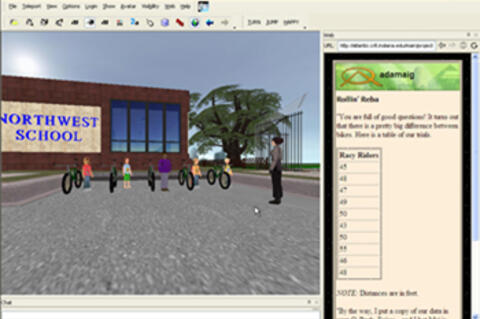
QA provides a virtual learning environment that combines academic concepts and "transformational play" with disciplinary practices, using new technologies in schools in an effort to create socially committed citizens. As organisers explain, "Students who play transformationally become protagonists who use the knowledge, skills, and concepts of the educational content to first make sense of a situation and then make choices that actually transform the play space and the player - they are able to see how that space changed because of their own efforts." QA draws on the playful aspects of games in a quest not only to create awareness about social and environmental issues, but to make the linkages to real-world action - such that children are guided to help their classmates and get involved in the community. Specifically, the QA project fosters an awareness of 7 dimensions in order to actualise them in the lives of children:
- Creative Expression - "I Create"
- Diversity Affirmation - "Everyone Matters"
- Personal Agency - "I Have Voice"
- Social Responsibility - "We Can Make a Difference"
- Environmental Awareness - "Think Globally, Act Locally"
- Healthy Communities - "Live, Love, Grow"
- Compassionate Wisdom - "Be Kind"
The core elements of QA are 1) a 3-D multi-user virtual environment, 2) learning Quests and unit plans, 3) a storyline, presented through an introductory video, novel, and comic book, that involves a mythical Council and a set of social commitments, and 4) a globally distributed community of participants. All of the academic activities are embedded in a secure online gaming context where children take part in the story of Atlantis - a fictional civilization on a faraway planet that is in need of help. At the core of student activity with QA is the completion of Quests. In order to complete these curricular experiences, students are required to participate in simulated and real-world activities such as environmental studies, researching other cultures, interviewing community members, and developing action plans. The Atlantis narrative helps to establish continuity among the QA elements, including weblogs (or "blogs") written by Atlantians, novels, comic books, cards, and various social opportunities. Central to this narrative is a group of young activists, the Council, who communicate with participating children and help support their activities.
The QA website features dedicated sections for each of the following groups: educators, researchers, "Questers", parents, and sponsors. For example, the "Questers" section begins with this introduction: "On Atlantis, water and air are polluted, fish are dying, cities are decaying, people are sick. Your time has come to help by venturing on exciting Quests, searching for answers and sharing your findings with the council. As an active Quester you will become part of an international community of students. Talk to and share your ideas with Questers in Malaysia, Turkey, Australia, Canada, New Zealand, China, and different parts of the United States." QA includes both curricular and optional projects that unfold both online and away from the computer, as children work alone or together to accomplish tasks within the international QA community.
For example, the Taiga Water Quality Unit is an interactive narrative set within an aquatic habitat (Taiga National Park) where a serious ecological problem has resulted in many fish dying. In the unit, students navigate through the virtual park and interact with other players and non-player characters who communicate their perspective on the problem. Students have to consider their conceptual tools (i.e. understanding eutrophication, erosion, and overfishing) in order to make a recommendation about what to do (i.e. stop the indigenous people from farming, tell the loggers they can no longer cut trees in the park, or shut down the game fishing company). After making a recommendation, students travel 20 years forward in game time, and see the results of their recommendations. At that point students are asked to reflect on the implications of their disciplinary recommendations on the context.
The activities of Quest Atlantis take place in registered Centers, typically schools, under the direction of teachers, whom QA supports with: a manual, professional development training, novels and comics for their students, continual monitoring of chat, time-relevant blog entries, and technology support and help in connecting students with other classrooms worldwide. For instance, the online professional development module is designed to facilitate effective integration of the QA curriculum into their classrooms, but it is not prescriptive; rather, it is meant to present a learning opportunity that gives teachers the tools to get the most out of a flexible curriculum.
Education.
Organisers contend that "the structure of many K-12 classrooms limits opportunities for students to engage meaningfully with information, thus positioning students as mere recorders of content rather than critical consumers and producers. Students are too often asked to reproduce procedures rather than leverage procedures to solve new problems because traditional structures of schooling and ideas about learning position textbooks as authorities, and students as recipients of knowledge created by others. Students have opportunities to remember, but not understand; to apply, but not create."
"We view games as particularly well suited to establish 'worlds' in which students can engage and adopt dispositions in response to the game dynamics. If, for example, students work collectively to analyze a water quality problem through using data collected in a virtual park, they also learn to address particular environmental problems by using to data to support claims. We also support teachers to develop dispositions to foster student agency and situational accountability. Such a disposition involves focusing on student thinking as a resource for instructional decisions; monitoring student ideas rather than answers; and supporting student learning relevant to their current activity (just-in-time teaching). Engaging this disposition requires that teachers connect deeply with content and develop pedagogical practices to empower students as independent problem solvers."
"Over the last four years, more than 20,000 children on five continents have participated in the project. We have demonstrated learning gains in science, language arts, and social studies, and students have completed literally thousands of Quests, some of which were assigned by teachers and many of which were chosen by students to complete in their free time. Equally important have been reported personal experiences, with teachers and students reporting increased levels of engagement and interest in pursuing the curricular issues outside of school. Students and teachers conduct rich inquiry-based explorations through which they learn particular standards-based content, and at the same time develop pro-social attitudes regarding significant environmental and social issues. Rather than just placing work and play side-by-side, QA strives to make learning fun and to show kids how they can make a difference."
United Nations Educational, Scientific and Cultural Organization (UNESCO) Asia and Pacific Regional Bureau for Education's "News on ICT in Education", June 24 2009; UNESCO website; and QA website, August 28 2009.
- Log in to post comments