










































Practical and Legal Tools to Protect the Safety of Journalists
"...violations of journalists' rights have immediate effects on their ability to provide information, and consequently on the right to information, which constitutes one of the major counter-powers of democratic regimes."
This set of practical and legal tools has been developed for journalists, media managers, and newsrooms to strengthen responses to online and offline harassment and to protect free and independent media. They were produced with the Thomson Reuters Foundation in partnership with the United Nations Educational, Scientific and Cultural Organization (UNESCO), International Women's Media Foundation (IWMF), and the International News Safety Institute (INSI) as part of the Thomson Reuters Foundation's work to foster a free and prosperous media ecosystem that can play a vital role in supporting democracy and development.
The set of tools is designed to address the increasing threats against journalists. "From impersonation accounts to hateful slurs and death threats, journalists around the world are facing increasing levels of abuse. The consequences are significant, ranging from physical and psychological harm to the individual, to preventing their work and effectively silencing their reporting."
The three tools are as follows (hyperlinked titles take you to the English language version on the Thomson Reuters Foundation website):
Practical Guide for Women Journalists on How to Respond to Online Harassment [PDF] - This guide addresses the challenges experienced by reporters and media workers in a climate where nearly three-quarters of women journalists surveyed say they have experienced online abuse. It details concrete actions women journalists can take both in limiting the risk of certain types of digital attacks and when facing harassment and gender-based violence online. The guide includes information on how to document abuse and potential remedial action.
Click here to access this resource in multiple languages on the UNESCO website.
Checklist and Guidelines on Gender-Sensitive Safety Policies for Newsrooms [PDF] - Developed for editors and media managers, this checklist and set of guidelines provide newsrooms with practice advice for creating a culture of safety in the workplace, both online and offline. It also outlines how to establish a culture within the organisation that tackles sexual harassment and creates a safe environment for journalists to report cases of harassment. Featuring a checklist that summarises the guidelines, it covers a range of measures and mechanisms that can be put in place to ensure that safety policies and practices within newsrooms are gender-sensitive and gender-responsive and that they address gender-based sexual harassment.
Click here to access this resource in multiple languages on the UNESCO website.
Online Attacks Against Journalists: Know Your Rights [PDF] - This guide seeks to provide journalists with concrete legal tools to deal with online harassment: to identify punishable offences, seek help from appropriate organisations, gather evidence efficiently, and take the correct steps should they decide to file a complaint against the perpetrators. It covers the legal rights of journalists across 13 countries, including Australia, Brazil, Finland, France, Germany, India, Ireland, Japan, Kenya, the Netherlands, Sweden, the United Kingdom, and the United States. Where applicable, it also presents examples of litigation initiated by journalists who were victims of online harassment.
Publishers
English, Arabic, Chinese, French, Italian, Russian, Spanish (Online Attacks Against Journalists: Know Your Rights is in English only.)
11 pages (Practical Guide for Women Journalists on How to Respond to Online Harassment); 10 pages (Checklist and Guidelines on Gender-Sensitive Safety Policies for Newsrooms); 75 pages (Online Attacks Against Journalists: Know Your Rights)
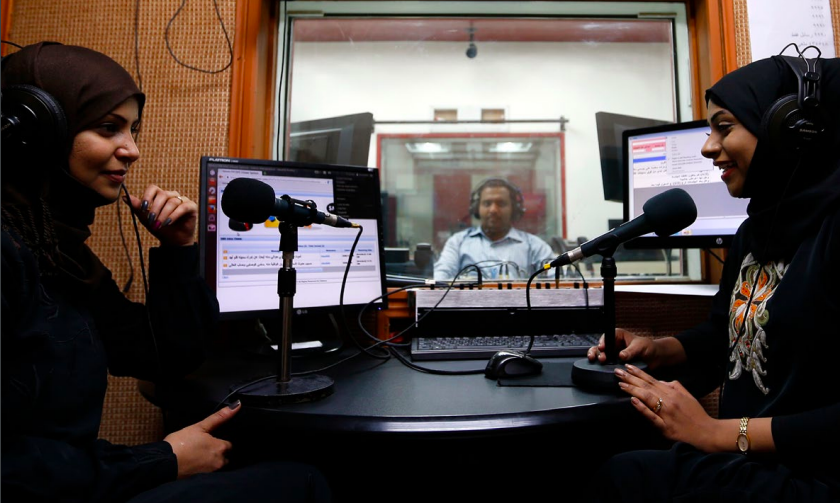
Thomson Reuters Foundation website on February 22 2022. Image credit: REUTERS/Khaled Abdullah
- Log in to post comments