











































Positioning Women's Land Rights in the Context of Right to Land
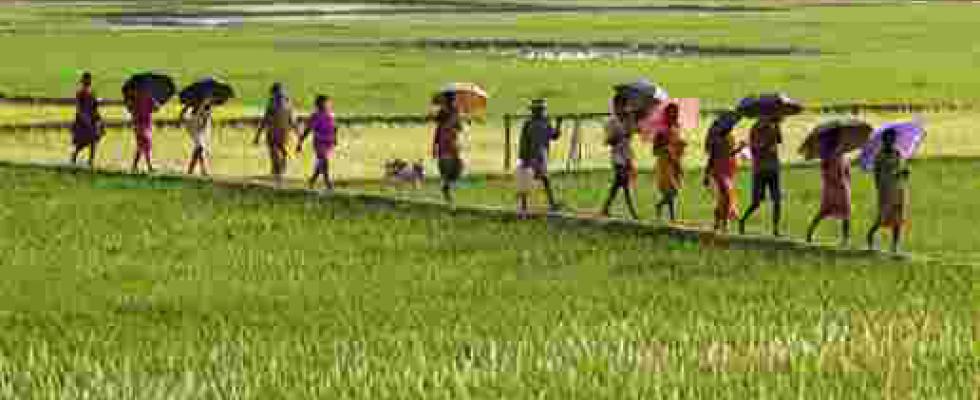
Author: Ranjani K. Murthy, July 1 2014 - Sex-disaggregated data on ownership of agricultural land is scarce. The Food and Agriculture Organization [FAO] provides data on share of women amongst agriculture holders, defined as those who exercise decisions and manage agricultural operations (FAO, 2011). This data, available for a limited number of countries, suggests that the share of women amongst agricultural holders ranges between 0.8% (Saudi Arabia) and 50.5% (Cape Verde) - most recent observation at the time of finalising the report. A majority of countries for which data was available record a figure of less than 25% as share of women amongst agriculture holders (FAO, 2011). The data on legal ownership of land is likely to be even lower, as, with the migration of men, women manage the farm which their husbands own. UN Women has rightly placed women’s ownership of land and resources as post 2015 development agenda (UN Women, 2013).
However can women’s right to land be achieved without the right of rural landless to land, and preventing land grab? Rural landlessness was always a concern in several Asian countries, wherein land distribution has been skewed across caste, religion and ethnicity. Land reform programmes which were conceived post-independence in countries like India to address skewed land distribution have rarely been implemented due to resistance from powerful groups. It is not just traditional hierarchies that have come in the way. In transition countries like Vietnam and Moldova, benefits of land distributed post-reform did not reach the younger generation. With globalisation, agriculture land is being acquired by governments for Special Economic Zones, bio-fuel production, tourism, real estate development and establishment of private education & health institution (Qinglian, 2012). Agriculture land available for rural landless households is declining. Right to land does not exist in most countries. Thus, it is difficult to further women’s land rights when agriculture land is declining and right to land does not exist in countries.
What can be done to further right to land and women’s land rights?
- Every landless rural household should be entitled to a minimum amount of land on women’s names or joint names based on the availability of cultivable land in that country. If necessary a General Recommendation could be made as part of the International Covenant on Economic and Social and Cultural Rights. National legislation on right to land may be formulated.
- Food sovereignty and food security has to be prioritised along with the right to land. Every country should commit not to acquire agriculture land for other purposes beyond what is required for household food/nutrition security and food sovereignty. There should be a ban on acquiring land belonging to women and marginalised groups. Legislation and policies in this regard need to be evolved.
- Legislation on land ceiling may be strictly implemented and land transferred to landless and marginalised groups on women’s or joint names. Excessive/vacant land owned by industries, religious bodies and Trusts should be acquired by the government and distributed on women’s or joint names. Alternatively, land could be given to collectives of women farmers.
- Make use of opportunities like computerisation of land records, transfer of land titles or issuing of land pass book to record women as co-owners or owners.
- Ensure equal inheritance rights of women to self-acquired and ancestral agriculture land, as well as evolve a legislation or policy that land on women’s names or women farmers collectives’ names can only pass on to women/next generation of women farmer’s group.
- Ensure support services that women need to engage in agriculture like access to credit, extension, seed banks, service centers, storage services, value addition, marketing, leadership in cooperatives/farmer’s collectives etc (IFAD, 2012).
- Engender institutional structures like government’s land-reform department, revenue department, agriculture department, civil courts etc.
- PLACE RIGHT OF RURAL PEOPLE TO LAND AND ON WOMEN’S NAMES/JOINT NAMES/ COLLECTIVE’S NAMES IN THE POST 2015 DEVELOPMENT AGENDA
Acknowledgements
I would like to acknowledge inputs from Tamil Nadu Dalit Women’s Movement, Tamil Nadu Women’s Collective, Law Trust for Women, Guide, and Director and board members of EKTA. They bear no responsibility for any shortcomings of this blog.
Image credit: Garavi Gujarat Business (GG2.net) website
Reference
Food and Agriculture Organization (FAO). 2011. The State of Food and Agriculture 2010-11,
Women in Agriculture: Closing the Gender Gap for Development, FAO, Rome p. 25.
International Fund for Agriculture Development, 2012, Gender Equality and Women’s Empowerment-Policy, IFAD, Rome.
Qinglian, He, 2012, China’s Over 100 Million Landless Peasants, Epoch Times, May 25, 2012.
UN Women, 2013, A Transformative Stand-Alone Goal On Achieving Gender Equality, Women’s Rights And Women’s Empowerment: Imperatives And Key Components.
- Log in to post comments