










































Network Capacity Analysis - Workshop Facilitation Guide: A Toolkit for Assessing and Building Capacities for High Quality Responses to HIV
The International HIV/AIDS Alliance (the Alliance) works with its civil society partners to ensure that they have the skills and strategies needed to make effective contributions to national HIV efforts as implementers and supporters of community-based action. This toolkit is part of a series designed to build the organisational, technical, and policy capacity of civil society organisations (CSOs) to plan and deliver high-quality responses to HIV.
The toolkit - which is one part of a 2-part set (please see "Related Summaries" below to access the other) - can be used by networks to help identify their capacity- building needs, plan technical support interventions, and monitor and evaluate the impact of capacity-building. It provides a structured approach to generating both quantitative and qualitative information about the situation of the organisation at the time of analysis. The resulting outcomes can also be used to track progress when developing capacity.
The toolkit emphasises the value of a variety of factors contributing to capacity, identifying six key areas that are particularly important to civil society networks engaged in HIV programming and policy work: involvement and accountability; leadership; knowledge and skills; internal communication; advocacy, policy, and external communication; and management and finance. Each area of capacity as explored in the toolkit begins with an open-ended question, followed by more detailed questions. Participants are asked to give their network a score based on the listed indicators. At the end of each area of capacity there are two discussion questions to help the network plan improvements in any weak areas and find out what resources are needed.
The workshop facilitation guide can be used to structure, deliver, and report on a two- to three-day workshop. Designed for use by both new and established networks, the guide requires facilitation by either an internal staff member or an external facilitator. A cross-section of staff from within the network are guided in working through group exercises and then scoring each capacity area. Specifically, the toolkit's sections include:
- Defining the purpose of the capacity analysis.
- Planning the capacity analysis workshop ("Staff and stakeholders should be involved in an initial meeting to clarify why capacity is being analysed, how the analysis will be done and how the results will be used.")
- Developing a profile - A profile template suggests key information that may be collected.
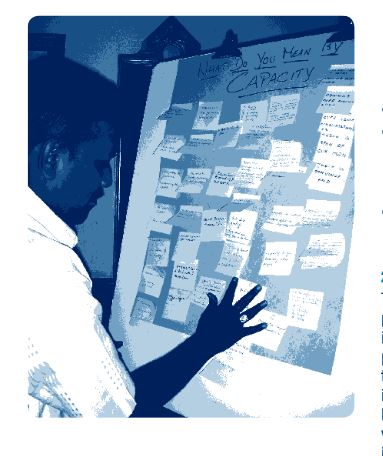
- Workshop sessions - Each session involves a discussion-based activity, followed by a group scoring exercise. Each area of capacity has an associated set of indicators that participants use to rate their own organisation's capacities.
- External review - This section provides 13 sets of indicators designed for scoring by a variety of organisations - for example, non-governmental organisation (NGO)/community-based organisation (CBO) members, other networks, and donors or organisations providing support to the network.
- Document review - An analysis of network documentation can provide objective evidence with which to verify discussion-based results. This section provides a template for reviewing the completeness and quality of relevant supporting documents.
- Capacities report - The report template aims to capture the discussion and findings about the network gleaned through the analysis process. It could be used to provide a baseline for evaluating future capacity development, to inform prospective donors, and/or as an internal reference for the future.
The toolkit was field-tested with the Asia Pacific Network of People Living with HIV/AIDS (APN+) in Thailand and the Indian Network of People Living with HIV/AIDS (INP+) in India, and the Association of Female Sex Workers of Argentina (AMMAR) in Argentina.
26
International HIV/AIDS Alliance (the Alliance) website, April 2 2009 and September 4 2014.
- Log in to post comments