










































Nepal Hygiene Improvement Project (NHIP)
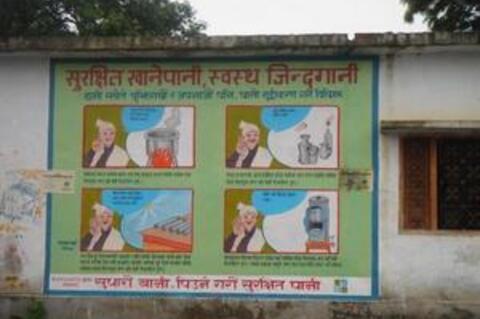
Following research indicating that the prevailing public perception was that if the water looked clear, it was safe to drink, NHIP worked in Panchthar, Parsa, Kapilvastu, and Dang districts to correct this misconception by increasing public awareness of the benefits of 2 practices: improved storage and treatment of drinking water and handwashing with soap. Through interpersonal and extensive mass media promotion, NHIP aimed also to increase access to and improve the affordability and quality of household water treatment products and create demand for these products.
Using an approach that started at the district pilot level with the goal of expanding to the national level, the project engaged in the following 4 strategies:
- Capacity Building: NHIP trained thousands of frontline community workers and volunteers, health personnel, school staff, retailers, and journalists to reach 500,000 households and increase their awareness of safe water treatment options and the importance of handwashing with soap. Specifically, the project trained master trainers who in turn trained 4,000 female community-level frontline workers/promoters in the project districts and the staff and children's clubs in 200 schools. An additional 5,500 frontline workers in flood-prone areas received this training. At the community/village level, trained promoters visited 1,000 households per Village Development Committee (VDC) to educate households on handwashing and safe water practices. This information was reinforced through community programmes and demonstrations - street dramas, cultural programmes at local fairs, local clubs/community-based organisation programmes, and at school clubs. Orientation was also provided to national, regional, and district-level government, non-governmental organisations (NGOs), and stakeholders such as water and sanitation implementation institutions/organisations to ensure their involvement, enable them to conduct their own trainings and orient their communities, and lay the groundwork for further scale-up. The district Water Supply and Sanitation Sub-Divisional Office (WSSSDO) conducted orientation meetings for health post staff, retailers, and journalists, which focused on strategies for disseminating key handwashing and water treatment messages. Health post training focused on preventative actions for diarrhoea control; retailer training highlighted the distribution network of various point-of-use (POU) options and marketing plans; and journalists were familiarised with POU interventions and given general information on the health benefits and availability of products in the districts.
- Mass Promotion and Media Campaign: Fact sheets summarising each of 4 water treatment technologies (locally produced sodium hypochlorite solution (Piyush and WaterGuard), improved boiling, solar disinfection (SODIS), and filters, especially colloidal silver (CS) filters) were developed for policy-level officials and decision makers. Materials to help frontline workers conduct training, orientation, and awareness-building within their communities were more in-depth and included a technical manual and flipcharts. Frontline workers distributed posters, calendars, brochures, and stickers to households as part of the door-to-door village level promotional campaign. An interactive children's book describing the importance of water and sanitation and key actions to take was developed. Designed to balance ethnic and geographic consciousness, the materials were reviewed by a task force of key water and sanitation stakeholders and pretested for clarity and understanding. Radio and television spots with messages of safe water and handwashing practices were produced in Nepali for a national audience and in the 4 major regional languages of the NHIP-focused districts. Village-level promotion included street dramas that reached an estimated 70,000 villagers, and trained staff from 20 local NGOs reached approximately 180,000 households through door-to-door promotion activities.
- Product Availability: The project collaborated with the various producers to improve supply and create demand, providing different types of support depending on what was needed. For instance, in the case of the CS filters, local manufacturers learned how to make filters leak-proof, more effective at removing bacteria, and less prone to breaking. With sustainability in mind, no direct monetary support was given to producers; instead a comprehensive package of support services was provided to promote products.
- Advocacy and Scaling Up: Nepal established a National Water Quality Steering Committee to formalise its commitment to addressing nationwide water quality shortcomings. Nepal's Epidemiology and Disease Control Division (EDCD) promotes these approaches to control the outbreak of disease in humanitarian disaster situations; UNICEF will include them in its School Sanitation Hygiene Education program, which will cover 23 districts; and organisations like UN-Habitat, Environment and Public Health Organization (ENPHO), Nepal Family Health Program, Rural Water Supply and Sanitation Fund Development Board, and the Coca-Cola Company are all working to raise awareness of these approaches to hygiene improvement. Humanitarian organisations such as the Red Cross and Rotary International are using NHIP project materials for mass promotion and awareness-raising during cholera outbreaks.
Also, because students have tremendous potential to be effective change agents, schools were viewed as an ideal place to expand POU promotion and installation activities. NHIP began its schools project by researching the effectiveness of high yield water treatment methods and mechanisms for maintaining treatment systems in the school environment. Schools were assisted in conducting assessments of water availability, water quality, the school environment, technology choices, and proposed financial arrangements before identifying the best POU option for the school. The team then provided students and teachers at all 200 schools with an orientation on safe water issues and handwashing, and children's clubs and school management committees were put in charge of day-to-day operations and monitoring of their school's water treatment technologies.
Children, Sanitation.
Central Bureau of Statistics indicate that household access to water supply in Nepal increased from 37% in 1990 to 82% in 2001. Despite this, USAID clarifies, water treatment at the household level is rarely practiced, and little progress has been made in hygiene and sanitation. Consequentially, the incidence of diarrhoea in the country is high. According to 2001 Nepal Demographic and Health Survey data, approximately 2,200 children under the age of 5 die each year from this preventable disease.
The HIP is a 5-year (2004-2009) project funded by the USAID Bureau for Global Health, Office of Health, Infectious Diseases and Nutrition, led by the Academy for Educational Development in partnership with ARD, Inc., the Manoff Group, and the IRC International Water and Sanitation Centre based in the Netherlands. HIP aims to reduce diarrhoeal disease prevalence and improve child survival through sustainable improvements in 3 key hygiene behaviours: hand washing with soap, safe faeces disposal, and safe storage and treatment of drinking water at the household level.
The Government of Nepal through the Department of Water Supply and Sewerage and UNICEF served as the implementing bodies of this public-private sector effort, while USAID/HIP provided technical assistance.
- Log in to post comments