











































Monitoring Guide and Toolkit for Key Population HIV Prevention, Care, and Treatment Programs
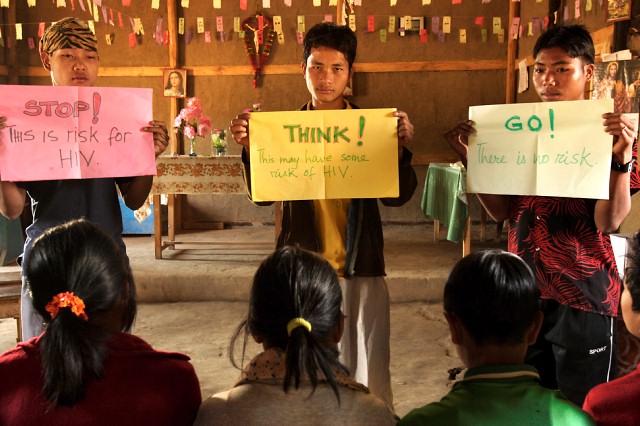
"A data-use culture allows peer outreach workers from key populations to assume a stronger role in the program and decide how to improve their daily outreach efforts based on data they collect."
This publication from FHI 360 provides guidance to governments, civil society organisations (non-governmental organisations (NGOs) and community-based organisations), and other partners implementing HIV prevention, care, and treatment programmes with key populations. These are population groups disproportionately affected by HIV, often because of punitive laws, regulations, and policies, and because they are stigmatised and marginalised. This includes men who have sex with men (MSM), transgender persons (TGs), sex workers (SWs), and people who inject drugs (PWID). The guide is designed to assist programmes seeking to reach such populations in the development of monitoring systems for frontline workers (such as peer outreach workers, staff outreach supervisors, and programme managers) to understand performance. It contains examples of tools and forms from around the world that may support efforts in monitoring programmes and services, and describes issues that should be considered when using these tools.
The rationale for the guide is that monitoring systems must tell managers in real time the specific individuals in the site they need to reach with which services, and at a higher level give partners a picture of which sites are performing well, which are not, and which factors are contributing to poor or good performance. To that end, the guide supports several basic strategies for effective prevention, treatment, and care interventions for key populations:
- Understanding the epidemic: knowing where and how many key population members to reach;
- Programme design: establishing programme infrastructure, capacity, and personnel;
- Peer-driven prevention, care, and treatment cascade: conducting intensive peer-based outreach and regular contact including effective registration, tracking, and referral processes;
- Efficient and high-quality services: providing high-quality sexually transmitted infection (STI) and HIV testing and treatment, and other health services; and
- Community mobilisation and participation, and creating an enabling environment: providing and supporting community- and facility-based services that will empower community members to make healthier decisions about condom use and health-seeking behaviours.
These strategies underpin the programme indicators that support the cascade of HIV testing, antiretroviral therapy (ART), and viral suppression for achieving the Joint United Nations Programme on HIV/AIDS (UNAIDS) goal of 90-90-90 by 2020 (90% of all people living with HIV will know their HIV status; 90% of all people with diagnosed HIV infection will receive sustained ART; and 90% of all people receiving ART will have viral suppression).
Key features of this guide include:
- "Carefully tailored monitoring tools" to collect data at the grassroots level so that the data can be used for prompt programme course correction at the site level and to track trends, gaps, and bottlenecks across a programme at the sub-national level, which can be aggregated and used for higher analysis at the national level.
- "Simple analytic tools" that show site statistics on various services provided to key population members, with a focus on behavioural, biomedical, and structural interventions.
- Dashboards and techniques built into tools that are designed to help programme teams to routinely see progress against targets in terms of coverage, scale-up, different components of the cascade, and the quality of clinical and outreach services.
- A programme-wide, team approach to data use for decision-making, data collection, data analysis, and action-oriented programme planning processes. The team approach means that data use is designed and implemented with the full engagement of key population communities and staff who manage outreach, clinical services, and commodities.
English, French
154 (English); 160 (French)
FHI 360 website, May 5 2017. Image credit: FHI 360
- Log in to post comments