











































Time to read
less than1 minute
Mentor-Facilitated Life Skills Programming - Greater Odds of Believing in Delaying Marriage and Child-Rearing
Strategy researched
Mentor-facilitated life skills programming, with some also providing caregiver sessions
Impact achieved
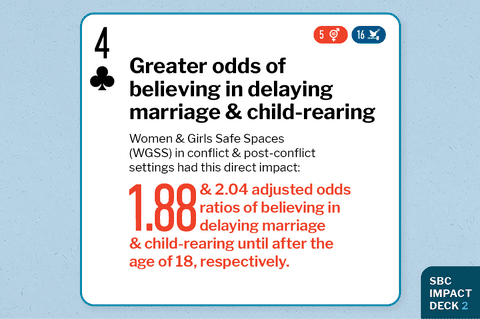
3 evaluations demonstrated moderate improvements in psychosocial well-being, social support, and attitudes toward rites of passage. For instance, safe space participants in one study exhibited greater odds of believing in delaying marriage and child-rearing until after the age of 18 (adjusted odds ratio [aORs] of 1.88 and 2.04, respectively). Girls who participated reported one additional year for the highest grade of school a participant believes should be completed versus those who did not participate. Among those married or living with someone as if married, girls in the treatment arm were 43% less likely to be married at the end of the programme compared to those in the control arm.
Country of study
Democratic Republic of the Congo, Ethiopia, Uganda, Tanzania, Kenya, Bangladesh, and Pakistan
Research methodology
Systematic review with 7 studies (2 of them cluster RCTs)
Journal
Trauma, Violence, & Abuse; 2021
Journal paper title and link
The Effectiveness of Women and Girls Safe Spaces: A Systematic Review of Evidence to Address Violence Against Women and Girls in Humanitarian Contexts
Excerpt from Abstract
"In conflict and postconflict settings, the incidence of violence against women and girls (VAWG) is exacerbated, resulting in increased negative social, economic, health, and psychosocial effects. In an attempt to prevent and respond to the occurrence of VAWG in humanitarian settings, Women and Girls Safe Spaces (WGSS) have been promoted as a promising intervention....While none of the studies reported reductions in exposure to or incidence of VAWG among program participants, three evaluations demonstrated moderate improvements in psychosocial well-being, social support, and attitudes toward rites of passage."
Mentor-facilitated life skills programming, with some also providing caregiver sessions
Impact achieved
3 evaluations demonstrated moderate improvements in psychosocial well-being, social support, and attitudes toward rites of passage. For instance, safe space participants in one study exhibited greater odds of believing in delaying marriage and child-rearing until after the age of 18 (adjusted odds ratio [aORs] of 1.88 and 2.04, respectively). Girls who participated reported one additional year for the highest grade of school a participant believes should be completed versus those who did not participate. Among those married or living with someone as if married, girls in the treatment arm were 43% less likely to be married at the end of the programme compared to those in the control arm.
Country of study
Democratic Republic of the Congo, Ethiopia, Uganda, Tanzania, Kenya, Bangladesh, and Pakistan
Research methodology
Systematic review with 7 studies (2 of them cluster RCTs)
Journal
Trauma, Violence, & Abuse; 2021
Journal paper title and link
The Effectiveness of Women and Girls Safe Spaces: A Systematic Review of Evidence to Address Violence Against Women and Girls in Humanitarian Contexts
Excerpt from Abstract
"In conflict and postconflict settings, the incidence of violence against women and girls (VAWG) is exacerbated, resulting in increased negative social, economic, health, and psychosocial effects. In an attempt to prevent and respond to the occurrence of VAWG in humanitarian settings, Women and Girls Safe Spaces (WGSS) have been promoted as a promising intervention....While none of the studies reported reductions in exposure to or incidence of VAWG among program participants, three evaluations demonstrated moderate improvements in psychosocial well-being, social support, and attitudes toward rites of passage."