










































Media Campaigns for Child Rights: Can we extend the "slum dog millionaire" beyond "Salaam Bombay" outcomes?
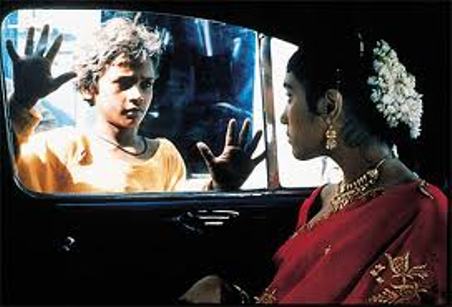
The media portrayal of poverty in the slums of Bombay and the surrounding red-light districts (a euphemism for illegal prostitution and sexual slavery) was brilliantly conveyed in the two movies- Slum Dog Millionaire and Salaam Bombay (released 10-15 years ago). Particularly the former probably did more in a matter of months to direct public focus to childhoods spent in urban poverty than the long years of work and money spent by UNICEF in media campaigns.
The success was, of course, in a large measure due to the throbbing realism behind it. The children were really part of the deprived, desperate, and heart-breaking context; it was not sophisticated acting and direction alone, it was the realization of people that this was our world and we contributed to making it so sad. The global recognition came in the form of awards from all possible sources for the directors and producers.
For the children who were actors in the movies - both movies - established trusts, one in Mumbai called the Salam Balak (child) and the other for the Slum Children. The first one excluded the main actor as he was 14 and the other one is still figuring out if the children get a home or two homes, while they continue to live in the same humble circumstances. I have not read anything from the government about education and schooling, nor admissions to any of the many higher education institutes in the country.
Regardless, people whose main job is to make movies do us a courtesy in the field of social development when they chose topics that are able to highlight urban poverty and its most vulnerable victims, the children in poor families, encompassing most of Millennium Development Goals.
The things that were really MIA were the follow ups from those around them. While a Ms. Universe is able to raise a whole lot of interest in social issues, these kids in the limelight, Azhar Ismail and Rubina Ali and Shafiq Sayyed, were not part of any anti-poverty media campaign and did not become the face of any health or urban sanitation. This is primarily because unlike the movies, which must connect with public to make their work successful, the media campaign of the development agencies continues to follow some dated motto and models. In synthetic environments, full of jargon from global development, with very little local context, the media campaigns are as contrived as they are confusing.
The government that announces scheme after scheme of child development, named after some political ambition or the other, is not able to facilitate a scheme driven by these children and their personalized expressions and experiences of poverty. The need of the hour is a media that facilitates the connection between mainstream realism and maintains its continued presence in the public conscious. Unfortunately, the global conception of what is successful media remains static in our field. And the social conscious of mainstream media has its own limitations: it lasts until the last award for good movie making!
For more background on this blog, click here.
Shweta does research on women and children and works in Loyola University Chicago. She is also the primary editor of the Zine Ewomen Indian Subcontinent.
Comments

Ready, Fire, Aim!
While I agree with much of the above, I think the real issues at heart are those of intent, and content, which often seem to be misunderstood or simply ignored in development communications materials.
The first, intent, speaks to development organizations, and thus their communications staff, not truly internalizing exactly what their communications programmes (and so dollars) are supposed to be achieving at a practical level. Rather than really looking at useful ways to target their communications, it seems a great deal of emphasis exists on using 'sexy' communications channels, TV, Facebook/social media, etc. And while TV, FB or any internet programming is very contemporary and appealing to current Western fashion, it is absolutely useless for targeting most developing country audiences such as the rural poor.
The second issue at hand, content, speaks to how dev orgs. communication intent is focused. Again, dev orgs seem to often confuse the donor audiences with beneficiary audiences, vice versa, or just seem to want to fire off public awareness/social interest messages with little internal understanding (and so commitment) to their issue at hand.
Frankly, it often 'feels' like dev org comm staff are doing what they most likely are doing, spending their budgets as quickly as possible in order to have something to bring to their next donor meeting. And as tobacco, fast food and soft drink companies will tell you, 'ready, fire, aim' communications are literally throwing money at the issue, and out the door...
Follow the rules
I agree with the article completely regarding the outmoded techniques employed for developmental marketing. In creating a film the first rule of order is to help the audience to connect to the main character/s. They must feel what they feel and care about what happens to the character. Many of the techniques for good screenwriting could easily be applied to developmental marketing with similar results to what Slumdog Millionaire and Salaam Bombay produced.
Sometimes the realm of academia gets so caught up in its own vernacular (and dare I say ego), that its first rule of order is how they are going to sound to their peers. Most newspapers are written to an eighth grade level. We must connect to our (donating) audience on a gut level. A 'what if this were your child?" level of feeling. The way to their wallet (I do mean this altruistically) is through their hearts. Drop the developmental nomenclature and talk about real people, real feelings, real suffering, and real solutions.
outcomes
As far as the essence of communication is concerned, this is true. Donors aside, if we're looking to engage the public and create an environment that supports development efforts in a variety of ways, the message does need to be couched in terms that people can understand and relate to.
At the same time, if the media really does aim to support intelligent development then there does need to be some kind of strategy involved. People might need to be provided with some sort of channels for their philanthropy, so that their generosity might have...in horrible development-speak...effective outcomes.
Vox Populi
I really enjoyed reading these comments and have some thoughts: in most Western countries, established media are in business to make money. What gets covered is governed by what media houses, through their own ideologies, define as newsworthy and 'in the public interest'.
Here in South Africa, we are seeing glimpses of media engagement with public issues which goes beyond audience ratings (although of course that helps). One radio station in Gauteng, the richest, most populous province is Radio 702 with a diverse but largely middle-aged and older audience which has successfully challenged government to introduce road safety measures for a community living on the edge of a very busy, poorly maintained road which experienced high levels of traffic fatalities. It also organised a march to promote the rights of women to wear what they want without being violated (particularly aimed at taxi drivers), and spearheaded a national movement called 'Lead South Africa' which advocates that every man, woman and child can be a leader by taking simple steps (eg. to pick up rubbish) to make the country a better place. This is an emerging ethos, and debatable as to whether it is cresting the popular trend wave, or is actually doing this because it is perceived as 'the right thing to do'.
The bottom line of all this is that Radio 702 has found it makes good business sense to engage with its listeners at their level, doing things that resonate with communities. Facebook, blogs and twitter are revolutionising the media which enable ordinary people to claim their own space and have their voices heard. I delight in seeing the emergence of this 'bottom-up' approach seriously challenging the status quo of dominant media paradigms through 'the voice of the people'.
Greer
- Log in to post comments