











































Making Sense of 'Intersectionality': A Manual for Lovers of People and Forests
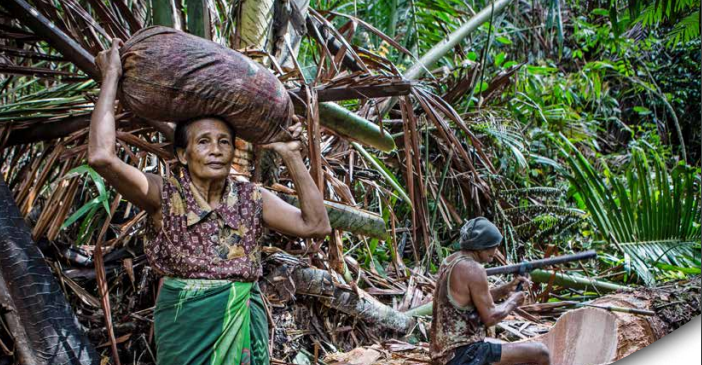
"We hope that the contents will facilitate more effective incorporation of the voices of the multiply marginalized in forest management and forest research, and in forest-related policymaking and other interventions."
Intersectionality describes the influences of multiple identities in a person as these interact with marginalising and empowering structures, norms, and narratives. This Center for International Forestry Research (CIFOR) manual aims to introduce this concept to researchers working on forestry and agroforestry who are unfamiliar with it, and to provide tips and strategies for applying it in their own work. Practitioners and policymakers who are concerned with using evidence to inform gender-inclusive programmes and policies may also find this manual useful.
The manual has been prompted by several factors, such as a felt need to address the power relations and institutional structures that (i) inhibit certain women's (and others') ability to lead productive and satisfying lives and (ii) on a broader scale, often interfere with good and equitable forest management.
The manual provides a brief and accessible overview of the major approaches and debates surrounding intersectionality in gender studies. It uses several mechanisms to encourage more explicit recognition of the concept: a review of key intersectionality literature; the identification of 5 complementary and interconnected lenses (cognitive, emotional, social, economic, and political) through which intersectionality can be viewed; and suggestions for useful steps in conducting an intersectional analysis. Throughout, the authors point to the value of being attentive to questions of "positionality" and "reflexivity" in research and of supporting marginalised individuals and communities to bring about socially inclusive change.
Ethnographic boxes provide examples of the functioning of intersectionality in a variety of contexts: from small villages to an international research centre. To cite one: "Sijapati's (2008, 2011) study on community forestry gender dynamics in Nepal found that even women from Tamang communities - with fairly egalitarian norms and high interactive participation of women in forest-related decisionmaking structures - relied on men to act as intermediaries between themselves and forest officials. The women viewed their spaces as confined to the local scale; they did not think they had the experience needed to reach out to extra-local actors such as forest officials, nor did they feel confident to relate to the highly technical discursive space forest officials occupied."
Part IV suggests 6 steps for researchers interested in conducting an intersectional analysis:
- Understanding how the local system works;
- Identifying who the marginalised really are at the time of research/action and what institutions contribute to sustaining that marginalisation;
- Estimating the level/significance of discrimination for individuals with multiple marginalising identities;
- Analysing how the institutions, norms, and narratives function to sustain inequitable systems;
- Strengthening collaboration within and among community members to reduce adverse impacts on multiply marginalised individuals ("The most straightforward and multi-purpose way to approach intersectionality in the forest - with a concern for social justice - will be through collaborative approaches in forest communities. Such approaches allow for regular interaction between formal forest managers and the multiply marginalized"); and
- Changing policies and inequitable systems.
The concluding section of the manual notes that "Intersectional analysis is a means by which women and others - in all their variety - can be more effectively and equitably integrated into thinking and action in the world's forests."
52
Email from Carol J. Pierce Colfer to The Communication Initiative on June 6 2018.
- Log in to post comments