










































Re-designing Sexuality Education in Thailand with Youth as Designers
Summary:
DSIL Global and UNICEF wanted to understand better how sexuality education is working in Thailand by evaluating the Thai youth's understanding of what they have learned so far. We were sure if we gave youth an opportunity to be listened to while learning about the process of innovation, they would then channel their experiences into actionable steps and design new solutions that could help us learn together. They did that and more that we never expected that is continuing even a year after the project has ended. Click here to read a related report.
Background/Objectives:
Objectives: Engage with adolescent girls and boys on digital health and sexuality education and sexuality intervention opportunities: 1. Meaningfully involve Thai youth from a variety of backgrounds. 2. Better understand, from a young persons perspective, what gaps exist in sexuality education, and what initiatives they find compelling or would like to create. 3. Support a youth cohort in Thailand to have agency and skills to engage, through human-centered design processes, with whatever challenges may emerge in their youth community. 4. Build a project that brought youth participation to youth partnership.
Description of Intervention and/or Methods/Design:
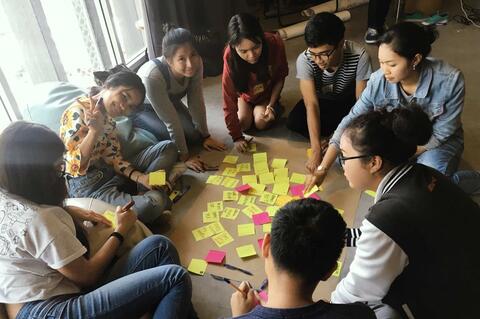
We used an inclusive human-centered design methodology that held the process and the relationships built between players as a deliverable that was as valuable in the technical data that came from it. The project led our organizations to find innovations that gave youth both awareness and agency in their sexual health. Finally, this project brought youth participation to next-level youth partnership. Youth were trained, coached, and paid the same as the professional designers in the field and worked as equals in the field. We held four main principles during this process, which underpinned the richness of the results; listening, sustainability: inclusion, agency, culture as our roots, and that foundation led to success.
Results/Lessons Learned:
When you start a process that seeks to listen first without questions to guide answers- the insights are always surprising. Some of our surprising insights were: Around 82% felt current models are not effective 87% feel their teachers do not have the capacity or interest to teach sexuality education The most significant gap in the existing education model was being unable to have these discussions about sexuality and gender with their parents and others they trust. Youth participants stated that the most significant focus for them was to learn why their parents would not open up to them about relationships, sex, and sexuality. 70% of youth didn't want to learn about sex and sexuality online; this was not true for LGBTQ youth.
Discussion/Implications for the Field:
UNICEF and DSIL Global put forth this cross-sector collaboration to develop a richer understanding while building skills + tech solutions for sexuality interventions in Thailand. What we continue to discover in this work is what must be in play during and HCD process so that what is alive for the youth can emerge. HCD can be used to pull data in non-exploitative ways while teaching skills that youth AND organizations can use well beyond the project. The youth are continuing to surprise us with the powerful ways they are taking the skills forward to create change without us.
Abstract submitted by:
Katy Grennier - DSIL Global
Gareth Durrant - DSIL Global
DSIL Global and UNICEF wanted to understand better how sexuality education is working in Thailand by evaluating the Thai youth's understanding of what they have learned so far. We were sure if we gave youth an opportunity to be listened to while learning about the process of innovation, they would then channel their experiences into actionable steps and design new solutions that could help us learn together. They did that and more that we never expected that is continuing even a year after the project has ended. Click here to read a related report.
Background/Objectives:
Objectives: Engage with adolescent girls and boys on digital health and sexuality education and sexuality intervention opportunities: 1. Meaningfully involve Thai youth from a variety of backgrounds. 2. Better understand, from a young persons perspective, what gaps exist in sexuality education, and what initiatives they find compelling or would like to create. 3. Support a youth cohort in Thailand to have agency and skills to engage, through human-centered design processes, with whatever challenges may emerge in their youth community. 4. Build a project that brought youth participation to youth partnership.
Description of Intervention and/or Methods/Design:
We used an inclusive human-centered design methodology that held the process and the relationships built between players as a deliverable that was as valuable in the technical data that came from it. The project led our organizations to find innovations that gave youth both awareness and agency in their sexual health. Finally, this project brought youth participation to next-level youth partnership. Youth were trained, coached, and paid the same as the professional designers in the field and worked as equals in the field. We held four main principles during this process, which underpinned the richness of the results; listening, sustainability: inclusion, agency, culture as our roots, and that foundation led to success.
Results/Lessons Learned:
When you start a process that seeks to listen first without questions to guide answers- the insights are always surprising. Some of our surprising insights were: Around 82% felt current models are not effective 87% feel their teachers do not have the capacity or interest to teach sexuality education The most significant gap in the existing education model was being unable to have these discussions about sexuality and gender with their parents and others they trust. Youth participants stated that the most significant focus for them was to learn why their parents would not open up to them about relationships, sex, and sexuality. 70% of youth didn't want to learn about sex and sexuality online; this was not true for LGBTQ youth.
Discussion/Implications for the Field:
UNICEF and DSIL Global put forth this cross-sector collaboration to develop a richer understanding while building skills + tech solutions for sexuality interventions in Thailand. What we continue to discover in this work is what must be in play during and HCD process so that what is alive for the youth can emerge. HCD can be used to pull data in non-exploitative ways while teaching skills that youth AND organizations can use well beyond the project. The youth are continuing to surprise us with the powerful ways they are taking the skills forward to create change without us.
Abstract submitted by:
Katy Grennier - DSIL Global
Gareth Durrant - DSIL Global
Source
Approved abstract for the postponed 2020 SBCC Summit in Marrakech, Morocco. Provided by the International Steering Committee for the Summit. Image credit: Rethinking Sex-Ed Thailand