










































Interreligious Action for Peace: Studies in Muslim-Christian Cooperation
"In development and humanitarian action, it is now widely accepted - including among many avowedly secular professionals and institutions - that religious actors are not only important influencers on a wide range of issues but that they can also be strategic partners....This drumbeat for religious engagement appears to be reaching a crescendo..."
With its focus on Muslim-Christian dynamics, this publication has its origins in an October 2015 workshop in which Catholic Relief Services (CRS) project teams and expert advisors gathered to reflect together on common elements, lessons learned, and future directions for interreligious action (IRA) and social cohesion. The report that emerged presents case studies on IRA (with a focus on Muslim-Christian IRA), highlighting specific approaches and tools that CRS staff members created and the networks they helped forge. In addition to discussing successes and lessons garnered from everyday experience, they point to challenges on the horizon, such as: finding ways to better employ religious resources in the pursuit of peace; linking community-level attitudinal and behavioural changes to broader social and religious transformation; effectively addressing personal traumas and prejudices; and fostering women's and young people's leadership in and through their religious communities.
In the Foreword, J. Andreas Hipple of the GHR Foundation explores the current attention being paid to IRA - including the crucial question of intrareligious collaboration, which is often as challenging as the interreligious work. He describes new initiatives such as the International Partnership on Religion and Sustainable Development (PaRD), a donor-driven effort "to harness the positive impact of religion in sustainable development," launched with German and United States (US) government backing in 2016. "Donors are motivated by the realization that religious actors are key influencers in societies around the world, and therefore can be unique allies in development efforts, particularly those that seek to bring about large-scale behavior change that can produce healthier and more prosperous societies....Reinforcing the trend is the donor community’s search for better ways to strengthen social cohesion and improve relations across religious lines for the sake of the peace and security, without which progress on other social issues is impossible." Through the Capacity for Inter-Religious Community Action (CIRCA) project, a multi-country grant to enhance the capacity of CRS and its local partners' ability to form effective interreligious partnerships and programmes, new training tools, evaluation frameworks, and case studies based on local "connector" projects are emerging. As this volume shows, these and other CRS programmes, as well as those developed by other organisations discussed in the chapters that follow, are yielding rich lessons.
As Tom Bamat, Nell Bolton, and Myla Leguro explain in the Introduction, CRS has been engaged in interreligious dialogue and action for over two decades, starting in the southern Philippines and expanding across a diverse array of countries in sub-Saharan Africa, the Middle East, the Balkans, and Southeast Asia. The primary focus has been on building people-to-people relationships and intergroup cohesion for the common good, rather than on "countering violence". While the programming has always aimed at fostering peaceful coexistence and cooperation, particularly at the level of local communities, increasingly its scope is being extended to integrate small advances in human development and promote good governance.
In "Interreligious Action as a Driver for Social Cohesion and Development", Professor Atalia Omer provides an academic overview and weaves together the case studies that follow. She highlights the intersections between development objectives (broadly construed) and intercommunal peacebuilding mechanisms and processes. These intersections point to the value of mainstreaming religion and religious actors in promoting social cohesion. "This mainstreaming involves the recognition that religious actors, networks, institutions, resources, and patterns of innovation play complex and historically contextualized roles in entrenching violence and patterns of dehumanising and exclusionary identity constructs as well as offering pathways for multipronged and multisectoral transformative processes and reduction of different varieties of violence - from discriminatory practices (structural and cultural violence) to deadly violence. The shift to action cultivating the common good, therefore, signals a focus on promoting social justice. The 'common good,' which IRA supports through various 'connector' projects, such as building a well or developing a collaborative health initiative, constitutes a secular space, indispensable in deeply pluralistic contexts."
In the essay, Omer: (i) examines the ways in which the turn to IRA inverts the logic of intrareligious radicalisation; (ii) analyses the accompaniment paradigm of the CRS approach, which through local partnerships facilitates binding, bonding and bridging activities (called the 3Bs) and multisectoral projects, involving but not limited to IRA; (iii) addresses the instrumental focus on religious actors as peacebuilding agents; (iv) explores how an emphasis on action for the "common good" and the promotion of social cohesion deepens the synergies and intersections of IRA with development objectives such as gender equality; and (v) considers IRA as a mechanism for social change that enhances the capacity of the dialogue paradigm to promote peacebuilding and justice. "The IRA paradigm helps to refocus the function of dialogue from interpersonal or symbolic levels of engagement toward systemic and cultural-relational patterns. Rather than limiting the scope of 'religion' in peacebuilding, IRA expands it by shifting the preoccupation from deadly violence toward sociocultural and structural concerns, opening up synergies with development foci on education, legal reform, food insecurity and women's empowerment."
The 6 case studies support the point that practical local issues and specific political and social interests play a crucial role in positive and negative dynamics between Muslim and Christian groups, even as globalisation reduces some of the traditional space between milieux. Overcoming a superficial understanding of Muslim-Christian dynamics depends on probing concrete contextual sources of conflict and the often-unexplored patterns of coexistence and effective springboards for interreligious cooperation. The case studies include:
- Bosnia-Herzegovina: Choosing Peace Together (CPT) - Nell Bolton and Edita Colo Zahirovic
- Building Capacities for Peace across Africa - Shamsia Ramadhan
- Central African Republic (CAR): Platforms for Social Cohesion - Jean Baptiste Talla
- Coastal Kenya: United for Children's Rights - Grace Ndugu
- Mindanao: Binding, Bonding and Bridging - Myla Leguro and the A3B Project Team
- Upper Egypt: Action for Interreligious Tolerance - Roger Fahmy and Malaka Refai
In the Afterword, Nell Bolton reflects on and brings together lessons learned from these case studies. She notes that "investing in interreligious collaboration for peace generates momentum towards ongoing joint initiatives. In the Mindanao case, for example, trained leaders applied their skills to resolve additional land conflicts, and community members' newly strengthened interreligious solidarity led them to identify and address mutual development needs. Participants in social cohesion trainings in CAR went on to play key roles in the country's political transition, bringing to this task a more inclusive vision for their communities and their nation. Religious and clan leaders in Egypt are opening their homes to one another, and at least one partner organization found that the credibility they gained from the initial project opened new doors for interreligious collaboration."
"Before it can be self-sustaining or self-replicating, however,... [IRA] for peace requires a significant investment of effort and time. As repeated throughout the lessons learned and recommendations, forging strong relationships and skills for interreligious peacebuilding rests on a foundation of intensive capacity strengthening, and ongoing accompaniment provided by a sufficient complement of personnel. Interreligious collaboration is relational work, and there are no shortcuts. Several of the cases, such as Bosnia-Herzegovina and CAR, suggest as well that programs should develop support systems or alumni networks so that participants can support one another in the challenging process of working to change established social patterns."
Bolton concludes by saying that the practical lessons and recommendations presented in this book are continuing to inform programming, partnerships, and research at CRS. Among the topics on the learning agenda are questions about more robust engagement of young people in interreligious peacebuilding, and approaches to strengthening capacities and motivations for interreligious engagement.
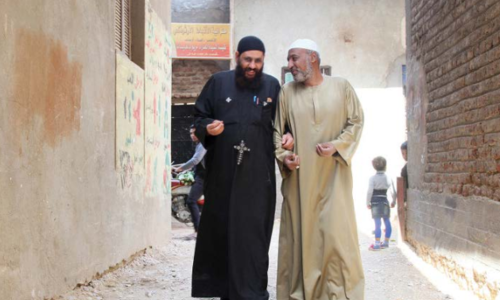
CRS website, August 30 2017. Image caption/credit: "Through the CRS peacebuilding program TA'ALA, religious leaders Father Rueis, left, and Sheikh Moustafa work together to engage the faithful in interreligious dialogue in the village of Al Odayssat in Upper Egypt. Photo by Nikki Gamer/CRS"
- Log in to post comments