











































Hope: 100 days after the Nepal earthquake
Author: Bhuwan Timilsina, August 3 2015 - I was alone on the ground floor of the new house I was constructing when I felt the earth shake beneath me. Instinct took hold and I was out into the open in a flash. Only then did I realise that we’d been hit by an earthquake.
As the streets filled with confusion and apprehension, I was one of the fortunate few whose phone call went through and was relieved to hear that my family was safe. Other people weren’t so lucky. Beside me, an elderly lady was frantically calling out her daughter’s name and crying while beating her chest with her fist. There were many more like her in the streets.
Questions without answers
I immediately left for home to see my eight-year-old daughter and my wife. My neighbours and family members had a lot of questions for me: “Is there a bigger one coming? Should we move inside the house tonight? How can we be safe? Will the school open tomorrow?” I wasn’t able to answer their questions as I too was searching for similar answers in my head.
Being a broadcaster with 15 years’ experience, along with the knowledge gained from BBC Media Action Lifeline training, I kept reminding myself; “Radio is the means to address these unanswered questions.”
I headed straight to the BBC Media Action office, as it’s the first meeting point under our crisis communication protocol. As no one had yet arrived, I quickly moved to Radio Sagarmatha, the alternative venue, where I finally spoke with Mona Laczo, our Country Director. She told me the team was planning to help affected communities by sharing life-saving messages through radio.
Life-saving information
The next day we gathered at Mona’s house, as we felt the office wasn’t safe to work in. We immediately got to work with the BBC World Service Nepali Service, creating a ‘Lifeline’ radio programme - designed to give people practical information to help them deal with the effects of the disaster. Topics dealt with questions about if and when another earthquake might strike, the protection of children, how to stay safe during an aftershock, building temporary shelters and issues of health and hygiene.
As the days unfolded, the gravity of the situation gradually began to surface - thousands of lives were lost, property wrecked and families separated. Relief in every shape and form was key to survival and the need for a Lifeline programme seemed greater every day.
On May 1, we recorded our first stand-alone Lifeline programme, Milijuli Nepali (Together Nepal). BBC World Service’s Nepali Service and hundreds of our local partner radio stations broadcast the show - collectively reaching the majority of the country.
Since then, our team has travelled to various earthquake affected areas to meet people and to bring back their stories and concerns. The second major earthquake, which hit us on May 12, added more fuel to the crisis. Along with other practical information, our programme incorporated comforting stories of survival and interviews with mental health experts to address the insecurity and fear in the minds of many.
Success stories
These days, it gives the team and me immense happiness when we hear stories of lives positively impacted by the programme. A local school head teacher in Dhading talked about how the show became his lifeline when a helpline number broadcast on Milijuli Nepali gave him vital information to help him demolish his damaged school. A local farmer told us how he purified dirty drinking water and organised toilet cleaning in his community at Kutal in Kavre district, after being inspired by listening to an episode on health and hygiene.
It’s been 100 days since the devastating earthquake of April 25. Currently, 250 community radio stations and 55 commercial radios are broadcasting Milijuli Nepali. Altogether, 79 episodes have been aired and more than 300 affected people, and 160 government officials and experts have been interviewed for the programme.
I can’t forget the day the earthquake hit us and how helpless I felt trying to answer all those questions from my family and friends. Now, 100 days on, Milijuli Nepali has become the platform on which to ask these very questions, share and learn and find practical answers and solutions.
Click here to access this BBC Media Action blog and related links on their work in Nepal.
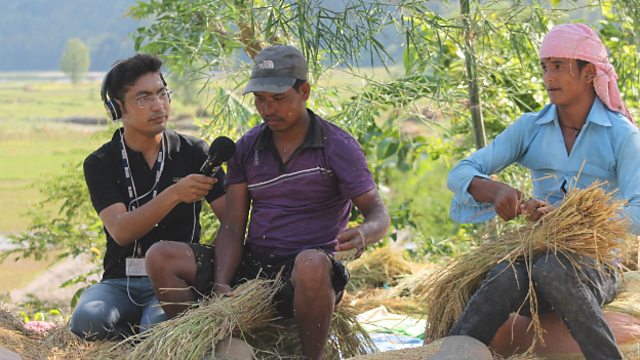
Image credit/caption: BBC Media Action, "Milijuli Nepali talking to farmers about rice harvesting and storage in Gorkha."
Contact:
BBC Media Action
BBC Media Centre, MC3A, 201 Wood Lane
London
W12 7TQ
United Kingdom (UK)
Phone: 44 (0) 20 8008 0001
Fax: 44 (0) 20 8008 5970
Media.action@bbc.co.uk
- Log in to post comments