










































Hi farmers, anyone with ideas on how to improve clay soil for farming?
Author Sandra Margaret Chao, December 12 2013: "Hi farmers, anyone with ideas on how to improve clay soil for farming?"
It is a post that has attracted about eight comments in the last ten hours since it was posted on the Facebook page Mkulima Young, where the advice ranges from soil techniques to better agronomic practises.
Mkulima is the Swahili word for farmer and the name Mkulima Young a clear description of the target audience for the generated content. On average, they get about 150 queries ranging from what agricultural opportunities a person can invest in, where to get the right inputs, the best agronomic practises as well as market information. This is just on Facebook - the agribusiness promoter gets more enquiries from other channels they run: Twitter, YouTube, via email, as well as on comments on their website.
Over the last three years, Kenya has seen an increase in the number of platforms which target youth with information on agriculture, and the growing conversations indicate that the once shunned-upon sector is becoming more appealing as a source of livelihood.
Like in many other countries in the developing world, the average age of the farmer in Kenya is 60 years, even though youth form a majority of the population.
According to a research paper on the drivers of youth unemployment in Kenya, released by the International Labour Organization in October, the country is listed as among those with the lowest youth employment rates globally.
While young men and women account for 37 per cent of the working-age population, only 20 per cent are employed.
"The youth in Kenya have not participated equally in the gains from growth. Indeed, not only is employment not growing fast enough, but the few jobs available to youth are of lower quality, since they entail a higher risk of falling into working-poverty," the report reads in part.
The UN World Population Prospects, which predicts that by 2050 there would be 17.5 million youth aged between 15 and 24 years in the country, underscores the need to create employment for the close to 1 million people that enter the job market annually.
From the time that Gerishom Boiyo has been involved in promoting the use of information and communication systems for agriculture in the Western parts of Kenya, he has noticed a positive trend.
"Young people who once looked at agriculture as dirty are becoming more interested in the opportunities ICTs [information and communication technologies] have to offer. Even though we advocate for the use of ICTs across the board, we are seeing the youth prefer online and social media content, unlike the older farmers who are keener on videos," he said.
Joseph Macharia, the founder of Mkulima Young, however, notes that it is not the total absence of young farmers that is the problem, rather the failure to highlight the few who are successfully living off agribusiness.
"At the end of the day it is about money we need to create celebrities similar to those we find in the music and entertainment scenes in order to attract the young people. Give them these success stories on social media because that is where you can easily find them and you will be able to create interest," he said.
Investing in platforms for the young people that have targeted content and are fully driven by their peers, not just for Kenya but the continent as a whole, he adds, would enable them to have hope and be more driven in the ventures they choose to set up.
"What they look for is something that brings money very quickly, can be adapted easily and in which they can work on as a group and there is need to provide information of these opportunities in agriculture."
It is not just the propagated "seeing is believing" culture in Kenya that has kept them at bay, unemployment has left a good majority of youth unable to secure loans from banks and microfinance institutions to use as the initial capital.
For this reason, Mkulima Young is seeking to transform the huge fan-base that it has acquired in the last three years into a savings and credit cooperative from which the youth can be able to access funding.
He proposes: "Rather than target those in rural areas, get those who are educated. If you enlighten them, they will be seeking to apply what they have learnt, the youth in rural areas will in turn want to be like those who have succeeded."
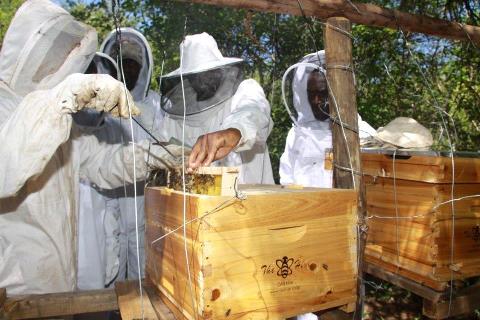
[Editor's note: Journalist Sandra Margaret Chao attended the International Conference on ICT4ag, which was co-hosted by the Technical Centre for Agricultural and Rural Cooperation (CTA) and the Rwandan Ministry of Agriculture and Animal Resources (MINAGRI), November 4-8 2013, Kigali, Rwanda.] Image credit and caption: Mkulima Young, Information found on Mkulima Young’s social media outlets and website include beekeeping, strawberry and mushroom growing along with rabbit rearing.
- Log in to post comments