










































Hen Mpoano (Our Coast)
During the first year of Hen Mpoano, research was conducted that engaged partners and community members, incorporated local stories and knowledge, and envisioned mechanisms to maintain and enhance coastal regions. Based on findings, in October 2011, programme partners launched the Biribireba radio drama and associated radio call-in shows on Goodnews FM and Ankobra FM, designed to improve knowledge, change attitudes, and influence behaviours of coastal communities to favou sustainable fishing and ecosystem management practices. Each episode of the drama is broadcast within a talk show designed to promote listener feedback and comments on the environmental themes.
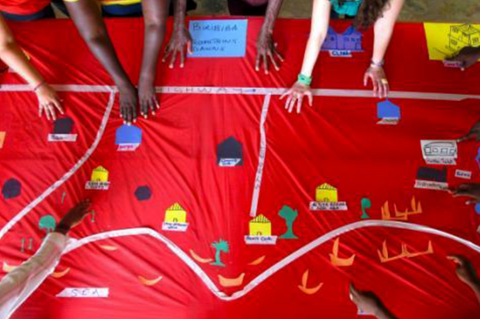
As part of the production process, Media Impact facilitated a five-day EE workshop for participants from the Hen Mpoano initiative’s partner organisations. Several community members, including a chief fisherman, fishmonger, and staff from two major local radio stations, joined representatives of CRC Ghana, Friends of the Nation, and other community-based organisations. The coalition of partners designed a regional 24-episode radio drama and one radio call-in-show and community action campaign per participating community. Participants also worked together to design the layout of the fictional fishing village depicted in the drama, identifying the location of characters’ houses, roads, schools, clinics, public toilets, and the key infrastructure. The village map assists writers to better imagine the story, and the producers and editors to ensure the soundscape matches the storylines.
The drama drama is set in the fishing community of Biribireba, where Kweku Anokye is a young mechanic who contributes to the pollution of his community. Anokye is in love with Gifty, but Gifty is dating Officer Bob. Tina, a teacher in the local school, takes action to address the community’s sanitation crisis because she recognizes the interconnectedness of her environment’s physical degradation and the community’s economic and public health. Former schoolmates, Anokye and Tina reconnect, but Tina is disturbed by Anokye lack of concern or responsibility for his role in Eku Lagoon’s polluted state. As Anokye’s friendship with Tina grows and he begins to express concern for his community and take responsibility for his actions, Gifty (Tina’s cousin) takes notice of Anokye’s transformation and cannot help but be tempted to stray from corrupt Officer Bob.
The radio drama ran weekly for six months. To reach the intended audience, the drama was produced in Fante and English and broadcast on Tuesdays. In accordance with local lore, fishermen do not go to sea on Tuesdays because they run the risk of encountering the water gods – which, according to the belief, can lead to an untimely death.
Click here to listen to the theme song and first three episodes.
Environment
The results of a 2009 AudienceScapes survey in Ghana indicate that radio is the most widely accessible and the most widely used source of news and information for Ghanaians. Ninety percent of respondents said they had listened to the radio in the last week (11% listened on mobile phones), and virtually all of those respondents (96%) said they turn to radio on at least a weekly basis as a trusted source for news and information. These results suggest that radio is a favourable conduit for delivering development information in Ghana. According to Media Impact, reaching communities with information about sustainable resource management is imperative, as the population is set to double in the next 20 years, which will result in increased pressure on fisheries and other resources in the Western region of Ghana.
United States Agency for International Development (USAID), the Coastal Resources Center (CRC) of the University of Rhode Island, SustainaMetrix, Friends of the Nation Ghana, the World Fish Center, and Media Impact.
Media Impact website on August 13 2011 and Our Coast report [PDF], and email from Lindsey Wahlstromon February 17 2012.
- Log in to post comments