










































FIFA Anti-Discrimination Days

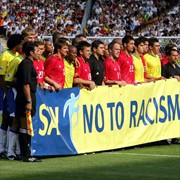
FIFA uses the platform afforded by its high-visibility sporting events to vividly demonstrate a firm stance against racism, not only in football but also in society in general. At the FIFA Confederations Cup, France 2003, the teams taking part united during the matches to send a message by lining up with their opponents and the referees before kick-off to display a banner to the crowd and television cameras bearing the slogan "Say no to racism". To cite another example, before kick-off at the semi-finals of the FIFA Confederations Cup Germany 2005 and the quarter-final matches of the FIFA World Youth Championship Netherlands 2005, both team captains read a declaration condemning and rejecting discrimination in football and society. Teams and match officials also posed jointly with a "Say No to Racism" banner.
In 2006, various activities were organised as part of the 2006 FIFA World Cup™ in Germany, with all 64 matches marked by a visible element sending a clear message against racism to the world. FIFA organised a media conference to launch the FIFA Anti-Discrimination Days and show support - through football personalities and world leaders - to the fight against racism. In addition to the anti-racist mini TV-spot that was provided to Infront Sports & Media for distribution among the FIFA World Cup broadcasters, a centre-circle round banner was used as a recurrent element for all matches and in all stadiums. It featured a combination of the FIFA World Cup emblem, the tournament's slogan "A time to make friends", and the "Say no to racism" message. In addition, a racism monitoring system was in place at all 12 stadiums. As part of this system, the Local Organising Committee and security officers knowledgeable in the languages of all 32 teams were trained to identify possible messages of racist, political, or in general discriminatory nature. Furthermore, anti-racism video spots were aired at all FIFA World Cup stadiums on giant screens. Five-second mini-spots were made available for free to all TV broadcasters of the 2006 FIFA World Cup for their integration in the programmes related to the event.
Also that year, FIFA collaborated with the FARE (Football Against Racism in Europe) network to create "Fussball verbindet - Football unites", a project to contribute to a positive and inclusive atmosphere during the Fans' Embassies at the 2006 FIFA World Cup. Recognising that football can be used to bring together fans of different origins, FIFA and FARE set as a specific goal the social integration of migrants and ethnic minorities at the World Cup. Organisers also sought to disseminate knowledge on far-right symbolism and other manifestations around the stadiums, providing tips on how to deal with any extreme-right football fans, neo-Nazis, and their sympathisers. FARE prepared a "fundamentals paper" that not only explained the codes, symbols, and chants commonly used by neo-Nazi and far-right groups, but also offered specific behavioural tips for stewards and volunteers. FARE also organised football matches on portable mini-pitches ("Streetkick") for German and foreign youth and football fans. The Streetkick activities were also accompanied by an intercultural programme of information that centred around FARE's anti-racism fanzine (per Wikipedia: "a nonprofessional and nonofficial publication produced by fans of a particular cultural phenomenon (such as a literary or musical genre) for the pleasure of others who share their interest."). Printed in English and German (with a print run of approximately 35,000), this publication contained statements by players as well as information on racism in football. Three exhibitions accompanied the Streetkick events. Each contained information on racism in football, fans' activities in Germany, the Anti-Racism Action Week, and so on. Local groups - e.g., fans and migrants - in the 12 host cities were also invited to design their own panel for their local event.
Another related component of FIFA's efforts against discrimination are the Ambassadors against Racism, a multi-racial "team" of current and former distinguished football players and coaches who actively promote the fight against racism and represent football's firm stance during interviews, events, summits, etc.
Rights.
FIFA claims that the problem of racism "has sharpened just at a time when players have become more mobile than ever, not only between countries but between continents, and at a time when ethnic families have been otherwise integrated in their adopted homeland for several generations...'The solution to this problem, as to any other, lies firstly in identifying it and acknowledging its existence,' says FIFA President Joseph S. Blatter."
As part of its efforts to rid football of racism, FIFA has revised article 58 of the Disciplinary Code, which explicitly states that any form of disparaging, discriminatory, or denigrating statement or action must be punished with a suspension, fine, or other sanction. Click here to read the specifics. Also, further details about the Extraordinary Congress, which followed the declaration against racism adopted by the FIFA Executive Committee in March 2000 and following the FIFA Conference Against Racism in Football held in Buenos Aires on July 6 2001, are available here.
FIFA website, August 18 2009.
- Log in to post comments