










































East Los High: Transmedia Edutainment to Promote the Sexual and Reproductive Health of Young Latina/o Americans
University at Buffalo, The State University of New York (Wang); The University of Texas at El Paso and Hedmark University College (Singhal)
...showing the potential of transmedia edutainment as a sustainable platform for large-scale, longer-term audience engagement..."
This report presents a programme evaluation of East Los High, a transmedia entertainment–education (edutainment) programme for young Latina/o Americans that embeds educational messages in entertainment narratives across digital platforms to promote sexual and reproductive health. (See Related Summaries, below, for a description of the initiative.) The authors set up the context of this project after a review of transmedia edutainment, including its theoretical foundations in narrative engagement and persuasion. They then offer their analysis of the strategic design elements of East Los High's season 1 programming, reporting the research methods used for evaluation, along with a discussion of the key findings and implications for designing sexual and reproductive health interventions for Latina/o youths.
In this project, instead of telling the story in a single medium, narrative elements are creatively coordinated across different media platforms (hence "transmedia") in a quest to build a story world, engage a broader spectrum of audience, and provide them an enriching experience beyond pure entertainment. As noted here, meta-analyses have demonstrated the advantages of using narratives in health interventions, because they can have "a sizably significant impact on combined changes in attitudes, intention, and behavior, even though they have a relatively small effect size in individual outcomes. Narratives are powerful interventional tools for eliciting affective audience response, and evidence suggests that those delivered through audio and video are more effective than are those delivered through print..."
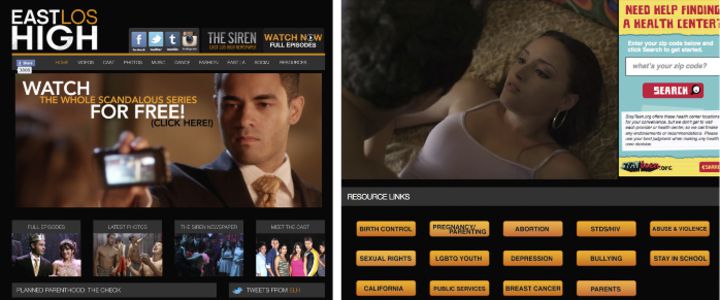
To further elaborate on this approach: East Los High season 1 was a 24-episode original drama series on Hulu, a Web-streaming site. At the end of each episode, viewers were encouraged to visit the East Los High website, where they could access 9 transmedia narrative extensions. Viewers could watch, for instance, an extended scene in which a health clinic counselor talks compassionately with one of the characters, Maya, about correct condom use. They could also access the character Ceci's vlogs. After being abandoned by her boyfriend, the pregnant Ceci is taken in by a women's shelter, where she learns about services available for pregnant adolescents. Viewers could access 6 of Ceci’s vlogs, which were linked to different episodes as the major storyline unfolded in the online drama. In the vlogs, the audience sees Ceci talking about how she feels about being a pregnant adolescent, the physiological changes in her body, and the socioeconomic and cultural challenges she faces. From there, viewers could visit the East Los High resources page, use widgets to find local health clinics, and click on external links for additional information. These transmedia extensions of East Los High were promoted on popular social networking sites (i.e., Facebook, Twitter, Tumblr, and Instagram).
According to the authors, in addition to this transmedia edutainment programing and the initiative's cultural sensitivity (e.g., it uses exclusively Latina/o creators, writers, and cast members), East Los High is distinguished from other popular series in the United States (US) that discuss sexual and reproductive health issues among youths by its foundation in collaborative multilateral partnerships. As part of that process, focus groups with Latina/o adolescents, conducted through non-governmental organisation (NGO) partners, sought to ensure realistic character portrayals and authentic dialogues.
The authors adopted a mixed methods approach to evaluate East Los High, season 1: analytics tracking to assess audience reach, which monitored Web traffic to the East Los High website and to NGO partners' websites and widgets; (ii) a viewer survey of 202 East Los High fans, who were predominantly young Latinas with low socioeconomic status (hence at risk for adolescent pregnancy) to assess narrative engagement and intended outcomes; and (iii) a laboratory experiment with 136 nonviewers to compare the effect of transmedia edutainment with other forms of narrative presentation. Complementary methods included: (i) social network analysis and content analysis to understand the social dynamics, message framing, and user-generated content on East Los High's social media presence; and (ii) participant observation and in-depth interviews with young Latino couples to reveal East Los High's influence on their sexual decision-making.
Here is a brief summary of the findings:
- Analyses of the geographical information system data indicated that East Los High reached an audience across all 50 states and the District of Columbia. Most visitors were located in states with a high Latina/o population and the highest rates of adolescent pregnancy. In addition, 10,398 visitors hailed from another 163 countries, including 20 countries in Latin America.
- Participants in the viewer survey gave East Los High 5-star ratings on its story appeal, its production quality, their enjoyment of the drama series and its transmedia extensions, and their desire for more shows like East Los High (see Table 2). Participants exhibited strong identification with the main characters. The most liked characters were those who demonstrated positive attitudes and behaviours; the least liked characters embodied violence, abuse, and irresponsibility.
- Most participants were active on social media by way of liking, commenting, sharing, retweeting, and hashtagging East Los High posts. They reported discussing East Los High on social media with their friends (84%), siblings (66%), parents (31%), and relatives (26%). Furthermore, 80% engaged in face-to-face discussions; 69% did so via text messaging; and 46% did so by mobile phone.
- Half of the participants reported learning at least 1 of 10 facts about correct condom use that they did not know, and 36% reported learning at least 1 of 7 facts about birth control pills and emergency contraception.
- 48% of the participants visited the East Los High resources page; of those, 100% found the information to be helpful, and 81% shared the resources page with others.
- Regarding attitudes and behavioural intentions about sexual responsibility, 95% agreed that "it doesn't matter if you are a girl or a guy, you should take your own responsibility for birth control", 98% said they were likely to use condoms correctly from now on, and 91% said they were likely to use condoms during sex every time. Regarding unprotected sex, 86% said they were likely to adopt emergency contraception, and 93% said they were likely to recommend emergency contraception to someone they know.
- After watching East Los High, willingness to be tested for sexually transmitted infections, HIV, and pregnancy was higher (96%, 96%, and 95%, respectively) as was the resolve to recommend testing to others (99%, 99%, and 100%, respectively).
- After being exposed to East Los High, 30% of the participants in the experimental conditions (prior nonviewers) searched online for more, 30% talked to people about the show, 6% watched full episodes, and 1% of active Facebook users and 7% of active Twitter users started following East Los High.
The authors reflect on major findings and implications, noting that, in addition to the millions of viewers who watched East Los High on Hulu, hundreds of thousands visited the show's website, with tens of thousands of visits occurring after season 1 ended. Moreover, the website served as a portal to additional health and social services via embedded widgets and referral to NGO partners' websites. "These tight connections between the intervention exposures and an infrastructure for follow-up actions (e.g., personalized health information seeking) can greatly boost the efficacy for behavior change." Overall, the authors say, the results suggest that East Los High "resonated well with its target audience; they perceived the program to be compelling, educational, and transformative. Their enthusiasm suggests that narrative-based transmedia edutainment interventions like East Los High can cultivate a fan base for deeper learning, lasting engagement, and broader social change."
Regarding the effectiveness of transmedia (as explored in the laboratory experiment with nonviewers): "There were encouraging positive trends over time and tendencies showing the advantages of transmedia, but most were not statistically significant and warrant future investigation. However, one revealing result regarded knowledge of correct condom use: transmedia yielded significantly better outcomes than did other conditions over time. This may have resulted from the extended scene of Maya's conversation with a health counselor about condom use....This suggests that...using transmedia to highlight critical and accurate information as incorporated in the dialogue with a main character can give the intervention a turbocharged boost."
In conclusion: "Pioneering transmedia edutainment interventions such as East Los High are tremendously promising for health promoters and educators, and more rigorous research design and empirical testing with future interventions are needed to validate this further."
American Journal of Public Health. 2016 June; 106(6): 1002–1010. doi: 10.2105/AJPH.2016.303072
- Log in to post comments