










































Defining Social and Behavior Change Communication (SBCC) and Other Essential Health Communication Terms
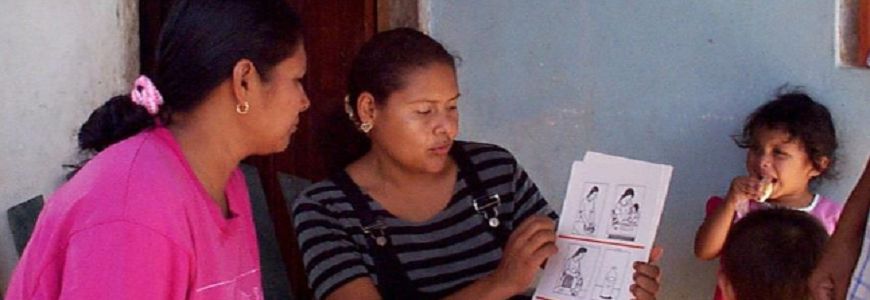
From The Manoff Group, this technical brief aims to clearly define social and behaviour change communication (SBCC) and to clarify key health communication terms. It is meant to help practitioners more precisely select and define their approaches, programmes, and activities.
In brief:
- "Health communication is a broad term that describes a number of strategies to share information that can lead to better health outcomes. Health communication activities can vary widely, depending on the objectives, audience, and communication channels."
- "Health education can be defined as any combination of learning experiences designed to help individuals and communities improve their health by increasing their knowledge or influencing their attitudes."
- "Information, Education and Communication (IEC)...can range from didactic one-way communication to entertaining methods. It can utilize a wide range of media channels and materials. Fundamentally, the IEC approach assumes that people will follow health advice when they are provided with the 'right' information."
- "Social Marketing was created to apply commercial marketing approaches to promoting products, services or behaviors that would improve health. Social marketing...recognizes that communication (i.e., promotion) is only one element of the marketing mix..."
- "Behavior Change Communication (BCC)...intends to foster necessary actions in the home, community, health facility or society that improve health outcomes by promoting healthy lifestyles or preventing and limiting the impact of health problems using an appropriate mix of interpersonal, group and mass-media channels. Maintaining social marketing focus, effective communication strategies rely on formative research with beneficiaries to understand the context, the issue from their perspective, and factors that influence improved practices."
- "Social and Behavior Change Communication (SBCC)...is a research-based, consultative process that uses communication to promote and facilitate behavior change and support the requisite social change for the purpose of improving health outcomes....SBCC is guided by a comprehensive ecological theory that incorporates both individual level change and change at broader environmental and structural levels. Thus, it works at one or more levels: the behavior or action of an individual, collective actions taken by groups, social and cultural structures, and the enabling environment."
As noted here, the addition of an "S" to BCC intends to signify that individuals and their immediate social relationships are dependent on the larger structural and environmental systems: gender, power, culture, community, organisation, political and economic environments. Unlike other terms, SBCC explicitly encompasses social change perspectives that foster processes of community dialogue and action. SBCC encompasses 3 core elements:
- Communication using channels and themes that fit an intended audience's needs and preferences.
- Behaviour change through efforts to make specific health actions easier, feasible, and closer to an ideal that will protect or improve health outcomes.
- Social change to achieve shifts in the definition of an issue, people’s participation and engagement, policies, and gender norms and relations.
SBCC can achieve change as a separate intervention, but usually it is part of a comprehensive change strategy that includes multiple interventions, including communication.
Editor's note, March 21 2019: Unfortunately, this document is no longer available online.
Publishers
4
The Manoff Group website, June 8 2017. Image credit: The Manoff Group
Comments

Another recommendation
I can also recommend Norms in the Wild book by Cristina Bicchieri where she explains how to diagnose, measure, and change Social norms and gives lots of practical examples as well as theory. The book is a core one in a very interesting and useful free online course on C4D from the University of Pennsylvania and UNICEF, see more here.
- Log in to post comments