










































COVID-19 Technical Briefs for Breakthrough ACTION Field Teams
This series of technical guides was developed by Breakthrough ACTION, together with various partners, to assist field teams in their COVID-19 responses. The guides cover a range of social and behaviour change (SBC)-related topics such as reducing stigma, tracking rumours, using mobile technology for surveys, and communicating through social media. They offer steps, considerations, resources, and messages to guide field teams in their SBC activities.
The technical briefs include the following:
COVID-19 Rumor Tracking (March 2020) [PDF, 6 pages] - provides steps and resources on how country programmes can track and address rumours around COVID-19. The guide includes a number of resources and links while also sharing knowledge about global, collective thinking around rumours.
Disrupting COVID-19 Stigma (March 2020) [PDF, 6 pages] - includes considerations and resources to support country programmes in recognising and working to reduce stigma around COVID-19. In the context of health, stigma is the negative association between a person or group of people who share certain characteristics and a specific disease. In an outbreak, this may mean people are labelled, stereotyped, discriminated against, treated separately, and/or subject to a loss of status because of a perceived link with a disease.
Creating a Real-Time Rumor Management System for COVID-19 (April 2020) [PDF, 8 pages] - offers considerations and resources to support country programmes in creating a functional rumour management system, enabling two-way communication with affected communities. In this technical brief, rumour management refers to a system to identify, track, and address rumours and to monitor how well the system is working to counter rumours. Breakthrough ACTION stresses that implementing this system while maintaining physical distancing is particularly important during the COVID-19 pandemic. The brief also offers guidance on obtaining feedback from communities on their beliefs (including rumours, misinformation, and disinformation), disseminating accurate information, and monitoring these approaches.
Guidance on Social and Behavior Change for Family Planning During COVID-19 (April 2020 - available in English (6 pages), French (7 pages), and Spanish - 7 pages) - features considerations, messages, and resources to support country programmes in adapting their family planning and reproductive health-focused SBC programming in response to the challenges presented by COVID-19. The point is made that programme adaptations and messaging should be adapted in line with the country context, available services, and local government response, including that of coordinating bodies responsible for COVID-19 risk communication and community engagement (RCCE) efforts.
Using SMS and IVR Surveys During COVID-19 (April 2020) [PDF, 8 pages] - is intended to serve as guidance for systematically administering short message service (SMS) and interactive voice response (IVR)-based surveys to collect data from a stratified sample of participants. It includes a number of reference documents and resource people to contact for additional information. This document is not intended to guide push or blast messaging, or opt-in texting to a shortcode.
Socially Marginalized Groups and COVID-19 (May 2020) [PDF, 9 pages] - focuses on addressing the unequal impact of COVID-19 in the immediate response to the pandemic, noting that these considerations will also be necessary as societies shift to maintenance and recovery phases. As communities reach different stages of the pandemic at different times, the COVID-19 RCCE response must consider the unique experiences and needs of individuals living in poverty or with restricted access to resources to avoid exacerbating existing disparities.
Integrating Gender Into the COVID-19 RCCE Response (May 2020) [PDF, 9 pages] - outlines practical recommendations to integrate gender across the six pillars of the risk communication and community engagement (RCCE) response. Integrating gender into the COVID-19 RCCE response demands consideration of how gender norms and roles, as well as inequitable power dynamics and decision-making, influence people's experiences and needs at all stages.
Using Social Media to Disseminate COVID-19 Information (May 2020) [PDF, 10 pages] - details the steps and considerations programmes can take to develop an overarching social media strategy to disseminate COVID-19 messages and combat misinformation. It also provides a list of relevant tools and resources for implementation.
Virtual Pretesting during COVID-19 (July 2020) [PDF, 9 pages] - presents workarounds - tips and tricks - to use digital platforms to conduct pretests virtually. Two instances for virtual pretesting are presented: the development of SBC materials, and the development of job aids. Both use similar processes, but the specific differences are highlighted in this document.
Social and Behavior Change for Maternal, Newborn, and Child Health during COVID-19 (July 2020) [PDF, 8 pages] - includes considerations, messages, and resources to support country programmes in adapting SBC programming for maternal, newborn, and child health in response to the challenges presented by COVID-19.
Guidance on Social and Behavior Change for Nutrition During COVID-19 (July 2020) [PDF, 9 pages] - provides considerations, messaging, and resources to support country programmes in adapting nutrition SBC programming in response to the challenges presented by COVID-19.
Managing Nutrition Myths and Misconceptions During COVID-19 (July 2020) [PDF, 6 pages]
- covers SBC strategies for responding to COVID-19 related misinformation that affects nutrition. Misinformation can undermine confidence in the underlying science behind disease prevention and limit participation in recommended practices, including making use of available nutrition services and activities.
Breakthrough ACTION is a 5-year cooperative agreement funded by the United States Agency for International Development (USAID) to lead their SBC programming around the world. It is a partnership led by the Johns Hopkins Center for Communication Programs (CCP) in collaboration with Save the Children, ThinkAction, ideas42, Camber Collective, International Center for Research on Women, and Viamo. The project works in partnership with governments, civil society, and communities in an effort to implement creative and sustainable SBC programming, nurture SBC champions, mainstream new techniques and technologies, and advocate for strategic and sustained investment in SBC.
Publishers
English (some briefs also available in French and Spanish)
Varied (see above).
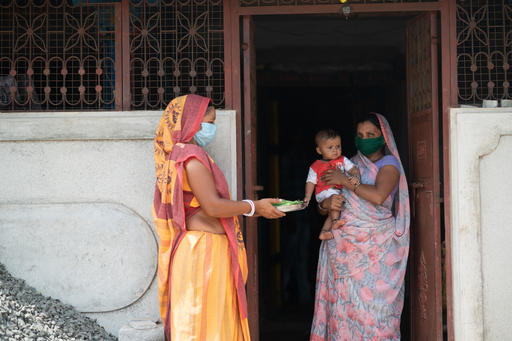
Breakthrough ACTION & RESEARCH website and COVID-19 Communication Network on October 2 2020. Image credit: © UNICEF/UNI342633/Panjwani
- Log in to post comments