










































The Big Read
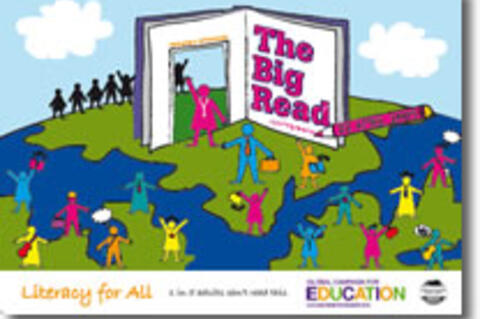
GCE uses interactive information and communication technology (ICT) like the campaign website and social networking tools like Twitter and Facebook to galvanise support for its demand that richer governments and international institutions guarantee predictable and long-term development aid that enables economically poorer countries to deliver the full Education for All (EFA) agenda, including adult literacy. (A new Global Funding for Education offers a larger, global pooled funding "pot" that drives ambitious appropriate financing of national education plans.)
Specifically, on The Big Read website campaigners were provided with advocacy materials (still available) such as The Big Read, a book of short stories and poems about education written by leading figures, Nobel Peace Prize winners, and award-winning authors. Distributed in more than 100 countries free of charge to children, parents, and adult learners, the book carries the message that readers should log on to add their name to a declaration demanding that all governments make constitutional provision for every child to have a free, good-quality, public education. "After reading a story in the Big Read we are asking you to write your name for the millions that cannot. We are collecting the names to deliver to governments during the week of the 20th to 26th of April 2009 to demand that they take action to make sure that everyone has an education."
By holding a Big Read event - with guidance from the Big Read website - people were invited to join with millions of people reading the same stories and demanding education for all. After downloading the poster, stickers, and resources here, people were asked to invite as many people (including politicians and local media) to gather to read the stories in The Big Read. "[Y]ou could include a mixture of reading stories, hearing the interviews with authors if you can download them, ask the students to read them out to each other, even ask the children to write new stories - any sent to us will be included in the Big story book we will present to world leaders later in the year." By providing a register for everyone present, organisers could gather a list of names in support for EFA and then send it to the President or Prime Minister.
The Big Read took place across the world, in a diverse range of places such as homes, schools, government buildings, etc. For example, in Cambodia 200 students were given training on the Big Read and were asked to disseminate it in their schools and local communities; a Big Read event was held in the national Olympic Stadium. In the United States there was a competition to be included in the Big Read book. The campaign aimed to get 50,000 signatories to deliver to President Obama just before the G8 Summit, asking him to contribute US$2 billion to the Global Fund for Education. Workshops trained Jordan's adolescents in advocacy and prepared them to play an active role in raising awareness of the negative impacts of illiteracy and dropping out of school. In Denmark, 187,000 students read the "Reading Rocket" as part of Action Week, and 500 students and teachers read speeches on education to the Danish Parliament. For additional examples, click here.
Education, Equity.
The Big Read is premised on the argument that education is crucial for economic, social, and physical well-being and a key tool for tackling poverty. According to GCE:
- A person's earnings increase by 10% for each year of schooling they receive, translating to a 1% annual increase in Gross Domestic Product (GDP) if good-quality education is offered to the entire population.
- 7 million cases of HIV/AIDS could be prevented in the next decade if every child received an education.
- A child born to a literate mother is 50% more likely to survive past the age of 5 years.
- Gains in women's education made the most significant difference in reducing malnutrition between 1970-1995, a more important role than increased food availability.
EFA has been promised by 2015, yet (according to GCE) there are 774 million illiterate adults, two-thirds of whom are women, and 75 million children of primary school-going age and 226 million adolescents of secondary school age are out of school. Furthermore,
- Two-thirds of all children arrive at primary school under-nourished or with a disability that will likely impair their education achievement throughout their lives.
- In Sub-Saharan Africa, 22 countries offering secondary education to less than one-quarter of the school-aged population.
- 113 countries missed the United Nations (UN) Millennium Development Goal (MDG) of gender parity in school set for 2005. In 54 countries, less than 50% of girls enrol in secondary education.
- More than three-quarters of the world's illiterate people live in only 15 countries, including 8 of the 9 high population countries: Bangladesh, Brazil, China, Egypt, India, Indonesia, Nigeria, and Pakistan.
The situation has been exacerbated by the international financial crisis. For example, the United Nations Educational, Scientific and Cultural Organization (UNESCO) predicts a drop in 20% per capita of Africa's economically poor that will force the poorest countries to reduce their spending on education. The European Union's aid commitment alone looks set to be US$4.6 billion lower than in previous years.
Founded in 1999, the GCE brings together major non-governmental organisations (NGOs) and teachers' unions in more than 120 countries to promote access to education as a basic human right. GCE received a Guinness World Record: 8,856,108 people took part in the 2008 GCE Action Week (World's Biggest Lesson) April 23 2008.
"South Africa: PPEN Launches the Big Read Campaign", Pambazuka News, Issue 437, June 12 2009; and The Big Read website, August 14 2009.

- Log in to post comments