










































Beyond the Verbal: Pregnant Women's Preferences for Receiving Influenza and Tdap Vaccine Information from Their Obstetric Care Providers
Emory University
The Centers for Disease Control and Prevention (CDC) and the American Congress of Obstetricians and Gynecologists (ACOG) recommend that pregnant women receive the influenza and the tetanus, reduced diphtheria toxoid, and acellular pertussis (Tdap) vaccines during pregnancy. Despite this, maternal immunisation rates in the United States (US) remain low. It is well documented that prenatal care providers play an essential role in vaccine promotion. However, there may be inadequate time to discuss vaccinations with every patient. This study aimed to assess pregnant women's preferences for receiving information on routine maternal vaccinations, aside from verbal exchanges with their providers.
The researchers distributed 100 hard-copy surveys (available in both English and Spanish) to each of 4 obstetric care practices in Atlanta, Georgia, US that volunteered to participate in this study. Only about half of the 408 women surveyed recalled discussing maternal vaccination with their providers (53.8%), compared to 82.0% of women who recalled discussing safe medications. Nearly two-thirds of respondents indicated on the survey that they were interested or very interested in information about maternal vaccination (64.4%).
Aside from verbal communications with their prenatal providers, the top resources that women reported currently using to obtain information about maternal vaccines were the CDC website (57.7%), other pregnancy-related websites (53.0%), and their obstetric provider's own practice website (35.4%). Currently used sources did not vary meaningfully by age; however, women with at least a Bachelor's degree were nearly 3.5 times more likely to use the CDC website to obtain vaccine information. White women were over 4 times as likely to use the CDC website than were African-American women, the latter of whom who tended to prefer other pregnancy websites (56.6%) to the CDC website (39.3%).
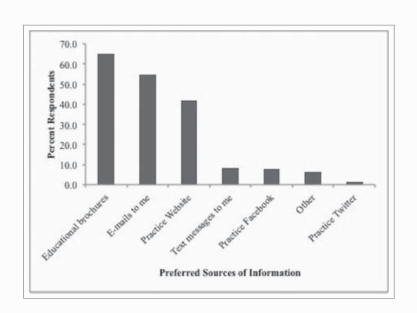
When asked how they would like to receive information about maternal vaccination from their prenatal care providers, women were most interested in educational brochures (64.9%), emails (54.7%), and a vaccine-related section on their provider's own website (42.1%). There was little desire in being able to obtain vaccine information via a practice-sponsored Facebook page (7.7%) or Twitter feed (1.2%).
In discussing the findings, the researchers note that, as evidenced by the substantial proportion of women in the study who reported not discussing maternal vaccines with their providers, "providers may not be relaying enough information about maternal vaccination to their patients. Alternatively, they may not be promoting the vaccines early enough in pregnancy or in ways the women are internalizing. With vaccination now a routine part of obstetric care, it is imperative that providers look to expand and refine the way they communicate with patients about vaccines and perhaps tailor their vaccine communication strategies according to the preferences of their own patient populations."
Also, the findings reveal that communication preferences may in fact differ by key patient characteristics or demographics, so "providers may want to be cognizant of these differences before investing time and energy into certain secondary communication avenues. While it is certainly not feasible to perfectly tailor educational content to every patient's unique communication preferences, it may be worthwhile to get at least a general understanding of the preferences of the majority of the patients a practice serves."
The researchers note that both brochures and emails require either a clinical encounter or providers' time investment. For instance, maintaining an up-to-date database of patient emails can be burdensome on providers and their staff. Also, while organisations like CDC and ACOG have produced brochure-type resources for obstetric care providers to use, they still require a physical encounter for distribution and do not necessarily align with women's current electronic information-seeking habits.
As detailed above, after the CDC website and other pregnancy-related websites, the third most popular source for obtaining vaccine-related information was women's prenatal care provider's own website. Per the researchers: "It is this platform that may offer the most practical and useful solution to bolstering providers' educational reach to their patients. This is because provider websites marry two important patient preferences into one modality: a desire to access evidence-based information online and having that information be endorsed by their own provider....[these] websites potentially offer the most promise in so far as they provide an appealing balance between aligning with pre-existing health seeking-behaviors, patient preferences, and provider burden."
Human Vaccines & Immunotherapeutics 2018, Vol. 14, No. 3, 767-71. https://doi.org/10.1080/21645515.2018.1425114
- Log in to post comments